A waterfront that asks you to slow down
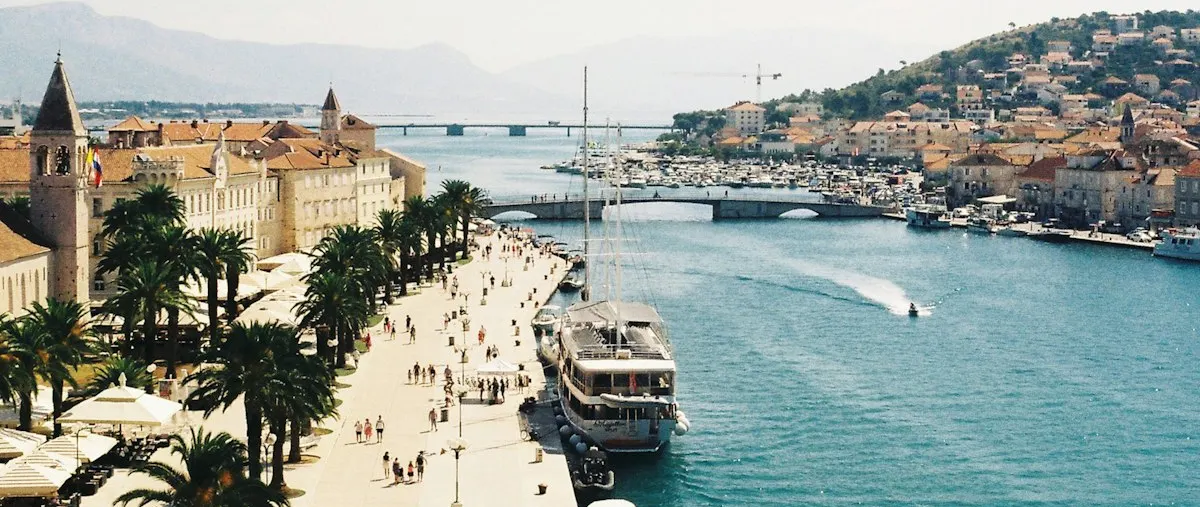
Trogir has an unusual advantage for travellers arriving aboard a privately operated luxury yacht: the old town is not merely near the harbour, it is the reason to make the stop. The historic core occupies a small island between the Croatian mainland and Čiovo. From the water, its stone edges and close-set roofs introduce a town that is navigable on foot, where a morning can pass between a market, the cathedral square and the quay without needing a car. For the owner or charter guest aboard a 12-to-23.99-metre yacht, that intimacy can make a short visit feel more substantial than a larger resort call. The most successful stay nevertheless begins with a practical distinction. Trogir has several different berthing operations, and their published lengths, approaches and services are not interchangeable. A reservation should specify the exact facility, not just the name of the town.
The two relevant marina settings
One option is ACI Marina Trogir on the Čiovo side of the canal opposite the old centre. ACI describes it as an all-year marina and states that the maximum length is 30 metres for a daily berth but 20 metres for an annual berth. That is a meaningful distinction for this readership: a 22-metre yacht may fit the operator's published short-stay category without necessarily meeting the stated annual-stay limit. ACI lists 161 sea berths and 26 dry berths. Another option is Marina Baotić at Seget Donji, a separate waterfront setting outside the historic core. Its official sea-berth page describes 280 berths, water and electrical connections, depths ranging from 2.5 to eight metres, and a concrete breakwater. The broader facility accommodates yachts much longer than the LYG segment, but a mid-size yacht can use it for the same practical combination of shore support, provisions and a relaxed coastal base. These are not promises of present vacancy; availability, draft suitability and rates require a direct quote.
Why the approach matters as much as the address
The channel around Trogir is not an open, obstacle-free stretch of deep water. ACI's official approach notes warn that the channel north of the historic centre is only about two metres deep and is not advisable for navigation. They also identify fixed bridge clearances that matter to a yacht carrying a mast, radar arch or high superstructure. In the published approach guidance, the bridge between Trogir and Čiovo is associated with a low clearance, while the deeper eastern passage has its own marks and limitations. This is exactly the sort of detail that can be overlooked if the crew relies on an appealing marina photograph rather than current charts. The marina itself directs visitors to official Croatian Hydrographic Institute chart editions. Skippers should use current notices, charted depths and harbour directions, and confirm their route and arrival instructions with the berth operator. A travel article cannot replace a passage plan, especially when a vessel is at the upper end of the luxury-yacht length bracket.
Staying beside the old centre
ACI's position offers a particularly immediate relationship with historic Trogir. The marina is across the water from the old centre, so the day can revolve around repeated short trips ashore rather than a single grand excursion. The operator lists practical services including showers, laundry, grocery provision, a restaurant, fuel, Wi-Fi and maintenance support. For some owners those services will be the deciding advantage; for others the attraction is simply being able to see the outline of the town from the boat and choose when to go exploring. The published facilities are not an undertaking that every service will be available at any hour or on every date, so arrangements for fuel, repairs or late arrivals deserve confirmation. A visiting crew should also distinguish a marina berth from an informal stop on the town waterfront. Permission, mooring method and local rules differ, and the most attractive quay seen in a photograph may not be a berth that can be booked by a private yacht.
Seget Donji as a quieter-feeling base
Marina Baotić provides another way of using Trogir as a destination. Its location at Seget Donji puts the yacht in a purpose-built marina environment rather than directly opposite the medieval island. The operator describes shore-side hospitality, fuel provision, berthing services and technical support, while its dedicated sea-berth page lists water and electricity connections and multilingual assistance. Owners arranging a longer pause, a handover or a service visit may value that combination. Seget's waterfront is a destination in its own right, so the crew can divide time between marina life and an excursion into Trogir's stone streets. The transfer should be planned according to actual local transport and berth location, rather than assuming that every Trogir-labelled berth is within a few footsteps of the main square. For a 12–24m yacht, the choice between the two facilities is therefore about the experience ashore as well as the geometry of the mooring.
The reason Trogir is protected
The city's cultural status is not simply a promotional tag. UNESCO lists the Historic City of Trogir as a World Heritage property, recognised for the continuity of its urban fabric and architectural layers. Its buildings trace Greek, Roman and later Adriatic influences, while the medieval street pattern remains unusually legible. The Cathedral of St Lawrence is a centrepiece of the historic ensemble, with construction beginning around 1200, according to UNESCO. These facts help explain why even a brief walk is rewarding: the old town is compact enough to read as one place, yet complex enough to keep revealing another courtyard, carved portal or change in stonework. The official Split-Dalmatia tourism authority also highlights Kamerlengo Fortress, whose substantial walls sit toward the western waterfront. Visitors do not need to turn the call into a race through monuments. The quality of the experience often comes from moving slowly and letting the living town sit alongside its heritage.
A first day with no rigid itinerary
An appealing first afternoon is deliberately simple. After the vessel is safely secured and the arrival formalities are complete, leave the technical decisions aboard and cross into the centre for a walk without a precise timetable. The main square makes a natural orientation point, with the cathedral and surrounding façades giving a sense of the town's layered history. From there, follow the narrower streets until they return to the waterfront. A late lunch or coffee can become part of the exploration rather than a destination in itself. The official tourist board's walking material connects the cathedral, the southern gate, the waterfront and Kamerlengo, providing a more dependable framework than an improvised list of internet favourites. On a private yacht stay, the privilege is flexibility: it is possible to return to the boat for a rest, then go ashore again when the light softens and the day-tripping crowds have thinned.
A second day with room for Čiovo and Seget
With a second day available, it becomes easier to appreciate why Trogir works as a base rather than merely a port of entry. The island of Čiovo has its own coastline and beaches, and Seget Donji has a distinct waterfront character. ACI's location notes point to Okrug Gornji on Čiovo as a popular beach area, but the sensible way to visit will depend on weather, season and local access. Guests who prefer culture may instead use the day for a longer look at a museum, church or the city's smaller architectural details. If the yacht's next destination lies farther along the Dalmatian coast, the crew can choose between another night alongside and a morning departure in suitable conditions. The best luxury here is not an elaborate programme; it is the ability to make that choice without sacrificing the pleasure of the place.
What 12–24m owners should ask before booking
The correct questions are specific. First, give the marina the yacht's length overall, beam, draft and any unusual boarding arrangement; a nominal size category is not an accurate berth request. Second, state whether the stay is overnight, several days or seasonal, because an operator's maximum published length may depend on berth type. Third, ask about the expected approach and arrival procedure, including the official VHF working channel and whether staff will assist with lines. Fourth, clarify power requirements, potable water, waste handling and any fuel needs. Finally, verify the actual tariff and cancellation conditions for the dates concerned. ACI publishes its own berth enquiry and booking links; Marina Baotić offers a berth request process. Neither publication of a maximum length nor the existence of a booking form guarantees an available berth for a particular hull. During busy summer periods, an early conversation is part of the holiday's practical comfort.
Care for the place that draws visitors
A UNESCO-listed harbour town and its coastal waters are not merely a backdrop for leisure. Yachts and shore visitors can reduce their impact through ordinary, disciplined decisions: use designated berths and waste facilities, avoid discharging waste into coastal waters, obey speed restrictions and keep noise considerate when close to residential quays. The wider Dalmatian coast contains sensitive shorelines and busy local traffic. A crew that uses marina waste services and follows local instructions is contributing to the quality of future visits. The most meaningful luxury is often privacy without intrusion: a peaceful dinner aboard, a walk before the busiest hours, and a departure that leaves the waterfront as it was found.
The difference between an overnight stop and a good stay
A hurried itinerary can reduce Trogir to a single photograph and a restaurant booking. A two-night approach creates room for a different rhythm. The first arrival is for settling the vessel, taking stock of the waterfront and allowing the crew to rest. The next morning is for the cathedral, the urban fabric and a quieter stretch of the promenade. An afternoon can be devoted to the coast or the marina's own facilities. Then a second evening offers a final chance to see the town without the pressure of an immediate departure. This structure is particularly well suited to a privately operated 12–24m yacht, where owners may want the crew's technical work to remain unobtrusive and the guest programme to be relaxed.
A useful base, not a promise of easy navigation
Because the town occupies a constrained coastal position, the passage into the chosen facility deserves the same professional attention as a more remote anchorage. The official marina guidance must take priority over travel commentary. Depths, bridge restrictions, local traffic and berth instructions can make one approach suitable for a vessel and another unsuitable. Navigation authorities, current charts and the harbourmaster are the sources for a final plan; photographs and old blogs are not. The same caution applies to service and price information. Published figures provide an introduction, but a yacht's actual dimensions and the particular berth determine feasibility. A clear distinction between confirmed facts and details that need direct reconfirmation is part of responsible luxury-yacht travel writing.
Why Trogir deserves a place on the route
There are Mediterranean marinas that sell their destination primarily through scale, retail or spectacle. Trogir's strength is the closeness of its historic city and working waterfront, together with a genuine choice between marina settings. ACI offers an immediate outlook toward the old centre and publishes precise short-stay and annual length limits. Marina Baotić offers an alternative in Seget Donji with a broader shore-service environment. Between them lies a city that UNESCO and Croatia's tourism authorities describe through its architecture rather than through contemporary luxury branding. For the owner of a 12–23.99m yacht, the reward is a stop where comfort and authenticity can coexist. Book the right berth, navigate the approach correctly, then give the town more time than the itinerary first seems to allow.