A new reason to spend time in Adelaide
Adelaide is rarely a city that demands a hurried itinerary. Its attractions are concentrated around a remarkably manageable centre, with beaches, wine country and a series of distinct neighbourhoods within reach. On 17 November 2026, Treehouse Hotels opened reservations for early 2027 stays at its new Adelaide property, bringing the brand to Australia and the wider Asia-Pacific region for the first time. The 248-room hotel sits above the Market Square development alongside Adelaide Central Market.
That location is probably the most compelling aspect of the project for travellers who prefer a comfortable hotel from which they can explore independently. Rather than dedicating the whole holiday to an enclosed resort, guests will have a major food market outside the door and the opportunity to spend a day at the coast or in the hills before returning to the city for dinner. For a couple planning a longer Australian journey, the hotel could provide a relatively relaxed counterpoint to a more complicated itinerary involving several flights and transfers.
The November announcement confirms that bookings have opened; it is not a report that the hotel is already operating. The brand is accepting reservations for early 2027, and the announced facilities and restaurant programme should be regarded as planned until the property opens.
An interior with the character of a collected home
Treehouse Hotels was developed by Barry Sternlicht, chairman of Starwood Hotels, as a rather different hospitality proposition from the traditional formal luxury hotel. In Adelaide, the design is the work of Woods Bagot in partnership with the group's own team. The architectural practice originated in Adelaide, an appropriate connection for a property that aims to incorporate references to the city's gardens and market culture.
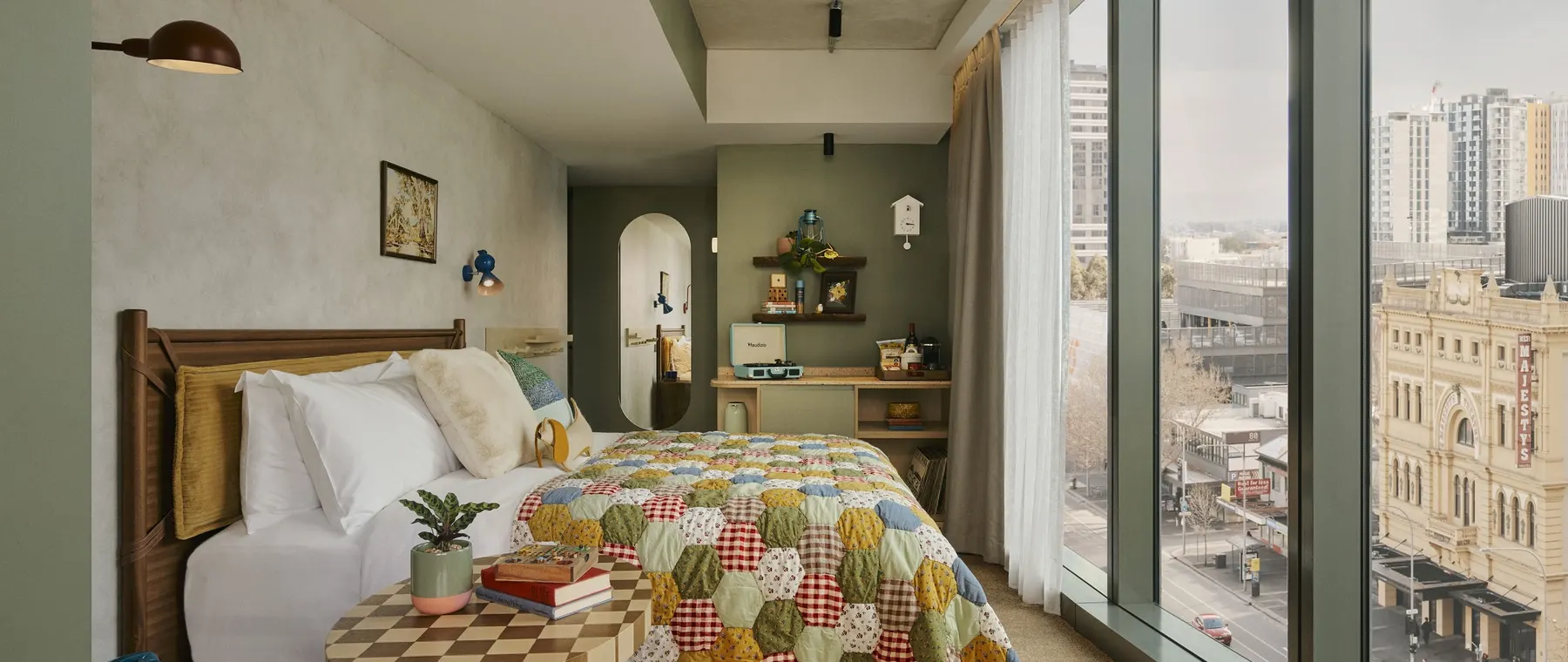
The publicly presented room photographs suggest a preference for warm materials, textiles and furniture that does not all belong to one perfectly matched collection. Timber finishes, Australian wool and patterned fabrics bring a domestic dimension to the guestroom. The company even describes a cuckoo clock as a reference to Hahndorf, the historic German-influenced settlement in the Adelaide Hills. It is a small detail, but one that makes more sense in context than imported decoration with no relationship to the destination.
The appeal of this kind of design is not necessarily the cost of the individual materials. A hotel can create a particularly welcoming room through the quality of its lighting, the comfort of the bed and chairs, and the arrangement of the space around a view. The photograph accompanying this article, credited to Anson Smart, shows the King Corner Room with Balcony. Its tall windows give the surrounding city a role in the interior, while the patterned textiles distinguish it from a generic business-hotel bedroom.
Prospective guests should still compare the sizes, outlooks and facilities of the available room categories. A photograph of a corner room does not establish that every room enjoys the same windows or balcony.
Room choices for more than one kind of holiday
The new hotel will have ten suites among its 248 rooms. Its signature Hideaway Suite and the Canopy Suite offer additional living space, with private balconies described in the announcement. In the latter, a separate dining area and discreet pantry are intended to complement a more spacious retreat. These categories may appeal to guests spending several nights in the city, particularly when the room itself is part of the planned holiday.
Yet one of the more useful aspects of the room inventory is considerably less extravagant. Almost a fifth of the rooms are planned with twin beds, making the hotel a practical option for friends travelling together or family groups whose needs are not met by a standard double room. The group also identifies accessible room options, including arrangements intended to assist guests with hearing or visual impairments.
For affluent travellers who are conscious of the overall cost of a holiday, the question is often where additional expenditure produces a noticeable benefit. A larger suite may be a worthwhile choice if several people intend to gather there or if a guest expects to spend substantial time at the hotel. Someone planning to leave immediately after breakfast and return late from the wine regions might gain more from allocating that budget to a private excursion, a good meal or another night in the region. There is no single correct balance.
The company has not included a representative nightly rate in the press announcement, so the relative cost of these choices cannot yet be assessed from that statement alone. Rates and cancellation arrangements should be checked for the intended travel dates.
South Australian food on the doorstep
A stay beside Adelaide Central Market offers an opportunity to make the city's food culture part of an ordinary morning, rather than an activity that needs to be organised around a formal tour. Visitors can explore the stalls, discover local produce and choose something for a light lunch before continuing through the centre. Opening times and the availability of individual traders should be checked in advance.
The hotel's own restaurant will be called Little Lemon, with executive chef Nick Tadija leading the culinary programme. The announced concept combines Italian cooking with ingredients sourced from South Australia. Tadija's experience includes working in London kitchens recognised by the Michelin guide, but the new restaurant has not itself received a Michelin distinction. Its proposed menu is organised around seasonal produce and a convivial style of dining rather than a demand for lengthy formal tasting menus.
Wine is intended to be another important element. The hotel plans to bring Italian selections together with bottles from McLaren Vale, the Adelaide Hills and the Barossa, allowing guests to explore the different regional styles without travelling out of the city for every tasting. The restaurant's design takes inspiration from glasshouses and gardens, with an open kitchen and a private dining space for larger gatherings.
It will be interesting to see how the menu develops after opening. A restaurant located next to a major market can offer an appealing variation on the destination-hotel dining experience if it maintains meaningful connections with the producers upon whom the culinary concept depends.
A city base for the beach and the wine country
The ease of combining urban and country experiences is one of Adelaide's strongest attractions. Glenelg, reached by tram from the city, offers a different pace from the centre. A few hours at the beach can complement a morning devoted to the market or galleries, without committing to a separate coastal hotel.
The Adelaide Hills provide another contrast. Hahndorf, referenced in the hotel interiors, is a popular destination in its own right. A visit can be combined with time in the surrounding countryside, subject to the preferences of the group. The Barossa and McLaren Vale provide opportunities to build a more dedicated day around wine, food and rural scenery. Travellers who intend to sample wines should arrange appropriate transport rather than rely on driving themselves afterwards.
The advantage of this approach is that an itinerary can be adjusted to suit the weather, the length of the stay and the interests of each traveller. A good city hotel is a particularly useful base when members of a group want to pursue different activities during the day and meet again in the evening. Adelaide is also a logical starting point for a longer journey elsewhere in South Australia.
An owner accustomed to holidays on the water may appreciate the possibility of adding coastal time without sacrificing the dining and cultural attractions of a city. It need not be a yachting holiday in itself to have that appeal. The new property offers another accommodation option for this kind of independent trip.
Wellness without turning the holiday into a programme
The hotel's planned fitness facilities occupy 205 square metres, with Technogym equipment, Peloton bicycles and Pilates Reform beds among the announced provisions. Such a gym can be particularly useful during a longer trip, especially for guests looking to maintain an established exercise routine without arranging separate memberships or appointments. The hotel's announcement also outlines refill stations, reusable water carafes, bulk amenities and a waste-management programme. These are stated operational intentions, not verified environmental performance results.
The attraction of Treehouse Adelaide, however, is primarily the combination of its location and its design. Guests are not expected to devote every day to a structured wellness experience or book a collection of expensive extras to enjoy the neighbourhood. A walk through the city, a visit to the market and an evening meal can be an experience in their own right.
Reservations for early 2027 are now open according to Treehouse Hotels. Travellers should confirm the actual arrival dates on offer and whether all the advertised facilities will be operating during an initial stay. Opening-period changes are possible with any new hospitality project. For readers seeking an engaging, contemporary Australian city break, the property is worth considering alongside other accommodation in central Adelaide, with the final choice determined by actual rates and the kind of holiday they want to enjoy.
Sources and lead image
Source documentation: https://www.prnewswire.com/news-releases/a-new-treehouse-hotel-is-growing-in-adelaide-302941236.html. Lead image: King Corner Room with Balcony at Treehouse Hotel Adelaide — Anson Smart, official press photograph supplied by Treehouse Hotels with its 17 November 2026 announcement.. Official issuer-supplied press photograph, reproduced for editorial coverage of the specific announcement and resized for web display.