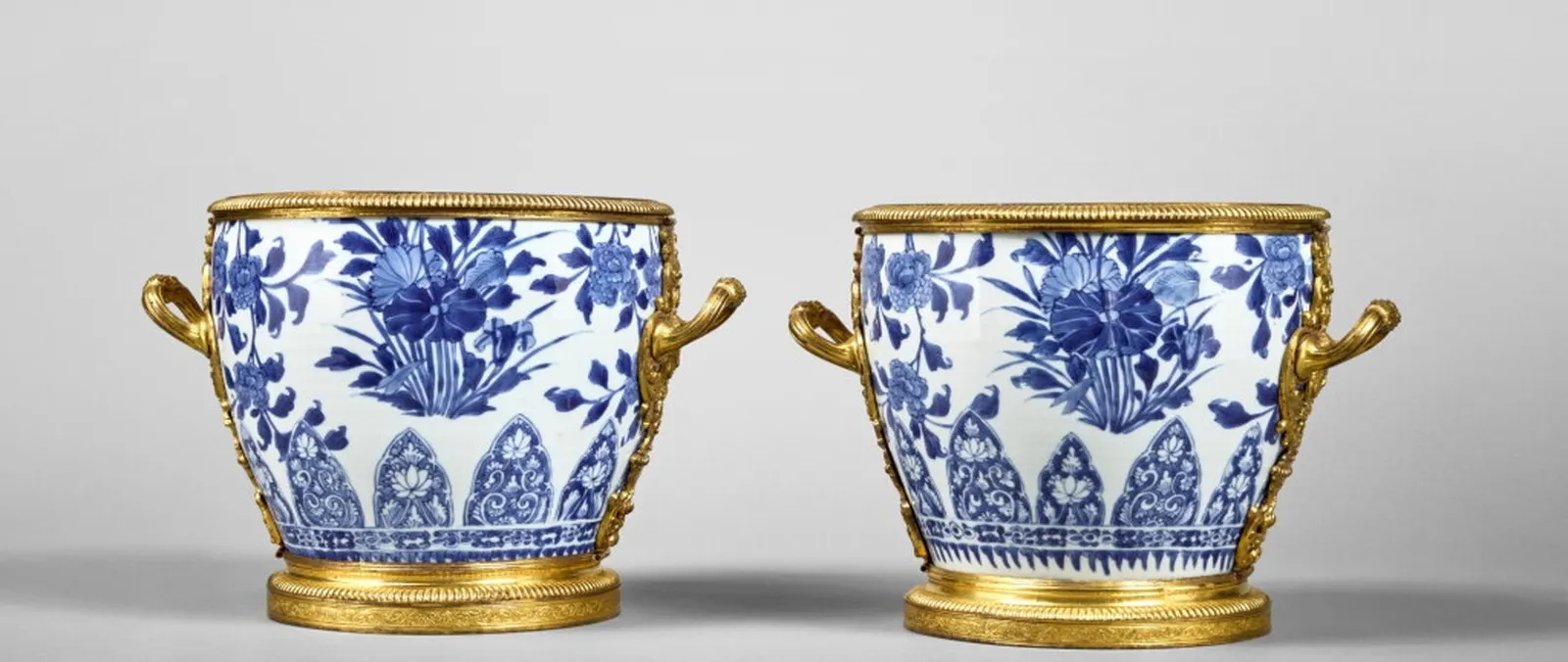
A large catalogue devoted to ornament
Sotheby’s New York has scheduled Magnum Opus Act IV: Ornament & Texture for 23 October 2026, with 268 catalogue results visible in the current online listing. The selection explores decorative objects through materials and surface treatments, allowing collectors to compare forms made across different regions and periods. It is especially rich in ceramics and objects designed for interiors.
The catalogue begins with a late-seventeenth-century Japanese blue-and-white octagonal vase, estimated at $3,000 to $5,000. Other early entries include Imari porcelain mounted with French Régence silverwork from the early eighteenth century. Those pairings demonstrate how luxury objects travelled between cultures and were sometimes transformed after arriving in a new market.
Japanese porcelain and French silver mounts
A pair of large Régence silver-mounted Imari porcelain covered pots, associated with Paris in 1717–1722, carries an estimate of $15,000 to $25,000. Related jars, beakers and potpourri objects offer variations on the combination of ceramic bodies and European metal mounts. The ornament is visually arresting, but it also provides evidence of historic collecting taste and workshop practice.
The buyer should ask whether mounts and porcelain bodies have always been paired or whether their association changed over time. Repairs, replacements and alterations are common in objects that have survived centuries of handling. An original mount may be historically important, while a later intervention can tell another story about changing taste. Either way, its age and authorship should be understood before an object is valued.
Iznik tiles and the art of colour
The catalogue also includes Turkish Iznik pottery, including a tile dated to around 1570 with cobalt blue, green and bole-red decoration. Such objects make ornament a serious subject in its own right: their design depends on the interaction of repeated forms, strong colour and the particular firing characteristics of glazed ceramic.
Authenticity and condition are inseparable from an object’s appearance. Glaze losses, breakage, restoration, modern supports and changes to the original edges may all alter how a tile should be interpreted. Buyers should look beyond its most attractive front-facing photograph and request information about the reverse, thickness and any historic or later mounting arrangements. Conservation advice is especially useful before wall installation.
Textiles and objects beyond pottery
The wider Magnum Opus collection also includes carpets and other decorative objects, reflecting the scope of the sale’s title. A Safavid medallion carpet from seventeenth-century Persia appears elsewhere among its featured lots. Textiles add a very different dimension to the idea of ornament, with pattern carried through weaving structure rather than glaze or applied metalwork.
Textile conservation raises questions about fading, fibre deterioration, insect activity and historic repairs. A valuable carpet need not be placed in a high-traffic setting simply because it was originally designed for a floor. Collectors can choose protective display methods that maintain the object’s cultural legibility while reducing wear. Practical use and long-term preservation must be balanced deliberately.
Collecting ornament as cultural history
Decorative arts are sometimes described as accessories to major paintings, yet many of these objects preserve extraordinary evidence of trade, design exchange and specialised craft. A Japanese porcelain vessel adapted with French mounts is a record of taste moving across borders. An Iznik tile may preserve a palette and pattern language associated with a particular workshop and architectural setting.
Sotheby’s primary catalogue supplies dates, estimates and lot descriptions, but any purchase should be preceded by individual provenance and condition checks. International movement can also involve cultural-property restrictions. The value of this auction lies in the opportunity to approach ornament not as an afterthought, but as a central form of artistic expression and historical documentation.