A November sale spanning Chinese history
Sotheby’s will hold its annual Chinese Art auction in London on 4 November 2026, presenting objects from early archaeological traditions through to the Qing period. The selection includes ceramics, bronzes, jade, cloisonné and archival material. This range invites collectors to think about artistic exchange and historical use rather than regard every object as a purely decorative acquisition.
The event is divided into sessions at 10:30 a.m. and 1:30 p.m., with public exhibitions scheduled from 30 October to 3 November. That calendar gives prospective buyers an opportunity to inspect works before the sale. In-person examination can reveal scale and surface detail that photographs do not communicate reliably.
An exceptional Xuande porcelain dish
Sotheby’s identifies a Xuande reign-marked yellow-ground blue-and-white dish with a pomegranate motif as a major highlight. The auction house describes it as one of only five recorded examples, a statement about documented rarity rather than a guarantee of commercial value. The dish's palette and decoration connect material technique with the symbolic language of imperial porcelain.
A rare vessel should be studied for its glaze, form, firing evidence and any restoration. Even small repairs can alter how specialist collectors assess an object. The chain of ownership and the reliability of expert comparison matter as much as whether a piece resembles a famous example.
Early ceramics tell a different story
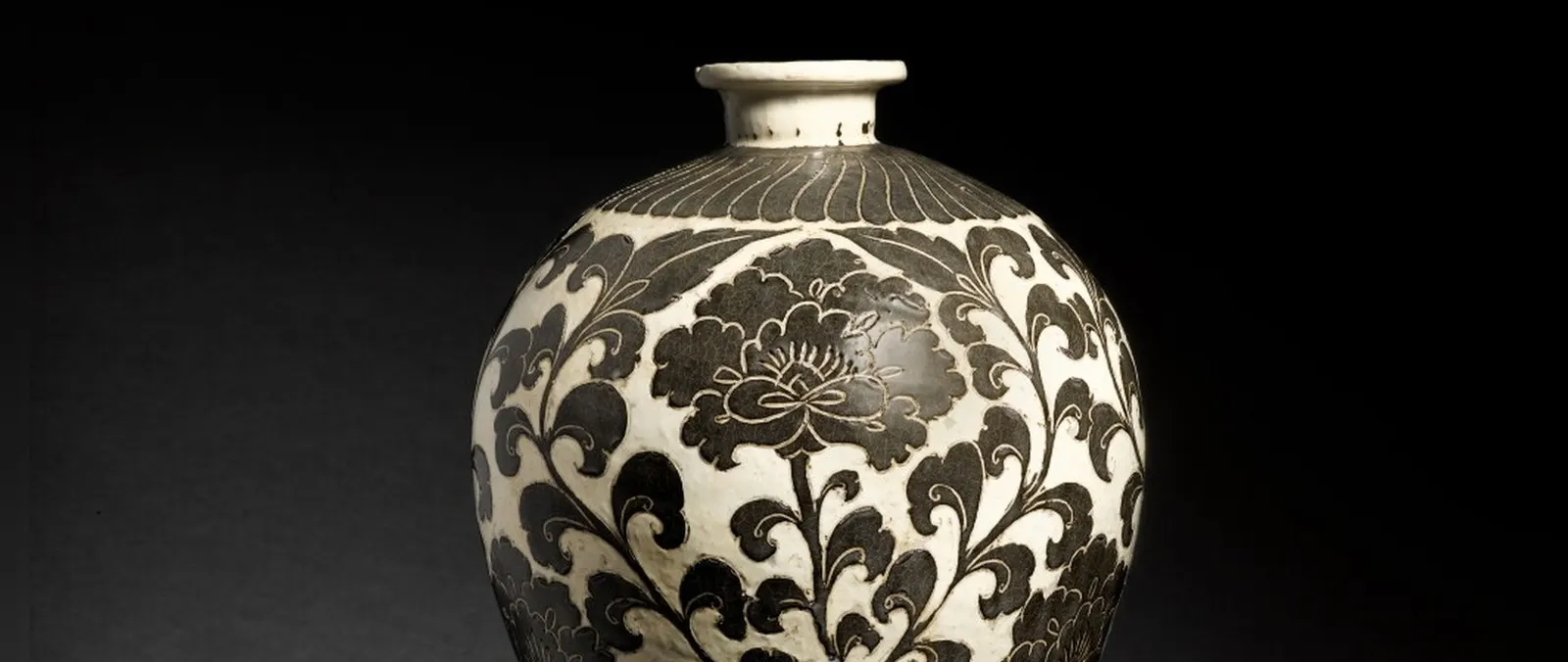
The Houlezhai Collection contributes early ceramics, including a Northern Song dynasty Cizhou sgraffiato meiping. The technique of carving or incising through a slip layer creates a distinctive contrast on the surface. Its appeal is closely tied to a period when workshops explored expressive decoration within functional ceramic traditions.
Collectors accustomed to later imperial porcelain may find this type of material unusually direct in its surface treatment. That does not make it simpler to authenticate. Wear, burial conditions, firing irregularities and historic repairs require specialist interpretation rather than an assumption that a rough surface proves age.
Private collections anchor the provenance
The sale also includes material from the collection of Sir Ewen and Lady Fergusson, along with Qing imperial documents and paintings collected by sinologist Professor Martin Gimm. These named collections provide starting points for research. Their documentary context may be important to understanding why objects were assembled and how they were preserved.
A named former owner can add interest without resolving every provenance question. Buyers should examine acquisition dates, export histories and any previous catalogue records. Museum comparisons may illuminate style and chronology, but they are not a substitute for object-specific evidence.
Documents can be as significant as sculptures
Alongside decorative works are official documents from the early 1950s, including correspondence associated with Mao Zedong and Deng Xiaoping. Their inclusion brings modern political history into an auction otherwise spanning much earlier craftsmanship. Collectors considering such material need an approach to authenticity different from that used for porcelain or jade.
Paper provenance, handwriting analysis and institutional records may all contribute to assessment. A historical document can be highly significant even when it lacks visual grandeur, while an ornate object may have little reliable history. The catalogue should be read with those differences in mind.
Cross-border ownership requires attention
Sotheby’s warns that certain non-EU works may be subject to additional European import requirements based on age and value. The auction house makes clear that buyers bear responsibility for permits and importer statements where applicable. This is a substantive practical consideration for collectors moving objects between homes.
The 4 November sale is upcoming on the date of this article, so no lot prices have yet been achieved. A buyer should check the latest catalogue, all documentation and transportation constraints before bidding. Successful collecting in this field depends on scholarship and legal provenance as much as personal taste.