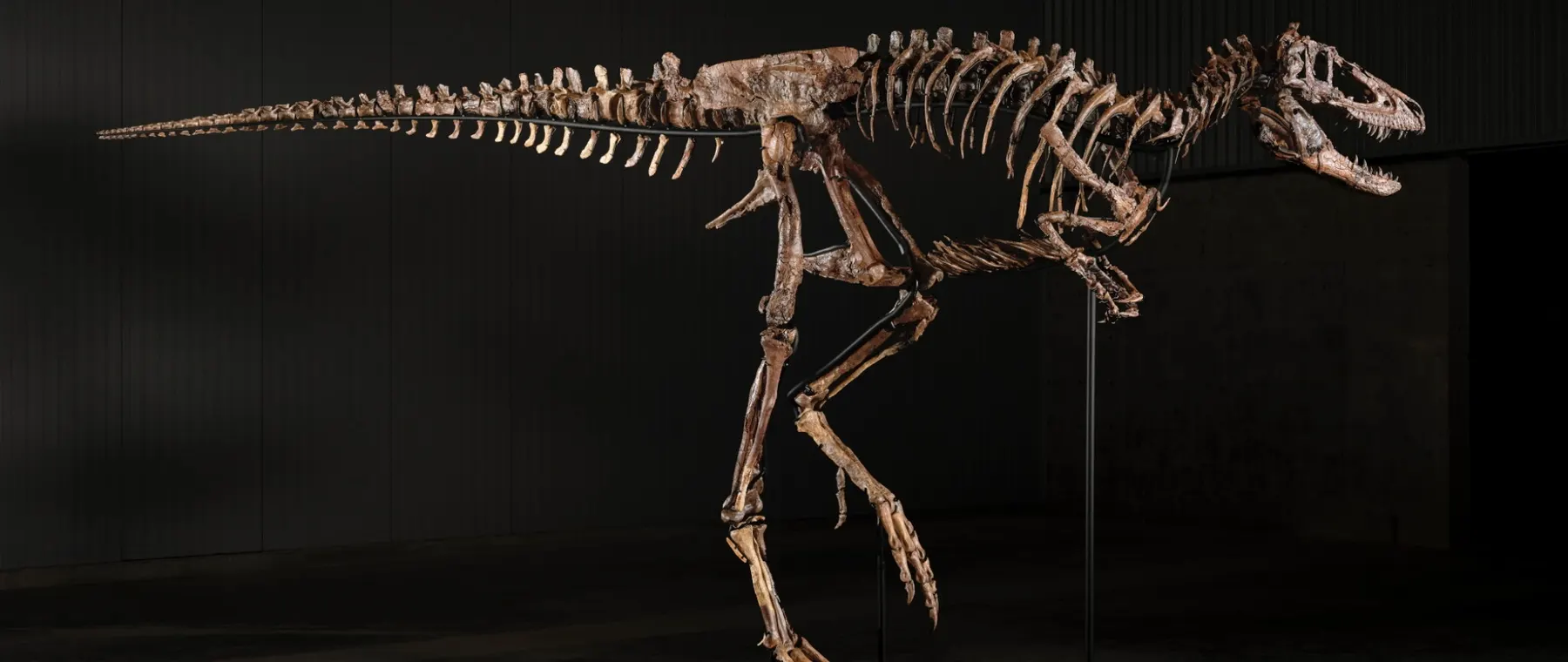
Sotheby's has scheduled a New York auction of Jodi, an approximately 67-million-year-old dinosaur skeleton identified as Nanotyrannus cf. lancensis. With a US$6–9 million estimate and an October 27 sale date, the fossil highlights a collecting field where scientific evidence, legal provenance and private capital meet.
A major fossil becomes an auction object
Jodi was recovered from the Hell Creek Formation in Garfield County, Montana, a geological area associated with the final part of the Cretaceous period. The mounted skeleton is a rare example of a specimen presented both for scientific interest and potential long-term ownership in a private collection.
The auction house's estimate indicates an expected price range ahead of bidding rather than a confirmed valuation. A bidder should consider preparation, skeletal completeness and mounting details separately from the immediate impact of seeing a dinosaur displayed at full scale.
Scientific interpretation has changed over time
The taxonomic status of smaller tyrannosaurs has been debated, particularly whether some fossils represented a separate genus or younger forms of Tyrannosaurus rex. Recent research has renewed support for a distinct Nanotyrannus interpretation, adding to scholarly discussion around important specimens.
The 'cf.' designation in the catalogue is a qualified identification, and it should remain part of any responsible description. Fossil research does not end when an object enters a sale; new comparative work, scanning and analysis may continue to change understanding of its place in evolutionary history.
Provenance and conservation require specialist attention
High-value natural-history specimens demand documentation of where they were found, how they were excavated and the basis on which ownership was established. An attractive mount may incorporate restorations or replacements that are legitimate but must be clearly distinguished from preserved original material.
If acquired for a private home or business premises, the fossil would also require suitable humidity management, security and an experienced installation team. It cannot be treated as an ordinary sculpture that can be transported or reassembled without specialist support.
Private stewardship creates responsibilities as well as prestige
Museums and researchers can benefit when fossil owners provide access to important specimens. Prospective bidders may wish to discuss the possibility of scientific loans and study permissions alongside the commercial documentation, especially for material linked with an active research debate.
The verified news is Sotheby's planned 27 October auction, not a completed record sale. For collectors interested in the history of life on Earth, responsible preservation and the continuing availability of research data are more important than a speculative future resale value.
Official sources: www.sothebys.com.