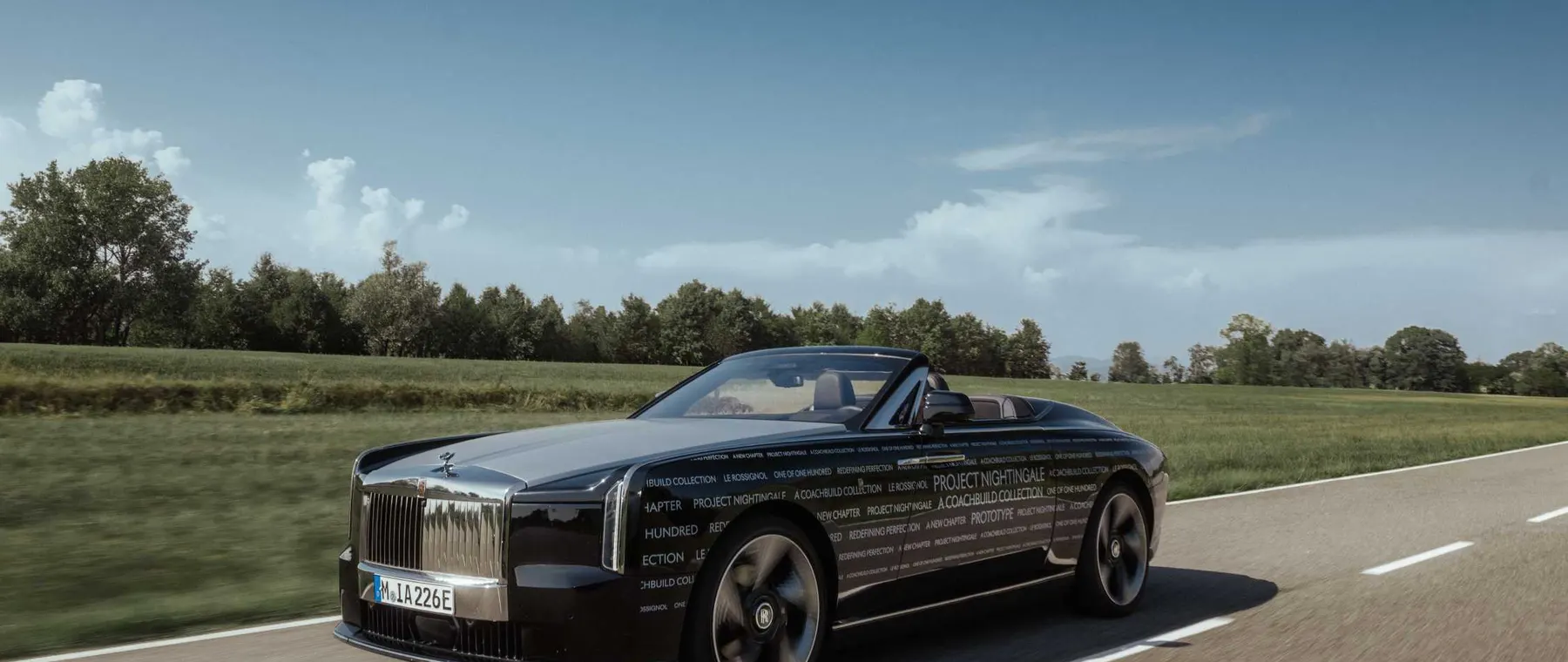
Rolls-Royce Motor Cars has moved Project Nightingale from the design and engineering phase into an unusually extensive global testing programme. The electric Coachbuild collection is limited to 100 client cars, with the company saying commissioning owners made clear from the outset that the cars would be driven rather than treated simply as display pieces.
The validation work is therefore being shaped around real journeys and very different climates. For buyers accustomed to moving between Mediterranean marinas, Alpine resorts, Gulf destinations and northern Europe, the underlying idea is familiar: a luxury object still has to function perfectly when the setting changes.
Testing starts on the roads of Southern Europe
The programme begins in Southern Europe, reconnecting the project with roads used in the early development history of Rolls-Royce. From there, prototypes are scheduled to travel through environments ranging from the Arctic Circle to the Arabian Peninsula, including elevations of up to 2,750 metres.
Rolls-Royce says the complete programme represents 350 collective weeks of testing. That scale is intended to validate not only propulsion and durability but also the refinement expected from a Coachbuild car across temperature, altitude and road-surface extremes.
Aerodynamics have already absorbed 1,430 hours
Before the road programme began, static prototypes completed more than 1,430 hours of aerodynamic modelling, digital simulation and wind-tunnel work. High-speed validation will now compare those calculations with physical behaviour as the car is taken to speeds of up to 155mph at a private proving facility.
Noise management is a major part of that work because an open car presents a different acoustic challenge from a conventional closed luxury saloon. Rolls-Royce has also developed an electrically operated wind deflector intended to reduce turbulence around the occupants when the roof is lowered.
The roof is being tested at temperatures up to 80°C
The folding roof uses a combination of cashmere, fabric and technical composites for sound deadening. Rolls-Royce plans ten separate tests covering the fabric, mechanism and performance, including exposure to temperatures as high as 80°C.
The attention extends to a new Piano Boot that opens sideways on a cantilever. That mechanism is scheduled for as many as 15,000 opening and closing cycles so the theatrical movement does not become a fragile novelty after repeated use.
Coachbuild luxury is being treated as usable engineering
The significant point is that Project Nightingale is not being positioned only as a one-off design statement. Its small production run and highly individual nature are being matched by an engineering programme aimed at making the car dependable in the varied environments its owners are expected to visit.
For LYG readers, that makes the project more interesting than rarity alone. It reflects a wider luxury trend in which exceptional craftsmanship is increasingly expected to coexist with genuine usability, whether the object is a car, a yacht or the equipment carried between them.