Two German design traditions meet in one case
RIMOWA and Faber-Castell have collaborated on a limited-edition Artist Case, bringing together premium luggage construction and specialist drawing instruments. Announced in September 2026, the object is made in RIMOWA’s Cologne factory and is intended to accompany creative work beyond a fixed studio. Its aluminium body recalls the grooved language of the luggage maker, while the contents reflect Faber-Castell’s long expertise in pencils and colour.
The partnership is particularly interesting because it addresses a genuine practical need. Artists who travel must protect expensive tools, keep colours organised and work efficiently in unfamiliar surroundings. A case can also become part of the ritual of drawing: opening it, arranging materials and returning everything to its place. The companies have concentrated on that process, rather than simply applying two established names to an empty collector’s object.
Anodised aluminium made for years of handling
The case is built from premium anodised aluminium, a material closely associated with RIMOWA’s luggage. Its exterior is designed to acquire character through use, rather than remain artificially pristine. A leather handle provides a contrasting point of contact and recalls the traditional detailing of the Classic luggage collection. Together, those choices give the piece an industrial appearance softened by familiar workshop materials.
Anodised aluminium is not immune to dents or surface marks. Those changes may form part of the intended patina, but anyone carrying delicate pencils should still think carefully about where the case is packed and how it is handled. The value of the material here is its structural purpose and longevity, not just its visual association with luxury travel. The case is meant to be opened and used.
A two-level tray makes the contents accessible
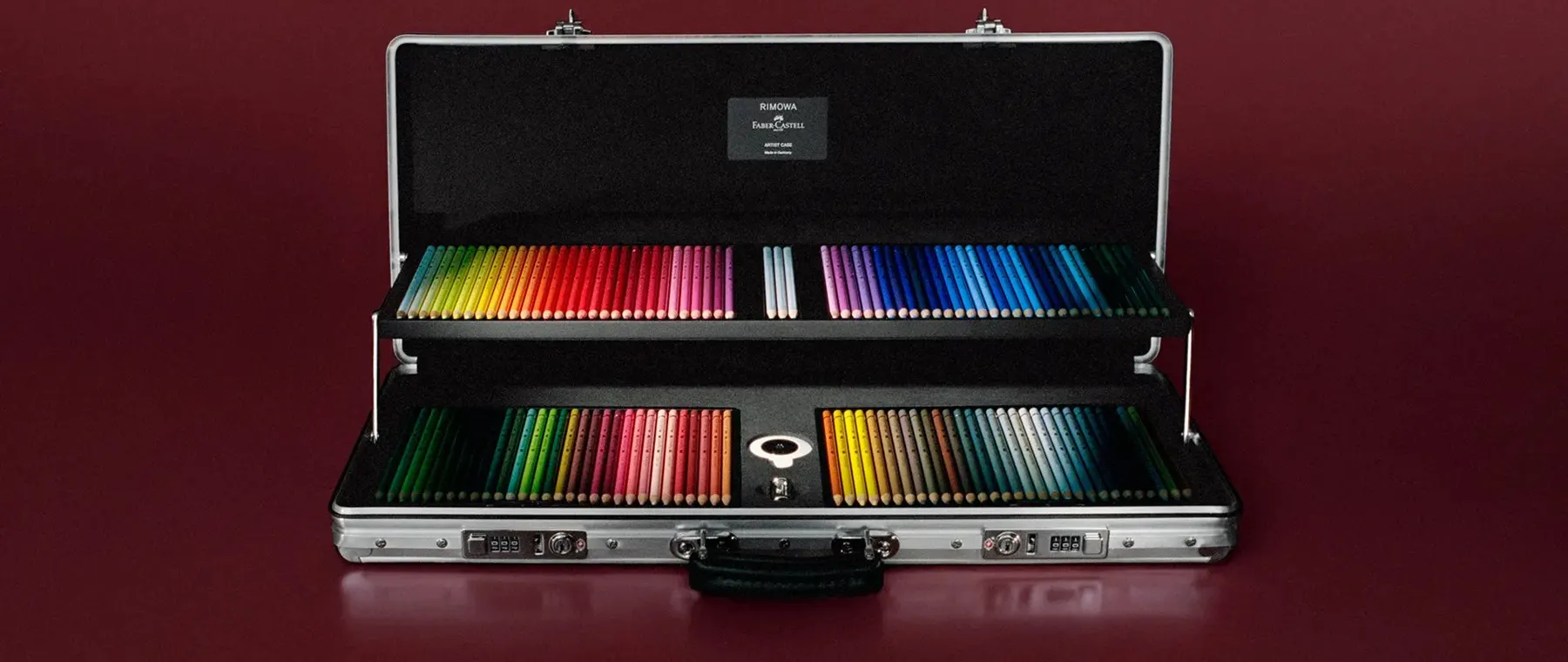
Inside, a specially developed two-tier tray opens to present the instruments in an organised display. This arrangement lets an artist view and reach drawing tools without unpacking every item onto a table. The opening motion is part of the design itself, revealing a curated set of pencils and accessories. It also helps the user see quickly whether an item is missing before the case is closed for another journey.
Organisation is particularly valuable when working outside a conventional studio. A hotel desk, yacht saloon or borrowed workspace may have little room for loose materials. A self-contained layout reduces the time spent searching for a colour or sharpening tool. The best travel equipment does not eliminate the need for skill; it removes small frustrations so that the artist can concentrate on the actual act of drawing.
One hundred and twenty Polychromos colours
The most substantial part of the included drawing set is a selection of 120 Faber-Castell Polychromos colour pencils. The range is known for oil-based cores and strong pigmentation, giving users a broad palette for sketches and developed drawings. The partnership also includes co-branded grooved 2B graphite pencils, a nod to RIMOWA’s exterior design. Together they cover early composition as well as later colour work.
A large colour range is useful only when the artist understands how the tones relate to one another. The case provides access to that range, but effective drawing still depends on layering, pressure, paper choice and technique. The graphite pencils are equally important: many pieces begin with a modest tonal study before colour is introduced. Faber-Castell’s contribution ensures the object is equipped for serious use, rather than presented as a decorative shell.
Small tools receive the same attention
The set includes a RIMOWA-branded sharpener with platinum-plated detailing and an eraser. These may be modest components next to the elaborate aluminium housing, but they are essential to a functioning drawing kit. A pencil that cannot be sharpened reliably, or a sketch that cannot be corrected, quickly undermines the pleasure of working away from home. The accessory selection completes the working proposition.
It is worth asking how consumable items can be replaced over time. Coloured pencils wear down, erasers age and sharpeners may eventually need attention. A case intended for long service should remain useful after its original contents have been replenished. The design is strongest when it provides an organised home for tools that the owner can continue to use, rather than tying the whole object to one untouched presentation.
A heritage collaboration with different histories
Faber-Castell was founded in 1761 and remains a ninth-generation family-owned company. RIMOWA traces its origins to 1898, developing its association with aluminium luggage during the twentieth century. The companies work in different categories, but both have a history of turning commonplace functional objects into highly recognisable manufactured products. That shared approach makes the collaboration more credible than a simple licensing exercise.
A pencil and a suitcase are not similar products, yet both depend on small engineering decisions that become evident during repeated use. The alignment of a case lid, the consistency of a pencil core and the way tools fit their compartments all influence experience. By combining those disciplines, the Artist Case draws attention to details often overlooked when luxury accessories are discussed only in terms of appearance.
Pricing and availability are clearly defined
The official announcement lists a recommended retail price of €2,400 for the silver limited edition and a two-year guarantee. Distribution began in September 2026 through RIMOWA stores and its online operation, with Faber-Castell retail availability in Germany and selected European online markets. Buyers should check current stock and regional terms directly, since a launch statement does not guarantee that a limited-edition product remains available everywhere.
The price positions the case as a luxury object and a specialist gift rather than an economical way to buy drawing pencils. The decision to purchase should therefore consider the case’s construction, the pleasure of its presentation and the owner’s likely use. It is entirely possible to make excellent art with less expensive equipment. This collaboration is aimed at someone who also values the design and lasting organisation of the tools.
Creative travel becomes the central idea
The RIMOWA x Faber-Castell Artist Case addresses a form of travel that is less often celebrated than holidays or business trips: taking a creative practice into new environments. Whether used by a professional artist or an enthusiastic amateur, the case offers a defined place for materials and an opening arrangement that can establish a temporary workspace. Its appeal comes from making that routine feel considered and enjoyable.
For yacht owners, travellers and people who move between studios, the practical question is whether the equipment will be used often enough to justify a dedicated carrying system. If it will, thoughtful storage can be as important as the prestige of the brands. The collaboration is at its most persuasive when the aluminium case leaves the display shelf, opens on a working table and helps an artist begin drawing.