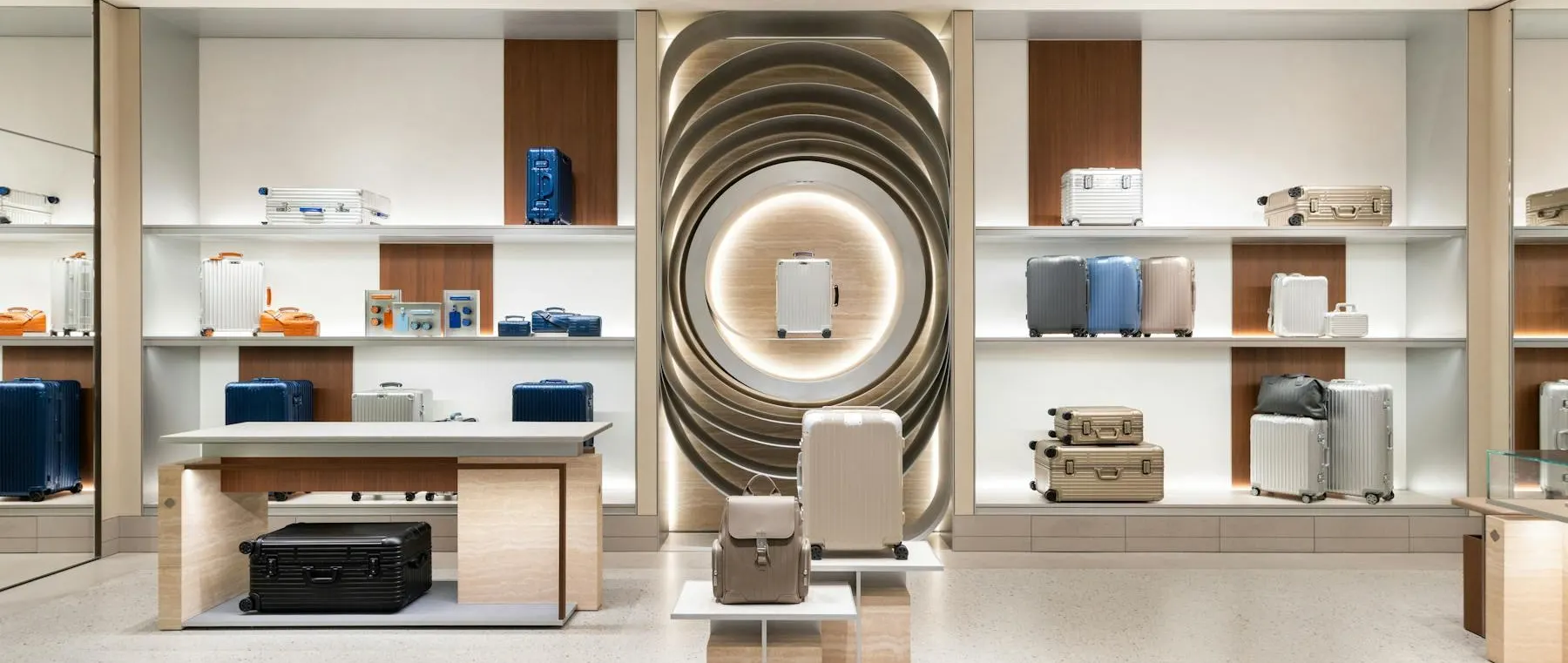
A luggage destination rather than a simple shop
RIMOWA has opened its first flagship store in Shanghai, at the Kerry Center, turning a retail address into a more complete destination for people who travel frequently. According to its parent group LVMH, the new store occupies more than 200 square metres and introduces services never previously offered by the German luggage maker in China. Its emphasis is as much on personalising and maintaining a case as on choosing one from a shelf.
The opening matters for luxury travellers because the relationship with a suitcase can last much longer than a shopping trip. Cases accumulate scratches, stickers, repair histories and memories of places visited. A specialist location that recognises those practical realities offers something different from a seasonal display. Shanghai also gives the brand a distinctive urban setting in which to reinterpret the rituals of international travel.
The Kerry Center setting and its visual language
The flagship is framed by a substantial glass façade and uses a restrained contemporary interior with clean architectural lines and wooden accents. That environment allows the grooved metal and polycarbonate surfaces of the luggage to remain visually prominent. The design suggests a considered pace of browsing, where visitors can inspect handles, hinges and interior compartments rather than judging a case solely by the silhouette seen in advertising.
Store architecture can help explain a technical product when the merchandise is intended to be used for years. Shoppers may compare the feel of a handle, the resilience of a wheel assembly or the organisation of a packing system. Those details are difficult to communicate in a photograph. A large flagship also permits staff to demonstrate more complex personalisation services in a setting suited to the time they require.
Crafted for You reaches China for the first time
One of the most substantial developments is the arrival of Crafted for You. Previously available only in Cologne, the service lets customers choose dimensions and proportions for a RIMOWA Classic suitcase. This is a more consequential form of customisation than a change of colour or a monogram, because overall scale influences how a case fits the travel routines, storage spaces and personal preferences of its owner.
The company has not described the service as an unlimited made-to-measure programme, and buyers should check which configurations are actually offered. Nevertheless, bringing this option to Shanghai marks a notable expansion of its geographical reach. For someone who travels with a consistent wardrobe or moves regularly between aircraft cabins and hotels, an informed conversation about proportions may be more valuable than decorative novelty.
Personal details connect the product to the city
The Shanghai store also introduces customisable leather luggage tags bearing an exclusive motif inspired by Yuyuan Garden. The reference is specific to a historic local landmark, giving the personal detail more character than a standard city-name souvenir. Leather adds a softer material contrast to the hard shell of the case while providing a visible point of identification on a luggage carousel.
A tag is small compared with the suitcase itself, but personal accessories are often the parts that turn an industrial product into a possession. The best examples remain functional: they must attach securely, age reasonably and be easy to recognise. RIMOWA is using that modest element to acknowledge its location without changing the underlying design language on which its international reputation is built.
RE-CRAFTED introduces a second life for aluminium
The flagship brings RIMOWA RE-CRAFTED to China for the first time. The programme is intended to encourage the reuse, repair and recycling of aluminium suitcases that have already travelled extensively. This is an important addition because premium luggage is often bought for longevity, yet the environmental and financial value of a durable shell is diminished if the owner cannot readily maintain or repurpose it.
RE-CRAFTED should not be confused with a claim that every old case will qualify for a particular service or that repairs eliminate environmental impact. Eligibility and costs need to be established case by case. Its significance is the business model: the maker is recognising previously owned products as part of its continuing relationship with customers. Repair and reuse become services with a physical home.
The Original Cabin Monogram gets Shanghai colours
For the opening, the company has presented a limited-edition Original Cabin Monogram suitcase with a purple-to-blue gradient. The palette takes inspiration from the city lights seen after nightfall, translating an urban impression into a distinctive surface finish. It gives the flagship an exclusive object associated with its debut, while preserving the recognisable proportions and function of the Original Cabin.
Colour is a particularly personal choice in travel goods. The familiar aluminium finish suggests industrial permanence, whereas a rich gradient offers a more expressive approach to the same journey. Owners considering a limited edition should weigh how the finish will look after years of handling and whether its appeal rests on collecting or practical use. RIMOWA has not presented an investment case or promised future scarcity values.
A larger move toward lifetime service
Taken together, Crafted for You and RE-CRAFTED suggest that luxury luggage retailers are increasingly being asked to provide long-term support, not simply a transaction. The first considers how a new case might be specified; the second considers what happens after a case has already accumulated years of service. Both aim to make the customer relationship more continuous and more attentive to individual journeys.
This approach has an obvious resonance for owners of yachts and residences in different countries. Reliable luggage is part of the infrastructure of frequent travel, as routine as dependable ground transport or a well-organised cabin. A well-made case that can be maintained and recognised quickly may deliver more genuine convenience than a purely decorative luxury object, even when both share impressive materials.
What travellers should take from the opening
RIMOWA has not merely announced another store. It has combined a substantial Shanghai retail address, locally inspired accessories, a city-specific suitcase and two services that are new to its Chinese operation. The strongest aspect is the breadth of the proposition: customers can consider an individual configuration, maintain existing aluminium luggage and choose an edition connected to the city.
For anyone travelling through Shanghai, the flagship is worth understanding as a product-service destination rather than simply another stop on a shopping itinerary. As ever, the details of availability, eligibility and bespoke specifications should be confirmed directly with the store. The lasting test will be whether this combination of retail design and aftercare makes frequent journeys measurably easier for the people who use the cases.