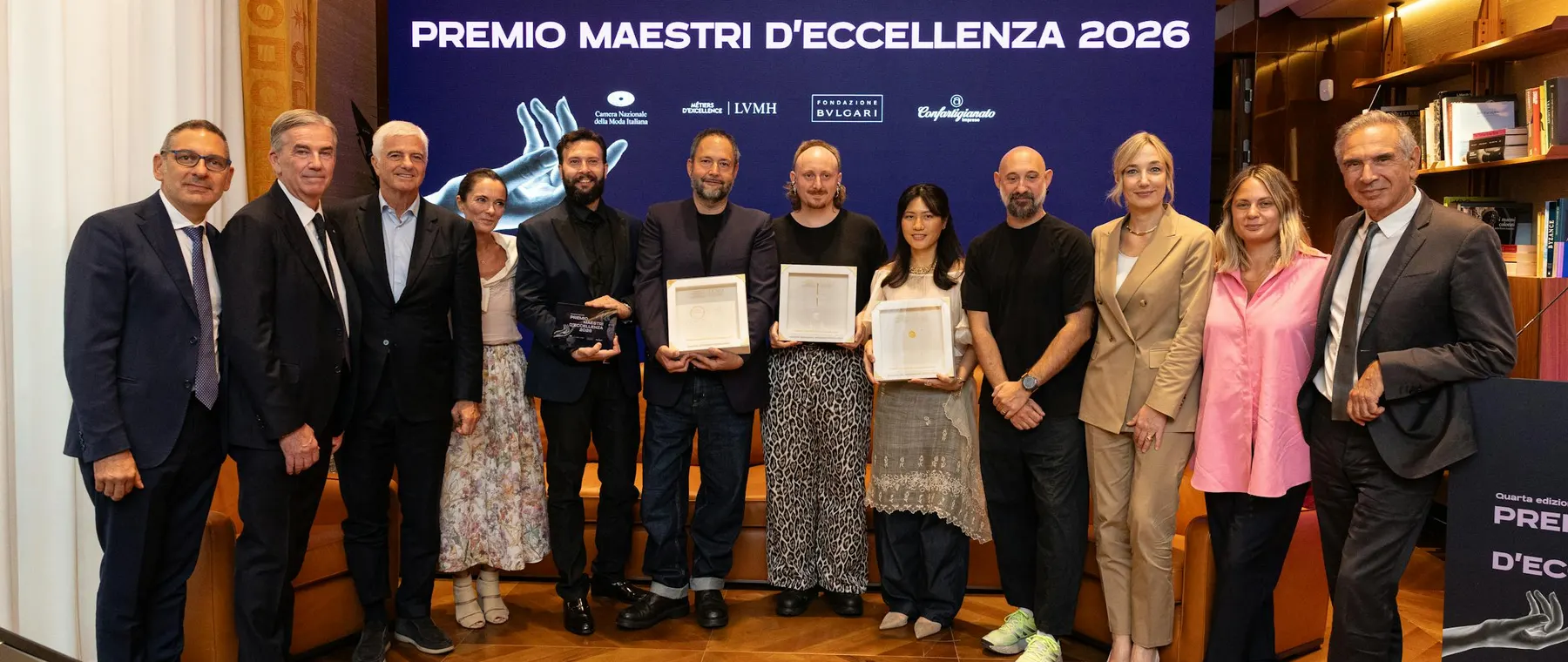
LVMH and Fondazione Bvlgari have announced the winners of the fourth Premio Maestri d’Eccellenza, an award created to recognise and protect exceptional Italian craftsmanship. The 2026 ceremony took place at the Bvlgari Hotel Roma and focused on both established skills and contemporary reinterpretation.
The awards span textile art, tailoring, illuminated sculpture and traditional Sicilian puppet-making. This breadth demonstrates that luxury craftsmanship is not one profession but a network of highly specific skills maintained by workshops, families and individual makers.
Carlo Colombo wins for textile art
Carlo Colombo of Tessitura la Colombina received the Maestro Artigiano d’Eccellenza award. The company traces its roots to 1895 and has moved through silk production, handweaving, accessories and knitwear while maintaining specialist textile knowledge.
The recognition highlights the difficulty of keeping historic production skills commercially relevant over several generations. Heritage matters most when techniques continue to be practised rather than simply preserved in archives.
Lorenzo Seghezzi represents a new tailoring generation
Lorenzo Seghezzi received the emerging artisan prize for contemporary tailoring. His Milan-based label places corsetry at the centre of a technically researched and highly crafted approach to clothing.
The work shows how traditional construction can be used for self-expression rather than historical reproduction. Younger makers are often most interesting when they treat established techniques as tools rather than rules.
Mirei Monticelli brings innovation through light sculpture
Mirei Monticelli won the innovation category for illuminated sculptures made with banaca, a natural fibre derived from abaca. The material is shaped through a process connecting weaving in the Philippines with design and finishing in Italy.
A special mention also went to Daniel Mauceri of Arte Pupara dal 1978, whose workshop preserves Syracuse’s Opera dei Pupi traditions. His work includes puppets, papier-mâché sculpture and jewellery influenced by historic armour decoration.
Craft knowledge is part of the luxury ecosystem
Each main winner receives funding, mentoring and access to Bvlgari production sites. The structure recognises that artisanal businesses need practical support as well as public recognition if rare skills are to survive.
For LYG readers, the awards provide a useful reminder that many luxury objects depend on small specialist workshops far removed from large brand campaigns. Understanding those skills adds depth to the clothes, interiors, jewellery and objects encountered throughout the luxury world.