A new chapter for the open-top sports car
Porsche has confirmed that development of its first all-electric 718 Boxster is approaching its concluding stage, with a production-vehicle presentation planned for the first quarter of 2027. The announcement, released on 24 November 2026, describes approximately four million kilometres of testing and a distinctive battery layout intended to retain the familiar relationship between driver, road and compact sports car. The vehicle is not yet a production model available for a verified independent road test, and the manufacturer has not announced all specifications, prices or delivery arrangements. What the release establishes is a significant development milestone for a model associated with open-air driving. For luxury-yacht owners who also enjoy touring by road, the interest is in how a traditionally mid-engined driving experience might be recreated using an electric powertrain. The answer matters as much to the feel of the car as to its emissions or charging arrangements, and Porsche is positioning its unusual architecture as a central part of that answer.
E-Core places the battery where the engine used to be
Porsche calls the arrangement E-Core. Instead of spreading the battery across a broad floor as many electric vehicles do, the new 718 Boxster places an 800-volt pack directly behind the seats, occupying an area associated with the combustion-engine installation in earlier generations. Porsche says this enables the low seating position and concentrated mass distribution it wants for a sports car. That statement is a manufacturer design claim, not an independently measured comparison with every battery-electric competitor. Packaging has consequences for driving position, space, structure and the way an open-top body carries loads. Putting a major component behind the passenger compartment may help protect the relationship between the cabin and the car's centre of gravity, but the actual handling cannot be determined solely from a drawing. The 800-volt architecture also does not establish charging speeds, usable battery capacity or real-world range, which require complete published specifications and standardised testing.
Testing from Arctic cold to desert heat
The company reports that its prototypes have undergone endurance testing in conditions ranging from minus 30 degrees Celsius in Sweden to as much as 51 degrees Celsius in Death Valley in the United States. Urban driving programmes in Las Vegas, Los Angeles and Shanghai tested convenience and assistance systems as well as the main drivetrain. These details are meaningful because heat and cold can affect battery performance, charging, cabin comfort and other functions. Yet a manufacturer's test-distance figure is not proof that every customer will achieve a particular range or reliability outcome. The announced four million kilometres refer to an overall development programme, not to one vehicle travelling that distance. Specialists also need to assess durability over different surfaces, weather and traffic conditions. The public can recognise the scale of testing while reserving judgement about final long-term ownership costs and performance. Production certification and independent road testing remain separate milestones.
Recreating the Boxster driver's relationship with the road
The 718 Boxster has a particular place in Porsche's portfolio because of its relatively compact proportions, two-seat layout and direct steering and chassis character. Porsche says the electric model aims to preserve that identity, despite replacing the combustion engine with an electric drive system. Such continuity cannot be judged entirely from a nameplate or a promotional film. A driver's experience depends on seating, controls, braking, steering feedback, suspension and how power arrives at the road. An electric motor can respond rapidly, but calibration determines whether that response feels natural and controllable during ordinary journeys. The open-top configuration also changes what occupants hear and sense, making sound and wind management more noticeable. Porsche is proposing that new technology can express familiar sports-car qualities, but that remains a design objective until independent drivers can evaluate a completed production car. The November release offers details of the engineering approach rather than a final verdict.
E-Shift introduces a different idea of involvement
Porsche describes E-Shift, a system intended to offer simulated gear-changing sensations through steering-wheel-mounted paddles. This reflects a wider debate about driver engagement in electric performance cars. Unlike a conventional manual gearbox or automatic transmission shifting several mechanical ratios, a simulated shift is an interface decision designed to create a particular response and rhythm. Porsche's announcement also refers to a sound experience inspired by the traditional Boxster. An enthusiast may appreciate such cues, while another driver may prefer uninterrupted electric acceleration and minimal artificial sound. Actual operation, customisation and whether these features can be disabled should be confirmed in final specifications. It would be premature to claim that E-Shift reproduces the mechanical feel of a specific earlier model. The significance is that Porsche is treating emotional engagement as part of its engineering brief, rather than assuming that instant torque alone defines the driving experience.
Everyday driving alongside occasional high performance
The manufacturer says development has included city traffic, routine usability and assistance functions as well as endurance and dynamic tests. That is important because even a car designed for performance will spend much of its life travelling on public roads at ordinary speeds. Visibility, access, comfortable seats, storage and efficient heating can influence ownership more than an isolated acceleration figure. The November statement does not provide a final list of all driver-assistance functions or a comprehensive specification for every market. Such equipment may vary with legislation, model and optional packages. The open-top body also creates different needs for noise control and climate performance. A potential buyer should compare actual equipment, warranty provisions and charging facilities when the car becomes available. For someone dividing time between a home, a yacht and several destinations, the practical experience of moving the car and charging it away from a primary residence may be particularly relevant.
High-voltage charging requires real infrastructure
An 800-volt battery architecture is an engineering characteristic, not a promise of unlimited charging convenience. High-power charging depends on compatible infrastructure, the vehicle's charging system and conditions such as battery temperature and state of charge. Porsche has not yet supplied in this announcement a complete charging curve or a standardised international range figure for the production model. It would therefore be misleading to invent a ten-minute charging time or a guaranteed distance between stops. Prospective owners should also consider that road-trip charging infrastructure differs between countries and even between regions within one country. A coastal touring route may offer different charging options from a major city. If a car is kept near a yacht berth or second residence, installation and electrical capacity require local advice. The electric drivetrain promises a different energy system, but the quality of the travel experience will depend on practical charging arrangements as well as battery technology.
Why the manufacturer's testing narrative matters
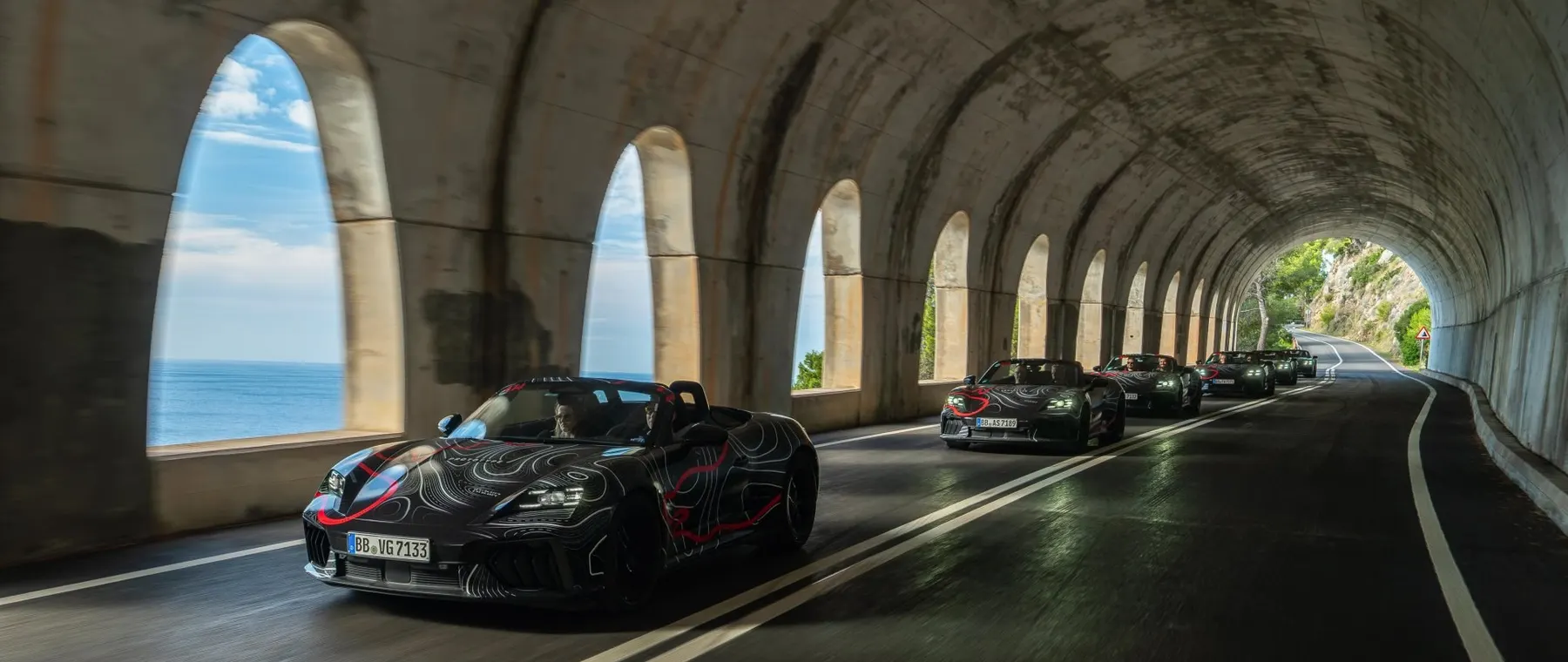
Automakers often publish photographs of prototypes in difficult environments. These images can show the breadth of development, but should not be mistaken for evidence of completed certification or independently measured performance. Porsche has identified locations and conditions in its programme and explained what its engineers were trying to achieve. That gives readers a starting point for evaluating the next announcement. When the production vehicle is revealed, journalists can compare the stated objectives with confirmed specifications and real driving behaviour. If the manufacturer claims a low seating position and particular balance, those elements can be assessed in the finished car. If it promises comfortable daily operation, that can be examined over ordinary journeys and in traffic. The value of a development report is that it records an accountable stage of the project rather than offering an uncritical advertisement for a model not yet available.
Motoring and the wider luxury travel itinerary
Many luxury travellers value the freedom of choosing between air, road and sea transport, sometimes keeping vehicles at several destinations. A compact open-top sports car can be part of an enjoyable road excursion from a marina or a home base, but its relationship to yachting is one of lifestyle rather than direct marine engineering. The 718's development does not imply that the electric car can be charged aboard every yacht or carried on a particular vessel. Such arrangements depend on deck structure, lifting systems, battery safety rules and electrical installation details far beyond this announcement. The relevant point is the broader interest in mobility design: quiet propulsion, energy storage, digital interfaces and craftsmanship are changing what luxury vehicles can offer. Comparing a sports car with a yacht requires respecting the different operating environments and technical requirements of each.
The development announcement's limits
The verified 24 November news is that Porsche has reached the final development stage of its all-electric 718 Boxster, after approximately four million kilometres of testing, with a model debut anticipated in the first quarter of 2027. The E-Core battery sits behind the seats, an 800-volt system is part of the design, and Porsche is exploring driver-engagement functions including E-Shift. The manufacturer also reports test environments ranging from Scandinavian winters to desert heat. These are attributable company claims about prototypes, not independent performance results or a live sales offer. Luxury Yacht Guide treats the car as a developing premium motoring product and records what can currently be established. The accompanying image is an official Porsche Newsroom press photograph, used as an illustration of the development story with the manufacturer's copyright acknowledged. A later article should assess final pricing, range, charging and road behaviour only when those details are verifiable.
Sources and image credits
Reporting based on Porsche Newsroom 24 November 2026 electric 718 Boxster development announcement.
Lead photograph: Porsche's Electric 718 Boxster Heads Into Its Final Development Phase — official first-party press visual, LYG Lifestyle batch02 25 Nov 2026. © Dr. Ing. h.c. F. Porsche AG; official Porsche Newsroom media photograph with photographer credit retained where provided. Original official image source.