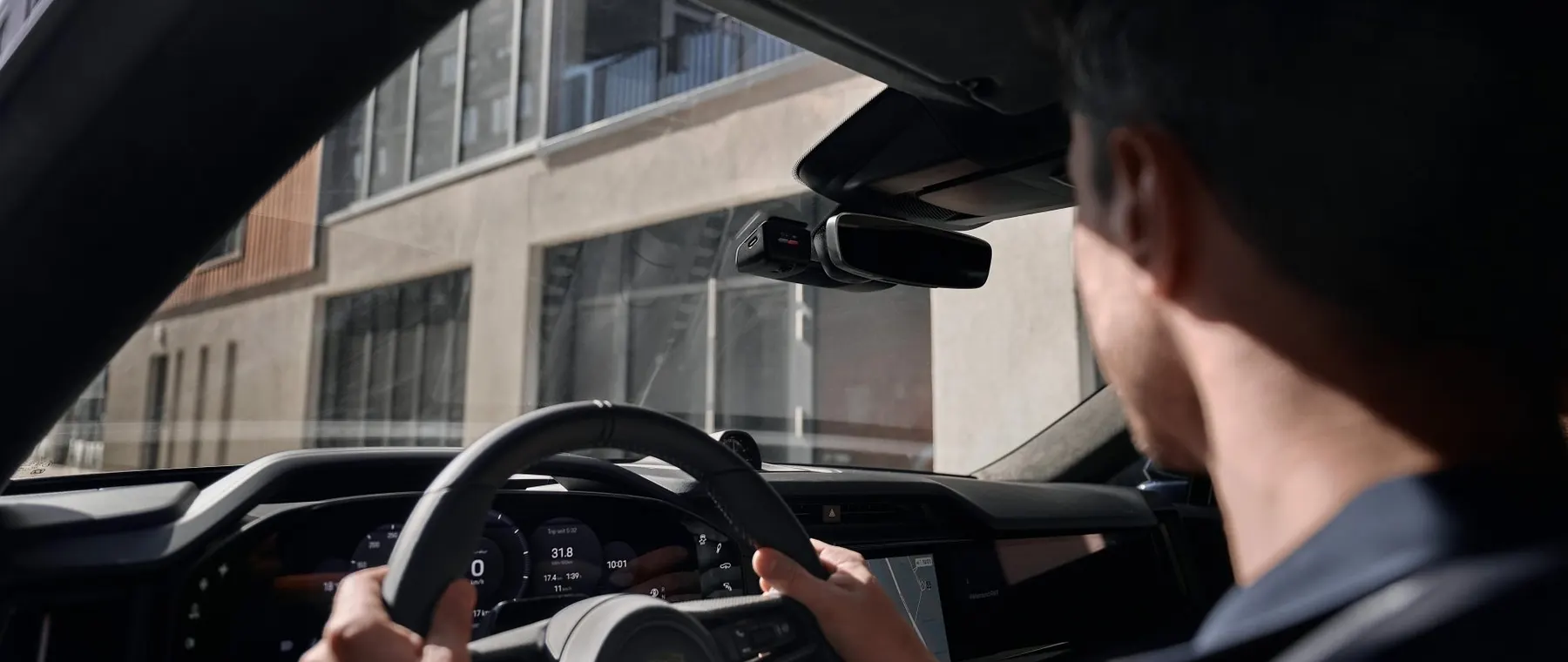
A new accessory for existing Porsche vehicles
Porsche has announced its second-generation dashcam, an accessory intended to record selected driving and parking events and to integrate with the My Porsche application. The official 24 November 2026 launch describes a multi-camera arrangement, high-resolution video, intelligent sensors and discreet mounting beneath the rear-view mirror. The product is available to order through Porsche Centres and the company's vehicle-accessories channels, according to the announcement. This is a real accessory launch rather than a concept for a future car, although an individual owner's installation and price will depend on model compatibility and local arrangements. The significance for luxury-car owners lies in the changing role of onboard electronics. Cameras are no longer simply devices fixed to a windscreen by an aftermarket bracket; they are being incorporated into the manufacturer's equipment ecosystem. That may improve convenience and consistency, but legal, privacy and practical questions remain whenever a car records the outside world or people inside it.
Front and interior views serve different purposes
The new Porsche Dashcam Gen. 2 records both the vehicle's surroundings and the interior, the latter being a new feature within the manufacturer's accessory range. Porsche says the system captures QHD-resolution video with high dynamic range. The terms describe recording capabilities, not a guarantee that every number plate or face will be readable under all conditions. Night lighting, weather, movement and lens positioning can affect the result. An interior-facing camera can offer a different perspective on an incident, but it also captures passengers who may not expect to be filmed. Owners need to understand whether and how interior recording can be controlled, what notification is appropriate and which rules apply where the vehicle is used. A holiday car driven between countries can cross legal environments that treat audio and video surveillance differently. The official product release is useful for identifying features; it is not a substitute for a privacy assessment or local legal advice.
HDR aims to handle difficult contrast
High dynamic range is one of the headline recording features. A camera driving out of a dark tunnel into bright sunlight, or facing strong reflections on a wet road, encounters a demanding range of light. HDR processing aims to retain more useful detail across the scene than a simpler recording setup might. The company also describes a polarising filter designed to reduce distracting reflections from glass surfaces. That may be particularly relevant where a windscreen reflects the dashboard or where strong low-angle sunlight complicates visibility. However, the real performance depends on the optics, sensor, processing and installation. A quoted resolution does not fully describe compression artefacts or detail during rapid movement. The launch has not supplied a comprehensive independently verified comparison against competing dashcams. A buyer should therefore interpret these specifications as manufacturer statements and seek actual sample recordings and current independent tests before assuming that the system will capture every detail of an incident.
Sensors can preserve unexpected moments
The dashcam uses a G-sensor and radar to detect events associated with vehicle movement or parking. Porsche says the accessory can trigger a recording automatically when a relevant event is detected. This has a practical appeal because a driver cannot anticipate every unusual occurrence or manually start a recording at the right instant. Yet automated event detection may be imperfect, and an owner should confirm what kinds of movement or impact are covered, how sensitivity is configured and whether false triggers are possible. Some parking conditions produce movement without damage, while a minor incident might not always generate a strong sensor signal. The product is not a substitute for safe parking, a comprehensive insurance policy or prompt documentation after a collision. Its function is to provide a potential record, subject to the camera's operating conditions. A useful recording may help establish a timeline, but neither the manufacturer nor a device can guarantee how an insurer or legal authority will interpret it.
GPS metadata adds context
Porsche says GPS information can document the vehicle's location when a recording begins. Location metadata can be helpful when a driver needs to establish where an event occurred, particularly during international travel or in an unfamiliar city. But the information can also be sensitive. Stored footage that combines images of a person with precise location and time data may reveal habits, routes or a place of residence. Owners should understand whether data is stored only on the device or made available through connected services, and how it is deleted or transferred. The official announcement does not establish that every country permits the same use of video and location information. It is also important not to treat GPS as a perfect substitute for independent evidence; poor reception, time synchronisation or other technical limitations can affect recorded metadata. The sensible approach is to regard the system as one potential information source and apply proportionate privacy safeguards.
Memory capacity and keeping recordings organised
Porsche supplies a 64-gigabyte storage medium and says capacity can be expanded to as much as 512 gigabytes. This allows a larger archive or more event recordings, depending on settings and compression, but storage size alone does not tell an owner exactly how many hours of footage can be retained. Recording quality, the number of active cameras and automatic overwriting rules matter. A dashcam should ideally make it easy to find and preserve important files before routine recording replaces them. Owners may wish to learn how the device differentiates an event clip from ordinary footage and whether backups are possible. The company release identifies the available capacity but does not set out every retention scenario. A vehicle kept in storage for weeks may have different needs from one used daily. The presence of expandable storage is useful, while the owner's responsibility for managing files and understanding privacy rules remains unchanged.
My Porsche app integration
The new accessory is designed to work with the My Porsche application, allowing owners to manage settings and access recordings through a familiar brand interface. This can reduce the friction of removing memory cards or navigating an unfamiliar standalone device. At the same time, app integration introduces questions about phone compatibility, software updates, account access and connectivity. The launch states that recordings and settings can be viewed and managed through the app, but it does not mean that every feature is available from any phone in every country. Buyers should confirm the current software requirements, compatible vehicles and any subscription or connectivity conditions. When footage might have legal or insurance importance, it is prudent to understand how to export a file without changing its contents or losing useful metadata. Convenience is valuable, but evidence preservation requires an appreciation of how the system stores and transfers data.
A more discreet installation
Porsche positions the Dashcam Gen. 2 centrally beneath the rear-view mirror, outside the driver's ordinary field of vision. The stated design goal is to integrate the device with the cabin rather than introduce an intrusive accessory. In a carefully finished premium car, the appearance of additional equipment can be a meaningful consideration. However, discreet positioning should not be interpreted as a reason to conceal recording from passengers where disclosure is required. Installation also needs to respect airbags, driver visibility, electrical connections and vehicle warranty conditions. The official press release describes an accessory designed for Porsche models, but a particular vehicle's year, trim or other accessories may influence the installation. Owners should use an authorised installer or obtain guidance from Porsche before purchasing. An elegant mounting arrangement is useful only when its operation and safety are appropriate to the specific car.
Privacy issues on international road trips
Drivers who travel across several countries may encounter different rules governing dashcams, public filming, audio recording and data protection. The existence of a manufacturer's accessory does not create a single uniform legal right to record or publish video everywhere. In some places, particular uses of footage may be restricted even when recording for personal purposes is allowed. Publishing a clip of an identifiable person can raise questions different from those involved in retaining footage privately for an insurer. Passengers and drivers sharing a vehicle may also have expectations about cabin recording. Owners should review local requirements and relevant guidance before use, especially when travelling for events or across borders. A yacht owner moving between marinas and road destinations may operate in several jurisdictions during the same trip. Vehicle technology offers capabilities, but responsibility for lawful and considerate use remains with the people who choose how it is deployed.
What the accessory can and cannot establish
A dashcam may supply useful evidence after a road incident, but it is not an automated legal judgement. It captures a view from its installed position, subject to the lens, light and recording state at the time. It may not show what happened outside the cameras' field of view, and a sensor may not activate under every condition. The recorded images should not replace statements from witnesses, vehicle inspections or advice from relevant authorities. Nor does the system remove a driver's obligation to act safely. From a design perspective, Porsche's decision to provide radar-triggered event capture, a cabin camera, HDR video and app management shows how premium vehicle accessories are becoming more integrated. Whether this implementation is preferable to an independently installed system will depend on price, compatibility, ease of use and the quality of real recordings. Those comparisons require evidence beyond the launch announcement.
The confirmed November launch
The verified development is Porsche's 24 November 2026 introduction of Dashcam Gen. 2. The company specifies multi-camera QHD recording with HDR, a polarising filter, an interior view, event detection using radar and a G-sensor, GPS metadata, a standard 64-gigabyte storage medium expandable to 512 gigabytes, and integration with My Porsche. The accessory is presented as available through the manufacturer's purchasing channels, subject to model and market conditions. Luxury Yacht Guide reports these capabilities as attributable product information, not as a personal test or guarantee of admissible evidence. The official manufacturer image accompanies the article with Porsche's copyright acknowledged and has been checked against the original press page. For premium-car owners who travel internationally, the interesting balance is between convenient built-in recording and the responsibility to manage data lawfully and carefully. Practical results will become clearer through documented installations and independent testing.
Sources and image credits
Reporting based on Porsche Newsroom official 24 November 2026 Porsche Dashcam Gen. 2 launch.
Lead photograph: Porsche Dashcam Gen 2 Introduces Multi-Camera Recording and App Access — official first-party press visual, LYG Lifestyle batch02 25 Nov 2026. © Dr. Ing. h.c. F. Porsche AG; official Porsche Dashcam Gen. 2 media illustration from Porsche Newsroom. Original official image source.