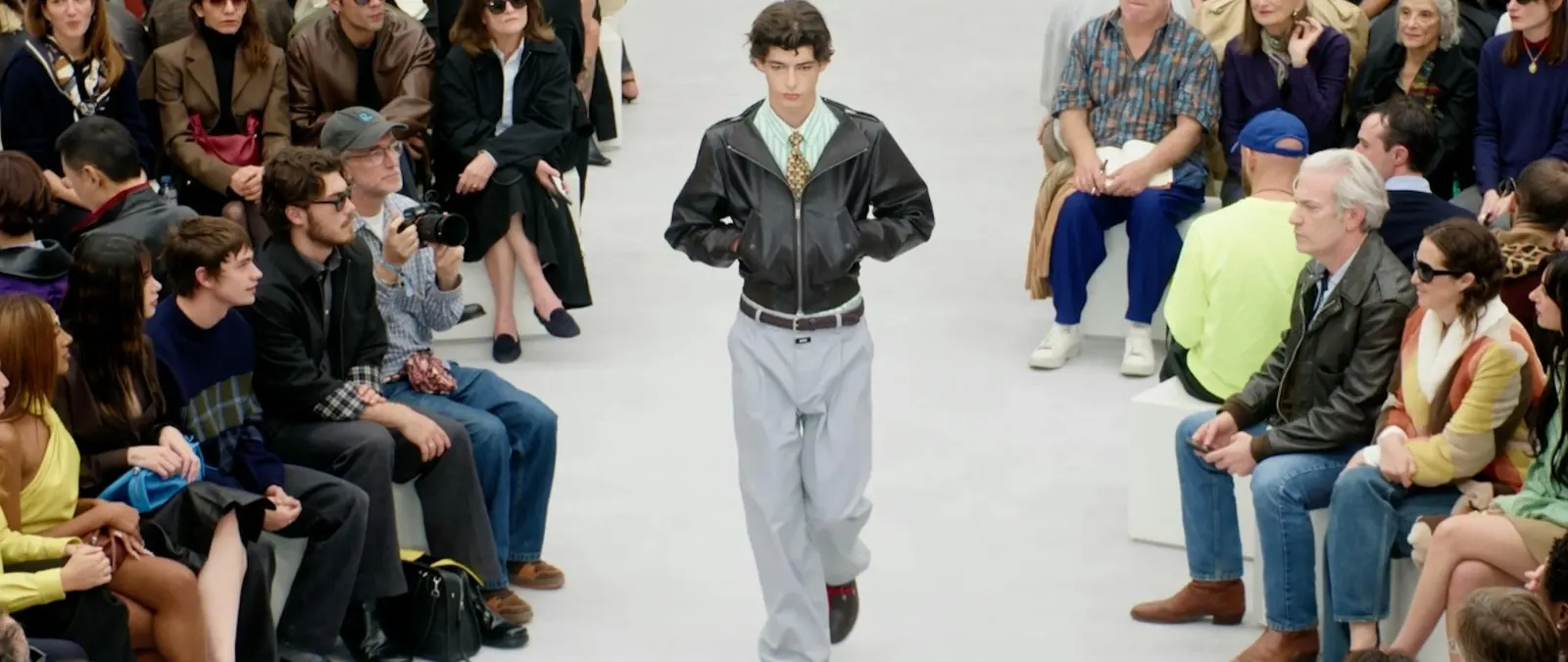
Loewe’s Spring–Summer 2027 collection under Jack McCollough and Lazaro Hernandez brings together two influences that could easily have pulled in opposite directions: the designers’ American relationship with sportswear and the Spanish Baroque references embedded in Loewe’s history. The result is a wardrobe that uses familiar shapes but repeatedly disrupts how they are cut, worn or decorated.
LVMH describes the collection through ideas of ease, presence and physicality. Rather than using heritage as a fixed archive to be reproduced, the designers treat it as material that can sit beside basketball jerseys, polos, silk anoraks and practical garments connected to everyday movement.
American archetypes are altered rather than simply borrowed
Polos are cut and worn backwards, while the outline of a basketball jersey appears in a chiffon slip dress finished with bead fringe. The references are recognisable enough to feel casual, but the change in material or orientation prevents them from reading as straightforward sportswear.
This tension matters because McCollough and Hernandez are working within a house known for leather craft and Spanish identity rather than an American athletic tradition. Their approach lets personal biography enter the collection without asking Loewe to abandon its own visual history.
Spanish Baroque arrives through colour and shape
The Spanish side of the collection appears through strong colour, faded patina, bleached hues and decorative flourishes that create movement around the body. Satin scarves flare from traditional taleguilla trousers, while exaggerated openings and splayed shapes at the waist introduce a sense of theatricality without turning the collection into costume.
Materials are also used for their physical sensation. Collars incorporate sunglass-like resin, silk anoraks are worn directly against the skin and glass beads add weight and movement to summer dresses, creating a wardrobe that depends on touch as much as on silhouette.
Leather goods continue to connect the collection to Loewe
The new Pasito bag and Puzzle Charm join the house’s established leather vocabulary, while a suede blazer revisits the first garment Loewe created in 1960. New nappa-leather pieces are cut into abbreviated trapeze dresses, turning one of the company’s most familiar materials into clothing rather than limiting it to accessories.
Silk ties are used as references to the brand’s past, but the overall effect is not nostalgic. The designers continually place old codes beside shapes associated with their own experience, suggesting that heritage is most useful when it can be reworked instead of simply preserved behind glass.
The collection argues for personality over uniform styling
Loewe frames the clothes around how a wearer lives and breathes, and that is visible in the refusal to settle on one narrow silhouette. Striped jackets, loose shirt dresses, fitted leather pieces and bead-woven dresses can coexist because the collection is organised more by attitude and material contrast than by a single repeated shape.
For luxury consumers, that approach reflects a wider shift away from obvious head-to-toe brand uniforms toward wardrobes built from highly individual pieces. Loewe’s Spring–Summer 2027 proposition is therefore less about prescribing one look than about giving the wearer enough distinctive objects and garments to construct a personal one.