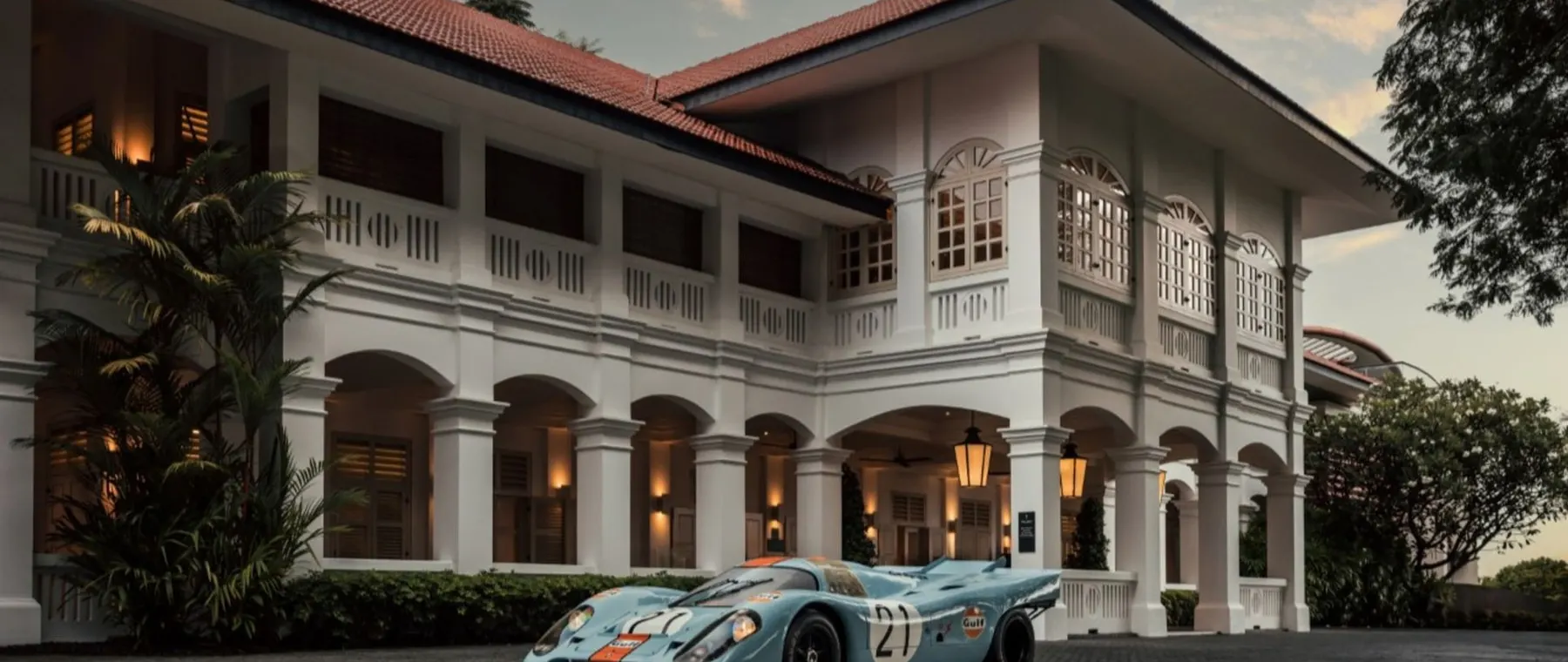
A celebrated race car in an unexpected setting
A Porsche 917 KH from the Porsche Museum travelled to Singapore for a series of photographic appearances and public displays associated with the 2026 Raceborn Fest. The car's presence offered enthusiasts a rare view of a historic endurance prototype against landmarks far removed from the European circuits on which it became famous. Porsche's regional newsroom described a tour through familiar city locations before the festival.
The Raceborn Fest was scheduled for 9 to 11 October, dates which have now passed. The original release was a preview, so its planned festival activities should not be described as newly forthcoming on 12 October. The confirmed report concerns the arrival of the car and the company's announced exhibition programme, without inventing attendance figures or final event results.
From Chinatown to Sentosa
Porsche arranged a photographic tour that took the low-slung racing machine through Singapore, including Chinatown and the Central Fire Station on Hill Street. The car travelled on a specially prepared flatbed rather than being driven through ordinary city traffic. That distinction matters both to accuracy and to the preservation of a valuable historic machine.
The tour concluded at Capella Singapore on Sentosa, where the car was photographed against the restored Tanah Merah building, once associated with British Royal Artillery quarters dating from the nineteenth century. The contrast between a purpose-built racing prototype and a conserved colonial structure gave the photographs an unusual sense of place. Both objects carry histories that reach beyond their present-day appearance.
The 917's place in Porsche history
The Porsche 917 helped secure the manufacturer's first overall victory at the 24 Hours of Le Mans in 1970. The short-tail Kurzheck configuration was developed in response to high-speed stability concerns that had affected early forms of the car. It became one of the most recognisable endurance-racing designs of the period, with a technical reputation matched by an enduring visual identity.
The Singapore visitor is a particular 1971 example rather than the winner of the 1970 Le Mans race. That distinction is essential because several 917 chassis competed with different teams and body configurations. Their histories cannot be combined simply because they carry the same model designation or a familiar Gulf-style livery.
An extraordinary record at Spa
The visiting car is associated with the 1971 Spa 1,000 km event, where Pedro Rodríguez and Jackie Oliver drove the number 21 Porsche to victory. Prepared by JW Automotive, the machine used a five-litre version of the air-cooled flat-twelve and aerodynamic features suited to the original high-speed road circuit. Porsche reports speeds around 350 kilometres per hour on the Masta straight.
The team completed the race at an average speed of 249.069 kilometres per hour including stops, a remarkable measure of sustained pace. That figure belongs to the historic Spa road course, not the modern circuit layout. It demonstrates why the car is remembered for both mechanical capability and team execution across a long-distance contest.
A bridge to Singapore's motorsport future
The car's presence accompanied Raceborn Fest, an event celebrating 75 years of Porsche Motorsport. The programme also highlighted a new 911 Challenge competition car and updates about the forthcoming Porsche Experience Centre Singapore. The latter has been described as a 2027 project, intended to bring more structured Porsche driving activities to the region.
Placing a celebrated prototype beside contemporary customer-motorsport plans creates a narrative spanning very different kinds of racing. Modern facilities may offer demonstrations and supervised experiences, while a priceless historic car is generally displayed and conserved. The two modes of engagement complement one another but should not be mistaken for the same activity.
Preserving the meaning of a machine
Historic racing cars attract attention through their appearance, but the deeper interest lies in a chassis's documented competition history, the people who operated it and the engineering choices that gave it a particular character. Exhibiting the 917 KH outside Europe helps new audiences encounter those details without having to travel to a manufacturer museum.
The verified story is the Porsche Museum car's Singapore appearance and the announced 2026 festival programme. Details of completed attendance and any subsequent exhibition arrangements should be checked in later official updates. The car's remarkable Spa victory remains the strongest reason to study this particular machine, regardless of the temporary location of its display.