Four Seasons' Greek Collection brought an unusual form of destination storytelling to Art Athina 2026, using contemporary art, scent and architectural history to explore the contrasting identities of the Athenian Riviera and Mykonos. The installation, titled Elemental Essence, was presented from 12 to 16 November at Onassis Ready in Athens, following an announcement on 26 October. Rather than offer a conventional model of a hotel or a simple gallery of photographs, the project invited visitors to consider the places through materials, moving images and specially created scents. The work was commissioned in connection with Four Seasons Astir Palace Hotel Athens and Four Seasons Hotel Mykonos. For luxury travellers interested in design and the Mediterranean, its importance lies in how hospitality settings can be interpreted as cultural landscapes rather than decorative backdrops.
Two Greek places, one curatorial idea
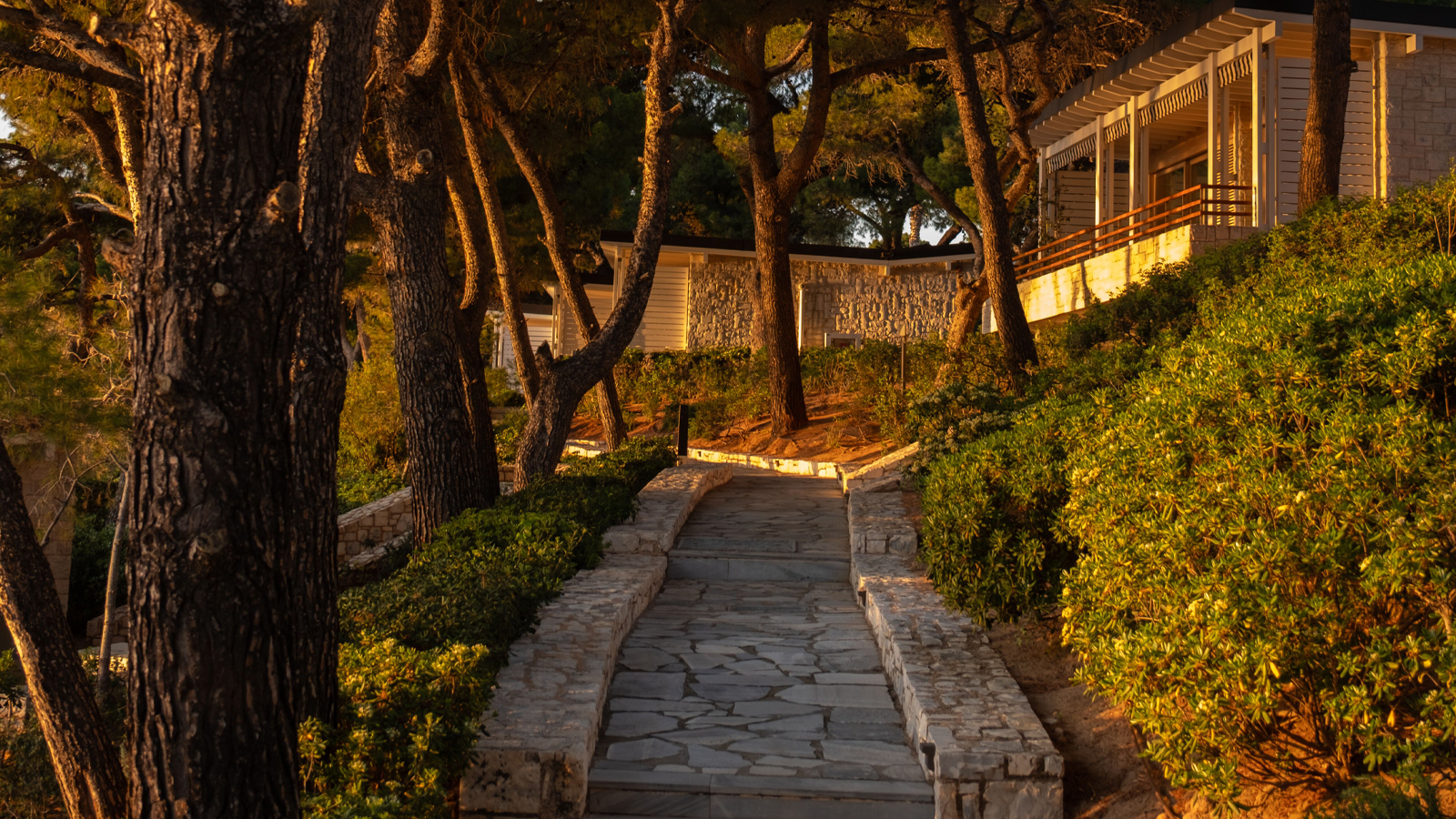
The installation was organised as two related environments, each reflecting a destination with a distinctive sense of place. Astir Palace occupies a pine-covered peninsula along the Athenian Riviera, where the architecture is associated with Greek modernism and the coastal leisure culture of the twentieth century. Mykonos brings a different visual language: whitewashed forms, hillside terraces, sheltered courtyards and the ever-present Aegean. Curator Claudia Paetzold used those contrasts to create connected but separate experiences rather than force the hotels into a single corporate aesthetic. This matters because two destinations can share a hospitality brand without losing their local characters. The strongest destination design begins by recognising what is already there, including climate, landscape and the history of how people have inhabited a place.
Empedocles and the four elements
The project's title and structure draw on the philosophy of Empedocles, who identified earth, air, fire and water as fundamental elements in his understanding of nature. The Four Seasons announcement says the concept informed an exploration of how architecture responds to the world around it. In a contemporary installation, such a framework works as a creative prompt rather than a scientific description of matter. Earth may be suggested through stone, vegetation and the weight of a building; air through movement, scent and the openness of a seafront space. Water and light provide other ways to connect art with the Mediterranean. The framework is useful when it helps visitors notice qualities of place that ordinary travel photographs can overlook. It should not be treated as a substitute for careful architectural or environmental analysis.
Sissel Tolaas brings smell into the gallery
Norwegian artist and chemist Sissel Tolaas created scent compositions following research visits to the two properties. Her work treats smell as a medium through which a place can be explored and remembered. For Astir Palace, the source material included the peninsula's pine environment; the Mykonos experience drew on its maritime atmosphere. Scent is a striking choice because it affects a visitor without requiring the visual concentration normally associated with an exhibition. A particular fragrance may evoke a landscape or memory, yet different people may respond differently to the same composition. The press release describes these works as sensory translations of their environments, not as exact laboratory replicas of the outdoors. That distinction leaves room for artistic interpretation, which is part of the point of the work.
Film and landscape at the Mykonos pavilion
Australian cinematographer Matthew Thorne contributed moving images examining architecture, light and landscape for the Mykonos element of the installation. In the pavilion, suspended translucent fabric and scent were combined with film to create a layered experience. The approach is appropriate to the island because its architecture is inseparable from intense sunlight, sea views and the way buildings follow the terrain. A static photograph can convey a striking whitewashed façade, but moving imagery can suggest shifting light, the passage of time and the relationship between an inhabited space and its surroundings. The use of film is particularly interesting for hospitality design, where a visitor's experience unfolds while moving through rooms, terraces and paths rather than from a single fixed viewpoint.
Astir Palace and the Athenian Riviera
The history of Astir Palace begins in 1960 on a forested cape in Vouliagmeni. According to the official exhibition announcement, architects including Emmanouil Vourekas, Periklis Sakellarios, Prokopis Vasileiadis and Konstantinos Dekavallas contributed to the site's development. The hotel became a defining address of the Athenian Riviera and entered the Four Seasons portfolio in 2019. The Art Athina display used archival material to trace this evolution, placing the contemporary property within a longer history of Greek coastal leisure. The archive was not simply nostalgic decoration. It helped explain how architecture and travel habits change over time and why some places continue to matter across generations. For visitors who appreciate design history, such context can make a hotel stay more intellectually satisfying.
Pine, material and the weight of place
The Athens half of Elemental Essence used sculptural forms, natural materials, scent and images to evoke the peninsula's vegetation and modernist architecture. Unlike a purely promotional presentation, this approach encourages viewers to think about the physical qualities of an environment: roughness, shade, scent, solidity and the relationship of structures to land. A successful installation can make those qualities tangible even to a visitor who has never stayed at the property. It also creates an interesting test for hotel design. If a destination's identity can be translated into materials and sensory details, then designers have a responsibility not to erase those same characteristics during future renovations. Authenticity is more convincing when it grows from the site rather than being applied as an interchangeable aesthetic.
Mykonos and the architecture of the hillside
Four Seasons Hotel Mykonos is set above Kalo Livadi Bay, with architecture by Greek architect Nikos Valsamakis. The hotel's whitewashed forms follow the contours of the hillside, using intimate courtyards and connected spaces that recall traditional Cycladic settlements. Landscape architect Helli Pangalou and her practice shaped planting and garden paths to integrate the buildings with their setting. The installation presented drawings and landscape studies that explained these decisions. This is useful because finished resort photographs often conceal the design process. Viewing the studies can reveal why a path turns, why a courtyard is sheltered or why a building's silhouette sits at a particular height. Such details can profoundly affect the guest's experience even when they are not consciously noticed.
Contemporary art as a travel conversation
Luxury travellers increasingly encounter art through hotels, restaurants and private residences as well as through galleries and museums. The Art Athina project demonstrates one way these worlds can meet without reducing the artist's role to supplying decoration. Tolaas's scent work and Thorne's films have their own creative methods; the hospitality settings provide their subject matter. Visitors can appreciate the work as interpretation rather than as a substitute for experiencing the destinations themselves. The collaboration also raises useful questions about commissioning: how much freedom do artists have, who owns the resulting work, and will it remain accessible after a short exhibition ends? The release does not answer every question about long-term display, so the five-day event should not be described as a permanent installation at either hotel.
Curator Claudia Paetzold's approach
Paetzold's stated interest is in work that connects to a place and in experiences that feel inhabited rather than merely exhibited. That ambition is especially relevant to hospitality, where guests move through designed environments without always knowing the history behind them. Art can slow down attention and make a familiar setting feel less predictable. A successful project gives the visitor room to form an individual response rather than insist on one predetermined meaning. For an audience of collectors and design-minded travellers, the choice of curator matters because it influences the relationship between commissioned artists and the host institution. The Four Seasons release identifies the participants and central ideas, but it does not present a complete critical assessment of the finished exhibition.
Art Athina as a meeting point
Art Athina was founded in 1993 and is among Europe's longstanding contemporary art fairs. Its programme brings together galleries, artists, curators and cultural organisations. Presenting Elemental Essence there placed a hotel-led commission in a setting where visitors might approach it with expectations different from those of ordinary travellers. Some may focus on the work's artistic qualities, others on architecture or the relationship between luxury and local culture. The event ran from 12 to 16 November 2026, and that schedule has now concluded. Readers should not confuse this retrospective account with an invitation to visit the installation today. What remains relevant is the example it offers of cultural collaboration between hospitality and the contemporary art world.
The appeal for Mediterranean yacht travellers
Athens and Mykonos are familiar destinations to people cruising the eastern Mediterranean, including owners of luxury yachts in the 12–24-metre class. But the experience of arriving by sea can easily encourage a narrow view based on berths, beaches and restaurants. The installation suggests another way to understand the coastline: by exploring the architectural ideas and sensory characteristics that make each location distinct. A traveller might pair a yacht itinerary with visits to cultural institutions, architecture walks and local artists' studios rather than relying entirely on conventional excursions. For a yacht owner planning an extended Greek season, such an approach can add depth to repeated visits. Specific mooring arrangements and sailing conditions must still be checked separately; an art project is not a navigational guide.
Scent and memory in travel design
Smell is closely linked to personal memory, which helps explain why it can play an unusually effective role in a destination installation. Pine, sea air and materials exposed to Mediterranean light may evoke an experience more immediately than a description of a building. But scent used deliberately in interiors also needs restraint. It can be distracting or uncomfortable to some people, and its perceived quality is subjective. The value of Tolaas's work is that it is presented as art, inviting reflection on how environments are experienced rather than prescribing a universal hotel fragrance. Designers and hospitality operators may find the idea instructive when considering how to create a strong identity without overwhelming guests with a formulaic sensory signature.
What this collaboration establishes
The October announcement and November presentation confirm a defined exhibition, held at Onassis Ready from 12 to 16 November 2026, with works involving Sissel Tolaas and Matthew Thorne under curator Claudia Paetzold. It brought together archival images, architectural studies, sculpture, film and scent to interpret Four Seasons properties in Athens and Mykonos. The five-day installation has ended; no ongoing public display at the two hotels is established by the release. For luxury lifestyle readers, it shows how a destination can be explained through creative disciplines rather than conventional hospitality promotion. The strongest result is a more nuanced appreciation of Greek coastal architecture, landscape and cultural memory—qualities that can enrich travel long after the exhibition itself has closed.
Sources and image credits: Four Seasons Astir Palace Hotel Athens and Four Seasons Hotel Mykonos original 26 October 2026 Art Athina announcement, including official Four Seasons Greek Collection press photography from the exhibition release. Exhibition dates and contributing artists are attributed to the organisers; interpretation of design, travel and collecting is independent Luxury Yacht Guide editorial analysis.
Sources and image credits
Reporting based on Four Seasons Greek Collection official 26 October 2026 Art Athina programme announcement.
Lead photograph: Four Seasons Astir Palace Hotel Athens modernist coastal property and walkway, original press photograph in the Art Athina 2026 announcement. Image: Four Seasons Astir Palace Hotel Athens, official Art Athina 2026 announcement gallery photograph of the property's landscape and walkway. Original official image source.