The maritime end of a Highland journey
Fort William occupies a striking position beside Loch Linnhe, with the mountains of Lochaber close to the town. For a yacht owner exploring western Scotland, it offers a rather different experience from the low-lying islands and coastal villages farther south. VisitScotland's Fort William guide identifies the town as a starting point for rail journeys, historic sites, mountain activities and exploration of the West Highland peninsulas. The geography gives the owner of a twelve-to-twenty-four-metre yacht an opportunity to plan a cruise in which the most memorable experiences ashore do not require the vessel itself to be moved every day. A suitable berth or other lawful and safe arrangement must first be confirmed for the individual yacht. Fort William's presence beside a large sea loch does not itself establish that every visiting vessel has access to an appropriate berth. The distinction is particularly important for owners planning a holiday with guests arriving by rail or road.
Loch Linnhe and the relationship between water and mountains
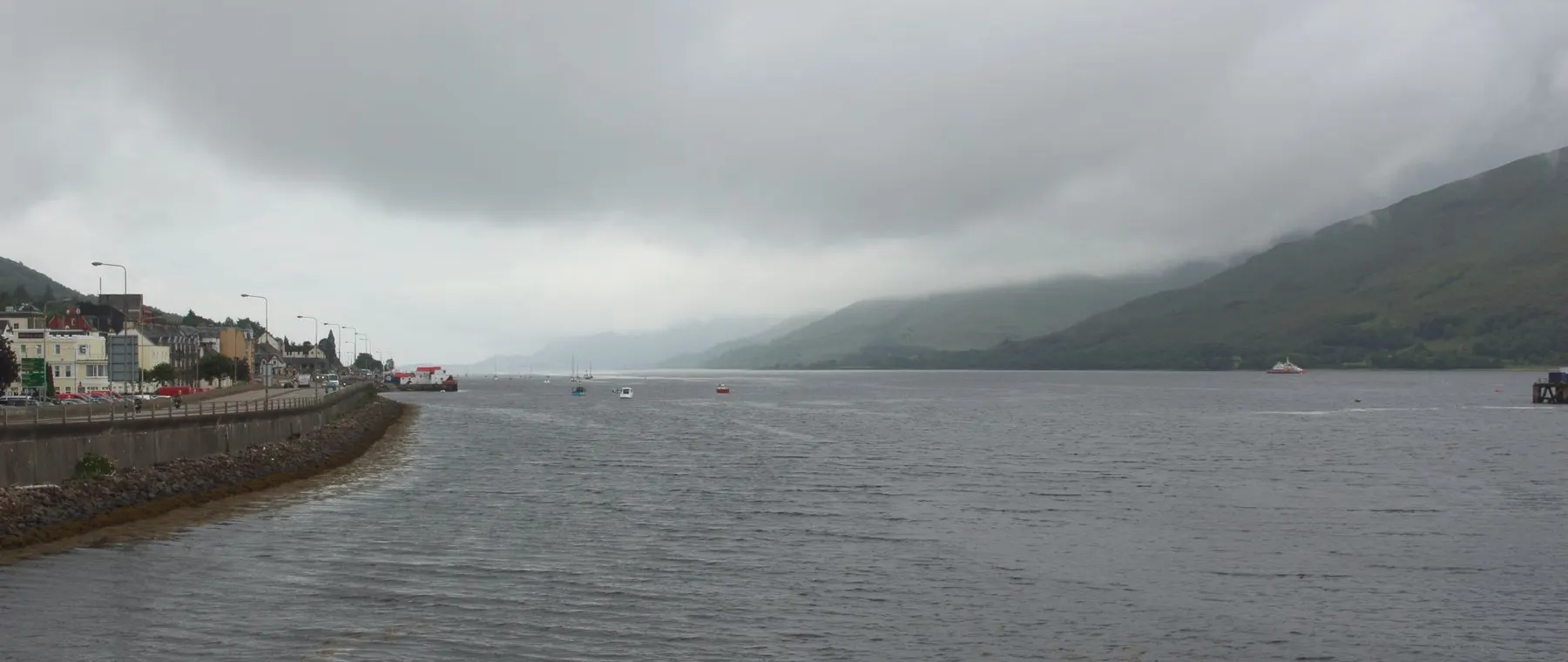
The accompanying photograph by Graham Robson depicts Loch Linnhe at Fort William. The scale of the surrounding landscape is one of the attractions of visiting Lochaber, whether the guests arrive by yacht or see the loch during an independent land excursion. The mountains give the water a changing visual character as clouds, light and precipitation move across the area. At the level of the yacht, the same geography demands appropriate attention to weather and the particular conditions of a planned route. A sheltered-looking loch is not necessarily free from strong winds, and a captain must evaluate the actual forecasts and navigation information rather than use the appearance of the water in photographs. For passengers interested in landscape photography, the change in perspective between the waterfront, higher ground and the railway can provide several distinct subjects. A flexible visit gives them more opportunity to appreciate that variety than a programme constructed around a single arrival and immediate onward departure.
Arriving and departing by Highland railway
VisitScotland identifies the town's rail connections, including the Caledonian Sleeper and ScotRail services, as options for travellers. These links are especially useful when some members of a family wish to join an established cruise rather than remain aboard for the whole of it. The opportunity to arrange independent land travel gives a captain more freedom to decide whether a particular passage is appropriate. It also makes it possible to design a Scottish holiday in which a journey by railway has its own appeal rather than serving merely as transportation to the yacht. The actual timetable, availability of accommodation aboard the sleeper and the logistics of carrying luggage must be confirmed before booking. Passengers joining a yacht should also know exactly where their shore transfer is intended to end, because the most suitable arrangement for the vessel may be outside the centre of the town. Owners should avoid making the boat's movement dependent on an inflexible passenger arrival time.
Glenfinnan and the railway seen in its landscape
The regional visitor guide identifies the Jacobite steam train and Glenfinnan Viaduct as notable experiences during the summer. The appeal of such a railway journey is not confined to the associations of the viaduct with films. The line crosses a landscape in which the engineering of a transport route and the shape of the terrain can be appreciated together. For visitors accustomed to travelling primarily by sea, it is a reminder that land transport has its own constraints, which have influenced the construction of bridges, cuttings and station facilities. A family interested in photography might plan a visit to the area separately from a train journey, taking account of access arrangements and the conditions at any chosen viewpoint. Neither a published tourism description nor previous operating patterns guarantee a particular steam service on a future date. Check current timetables and ticket conditions directly, particularly when considering a journey during the quieter months of the year.
The West Highland Museum and a historical town
VisitScotland recommends the West Highland Museum as a way to explore the history and archaeology of the region. Its collections introduce subjects including the Jacobite period, the siege of Fort William and the appearance of the town in earlier generations. These subjects give an interesting historical context to the modern experience of travelling through Lochaber. Guests who have observed the coastline from the yacht can consider how different forms of transport, settlement and political power shaped the wider region. A museum day is also a sensible complement to a holiday otherwise dominated by outdoor activities. It allows people with different levels of fitness to participate in a shared excursion without requiring them to undertake a demanding walk. The current opening information and the availability of particular displays should be obtained from the museum. The regional guide describes the scope of the institution, not a guarantee that all objects will be accessible during a particular visit.
Ben Nevis and outdoor activities arranged on their own terms
The presence of Britain's highest mountain contributes substantially to the character of the surrounding area. Fort William's official tourism information highlights Ben Nevis, Glen Nevis, the Great Glen Way and West Highland Way, as well as guided outdoor activities and the Nevis Range. For owners organising a visit with active guests, the range of possible experiences is useful. Some passengers may wish to undertake a substantial mountain walk, whereas others may prefer a shorter outing in a valley. Mountain weather and terrain differ from the conditions encountered at the waterfront, and the people arranging an excursion should assess the actual route and level of experience required. A guide may be appropriate, especially for unfamiliar terrain or winter conditions. The yacht's captain is not necessarily qualified to lead a mountain activity merely through holding professional maritime qualifications. Arrange appropriate expertise ashore and choose an itinerary that does not require every guest to participate in the most demanding outing.
A winter festival as a reason for a land-based return
The official Fort William destination information currently lists the Mountain Festival for 11–14 February 2027, with talks, films, workshops and guided experiences among the planned activities. The timing gives a possible reason for a separate winter visit to Lochaber. It should not be interpreted as an encouragement to undertake a winter yacht passage simply to coincide with those dates. Owners may be able to return to the area by suitable land transport while their vessel remains at an appropriate seasonal base. Before making commitments, consult the festival's current programme and the booking conditions for any activity of particular interest. The opportunity to revisit a coastal location in a different season is one of the pleasures of developing a longer relationship with a cruising region. A summer visit can focus on travel afloat, while a winter trip gives guests another perspective on the mountains, cultural programme and residents' experience of the area.
Nevis Range and different ways of enjoying the high ground
VisitScotland describes gondola rides, walking, cycling, winter sports and other activities at Nevis Range. The appropriate choice varies considerably with season, weather, the interests of the group and the arrangements actually operating. A family travelling together need not make identical activities the centrepiece of the holiday. Those wishing to explore the high ground can arrange an excursion while others remain in the town or spend time aboard. Equipment, transport, supervision and the suitability of activities for children should be established with the responsible operator. Access to a gondola does not prove that an arbitrary mountain route beyond its station is suitable for a casual visitor. Discuss the specific experience intended, and check the actual conditions on the chosen day. The value of the destination is the ability to combine mountain experiences with the comforts of a privately arranged holiday rather than attempt to include every available activity in one fixed schedule.
Making Lochaber part of a considered cruising itinerary
A rewarding visit can combine a day devoted to the town and its museum with a railway excursion or a separate exploration of one of the valleys. The length of time spent in the area will depend on the yacht's confirmed arrangements and the interests of those travelling. Owners should not assume that the yacht can remain at an unspecified position on Loch Linnhe while they undertake a lengthy land itinerary. Establish the responsibilities for the vessel, the practical shore connection and access to essential services. Use current authoritative charts and local information when planning any subsequent passage. A photograph of Loch Linnhe provides a record of the region's scenery, not navigational clearance. Fort William's particular attraction is that it brings together the perspectives of a contemporary yacht journey, a historic railway and a dramatic Highland landscape. Allowing time for all three can make the visit substantially richer than treating the town as a brief stop before continuing elsewhere.
Sources and photograph
Source documentation: https://www.visitscotland.com/places-to-go/fort-william. Photograph: Loch Linnhe, Fort William — Graham Robson / Wikimedia Commons, CC BY-SA 2.0. Resized for web display under CC BY-SA 2.0.