Begin with the race documents
Preparing a 12–24m sailing yacht for its first offshore regatta starts long before the warning signal. The Notice of Race, Sailing Instructions and event-specific safety requirements determine what a boat must carry, who is eligible and when inspections may take place. A skipper familiar with comfortable coastal cruising should not assume that ordinary leisure equipment automatically meets the rules for an offshore event.
World Sailing publishes the Offshore Special Regulations, while the organising authority specifies which category and additional conditions apply to its particular race. Read those documents together rather than relying on a checklist copied from another event. A boat competing in a short coastal race may have different obligations from a yacht entering an extended offshore passage. Record the relevant requirements and identify who is responsible for satisfying each one.
Give the boat a genuine systems review
A survey suitable for a holiday purchase is not the same as preparing a yacht for sustained racing use. Review standing and running rigging, steering, deck hardware, keel attachments, bilge systems, electrical supply, fuel arrangements and engine reliability with the people qualified to inspect them. Check when critical equipment was last maintained and whether any repair remains outstanding. A practical preparation plan starts with defects, not new accessories.
A yacht that has performed reliably on short summer trips may encounter higher repeated loads when carrying sail for longer periods. Examine chafe points, winch operation, attachment points and the condition of important sails. Where specialist work is needed, book it early enough to test the result. A departure deadline is not a good reason to postpone safety-critical maintenance or accept uncertainty about a component.
Treat safety gear as working equipment
The Offshore Special Regulations address items such as personal flotation, communications, emergency location equipment, emergency steering, fire protection and arrangements for recovering a person overboard. The precise provisions vary with the event category and the yacht. Assemble a category-specific inventory, check service dates and demonstrate that critical items can actually be reached and operated in their stowed positions.
Crew members should understand where emergency equipment is kept and how to use it, not merely know that a certificate exists. Inspect harness attachment arrangements and discuss appropriate personal equipment for night watches and poor weather. An offshore yacht is a small working environment, so inaccessible lockers and unfamiliar controls can turn a minor problem into a major one. Practical rehearsal makes a far more useful preparation exercise than a box-ticking inspection.
Build a watch system the crew can sustain
Longer races expose the weakness of a watch plan designed only around the start and finish. Assess experience, physical condition and the number of people needed for ordinary manoeuvres, sail changes and unexpected events. Assign essential roles before departure, including navigation, helm, sail handling, catering and engine checks. Rotate duties so that the same capable crew member does not become permanently indispensable.
A proper briefing should explain how to call assistance, respond to a person-overboard incident, wake the off-watch crew and communicate a change of course or weather. Encourage sailors to speak up early about fatigue and unfamiliar tasks. Even a technically well-prepared yacht can become unsafe if the crew has not rehearsed operating together. Training outings with full kit and realistic watch periods reveal weaknesses that a dockside meeting will not.
Make navigation a shared responsibility
Electronic chartplotters, routing software and weather forecasts are valuable, but no single screen should become the only source of navigational confidence. Establish a primary and backup method for fixing the yacht’s position and keep navigation information current. Check any race restrictions, traffic separation schemes, local notices and potential hazards along the course. If the race uses designated waypoints, verify them against the definitive event documents.
Navigation responsibilities must be clear when the person normally at the plotter goes off watch. Agree what must be recorded, who checks the track and under which conditions the skipper is called. Visibility, fishing activity and commercial traffic can make short stretches of water particularly demanding. Rehearsing a loss of instruments or an unexpected route change is useful even when the planned course appears straightforward.
Plan food, rest and weather decisions
A good offshore crew cannot function on optimism and energy drinks. Provision for the expected duration with reserve food and drinking water, and make sure meals can be prepared when the yacht is heeled or moving vigorously. Check that bunks can be used safely and that warm, dry layers are accessible after a wet watch. People who have not slept properly will struggle to make measured decisions.
Weather routing is more than selecting the fastest predicted line. Discuss the conditions the yacht and crew are prepared to accept, establish thresholds for reducing sail and agree when an alternative plan or withdrawal is appropriate. Forecast uncertainty grows over time, and a race result should never outweigh the need to keep the vessel under control. Good seamanship includes making an early conservative call when circumstances change.
Test the whole arrangement before race day
A useful shakedown includes extended sailing with the actual race crew, not just a brief engine run outside the marina. Raise and reef sails, make sail changes, practise person-overboard recovery, operate communications and check electrical consumption overnight. Verify that loose equipment remains secure and that every crew member can find essential items in poor light. Use the outing to refine the stowage plan and identify repairs.
On return, write up what worked and what did not, then close out the important findings. A missing torch, uncomfortable harness point or confusing switch panel is easier to address at the home berth than at sea. Recheck the vessel after any substantial maintenance. Small operational improvements often contribute more to a successful first event than ambitious changes to performance equipment.
Choose a manageable first event
A smaller offshore regatta can provide an excellent introduction to racing and crew teamwork, but the entry should match the yacht’s condition, classification and the experience aboard. Contact the organisers if eligibility or equipment wording is unclear. Insurance coverage and any rating or measurement documentation should be checked well before final registration. Owners who want support can seek experienced race crew and a suitably qualified skipper.
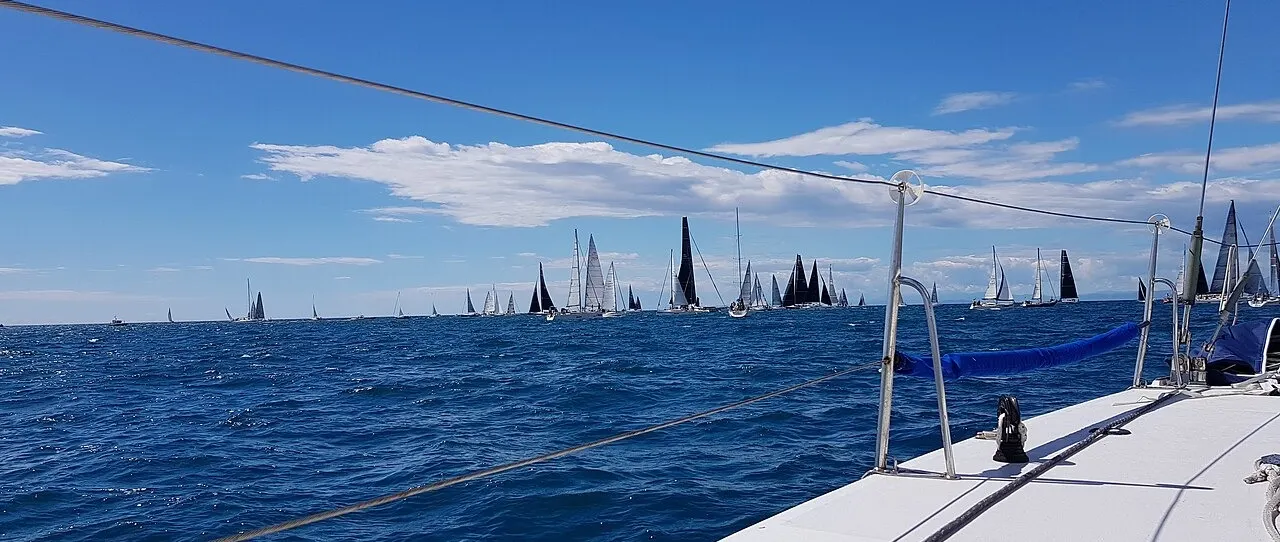
This guide uses World Sailing’s Offshore Special Regulations and Royal Ocean Racing Club resources as reference points; the organising authority’s current documents always take precedence. The photograph records yachts assembling at the start of the 151 Miglia regatta on 30 May 2019. Photographer ElettraSwanLake released it under Creative Commons Attribution-ShareAlike 4.0; it has been resized for this editorial illustration.