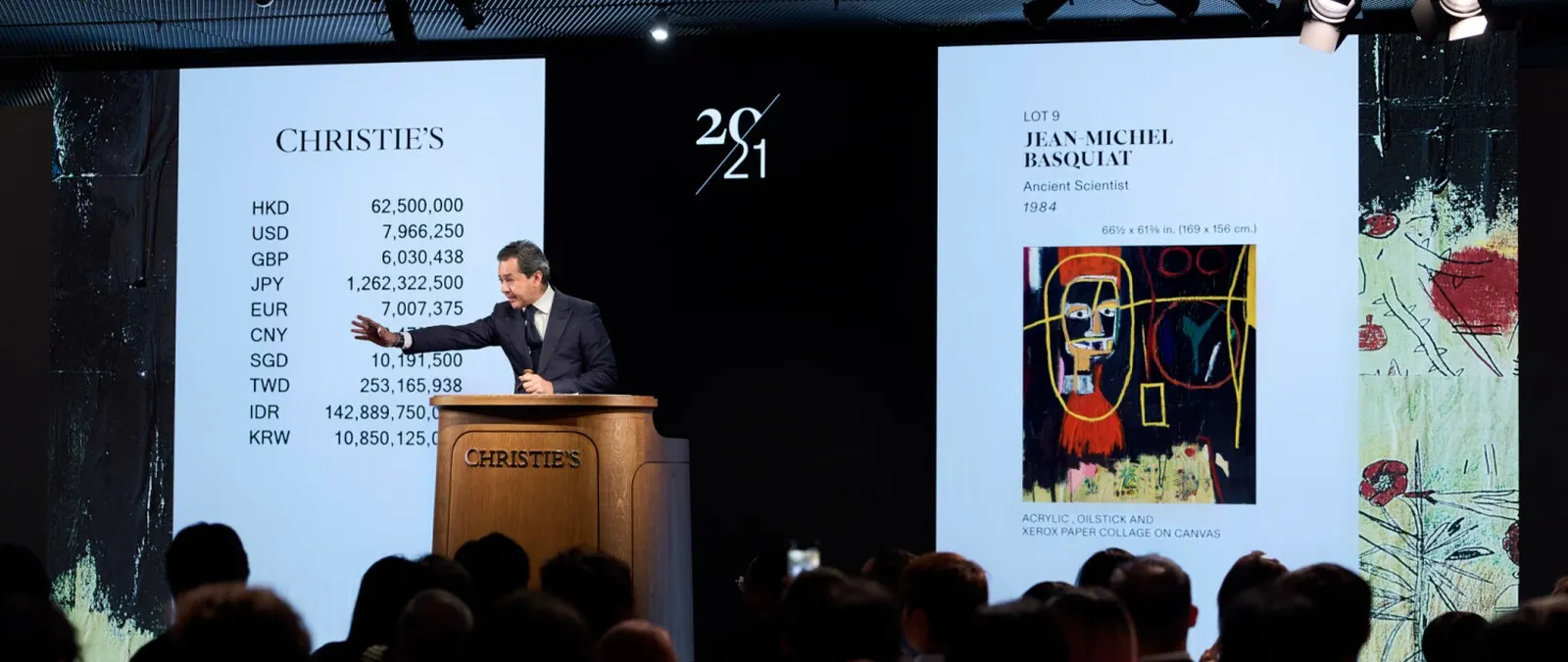
Christie’s Hong Kong has closed its 20th/21st Century autumn sales with a combined total of HK$956.5 million, approximately US$121.9 million. The result was led by a fully sold evening auction and Jean-Michel Basquiat’s Ancient Scientist, which realised HK$76.975 million and became the most valuable lot sold in Asia during the autumn season at that point.
The auction house says its 2026 running total for the category in Hong Kong has reached HK$1.85 billion. Beyond the headline figure, the results offer a useful view of how demand is developing across modern and contemporary art in Asia, particularly as younger buyers and collectors from a wide range of countries become more visible.
Basquiat provided the season’s top price in Asia
Ancient Scientist sold for just under HK$77 million, giving Christie’s a major contemporary-art result while reinforcing Basquiat’s continued global market strength. His work has long attracted buyers across North America, Europe and Asia, making a strong Hong Kong result relevant well beyond the regional auction calendar.
The price is also significant because the market has become more selective after several years of rapid growth. Buyers are still prepared to compete aggressively for works with strong artist recognition, quality and provenance, even when secondary material receives more cautious bidding.
The evening sale achieved a complete sell-through
Christie’s reported that every lot in the evening sale found a buyer. A 100 per cent sell-through rate is an important confidence signal because it shows that estimates, consignor expectations and demand were aligned closely enough for the entire catalogue to transact.
Strong sell-through can matter as much as one exceptional top lot. It suggests depth across price bands and gives consignors evidence that the market is functioning for more than a handful of trophy works.
Buyers participated from 36 countries
Christie’s says bidders and buyers came from 36 countries and regions, underlining Hong Kong’s role as an international rather than purely domestic market centre. The city’s position is strengthened by the concentration of auction houses, galleries, fairs, private banks and collectors who use Hong Kong as a gateway to wider Asian markets.
That international participation can also make price discovery more robust. When several geographic buyer groups compete for the same artists, results are less dependent on the confidence of one local market or currency cycle.
Younger collectors are becoming more important
Millennial and Generation Z collectors represented a meaningful share of new buyers during the season. Auction houses have spent heavily on digital bidding, social content and lower-friction online access, and the demographic shift suggests those channels are beginning to translate into real purchasing behaviour.
Younger buyers do not necessarily collect the same artists or categories as established clients. Their participation can broaden demand toward contemporary voices, design-led objects and cross-category collecting while also creating future clients for higher-value sales as collections mature.
Hong Kong remains central to the Asian art market
The autumn results arrive as competition increases among auction centres across Asia and the Middle East. Hong Kong still benefits from decades of specialist infrastructure and an established collector base, but it must continue attracting consignments and global buyers as new cultural hubs develop elsewhere.
Christie’s HK$957 million total suggests the city retains substantial market weight. For collectors, however, the more useful message is the combination of strong sell-through, international participation and demand for top-quality work rather than the aggregate figure alone.