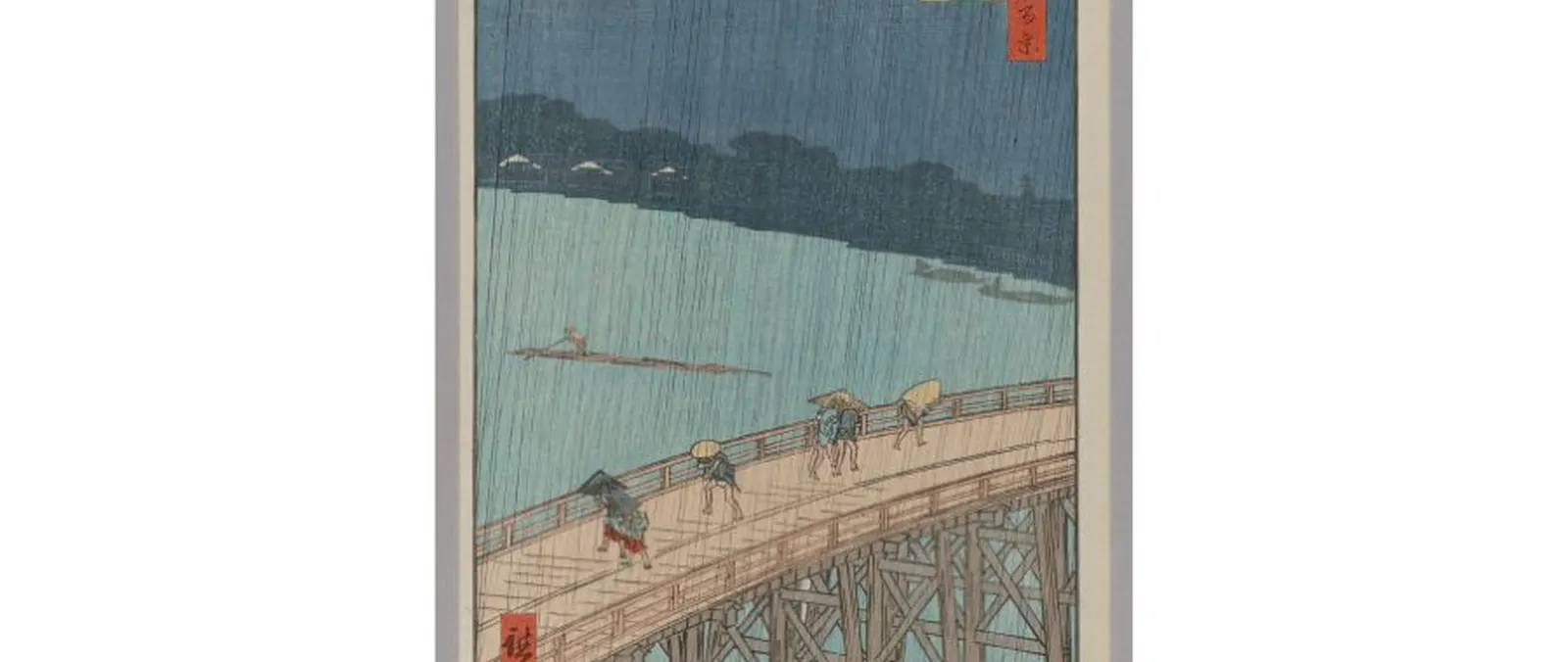
Christie’s will bring more than 180 prints by Utagawa Hiroshige from the Alan Medaugh Collection to New York on September 15, beginning a three-sale dispersal of one of the most important private Hiroshige collections formed in the United States. Medaugh assembled more than 600 sheets over roughly half a century, focusing on early impressions, vibrant colour and condition rather than simply collecting the most famous titles.
The first auction, Hiroshige: Colors of the Four Seasons, places the Japanese master’s landscapes, travel scenes and seasonal imagery at the centre of Christie’s Rockefeller Center programme. For collectors, the sale offers the rare opportunity to see a large group formed by one connoisseur before the works separate into new collections.
Early impressions were central to Medaugh’s collecting approach
Woodblock prints exist in editions, but not every impression is equal. As blocks were repeatedly printed, lines could soften, colours could change and later publishers might alter details, making early impressions particularly desirable when they retain crisp carving and the artist’s intended colour relationships.
Medaugh built the collection with close attention to those distinctions. Rather than treating a Hiroshige image as interchangeable with every other example of the same design, he sought sheets where printing quality, colour and condition allowed the original visual impact to remain unusually strong.
Sudden Shower over Shin-Ōhashi Bridge is among the major highlights
One of the leading works is Ohashi Atake no yudachi, often translated as Sudden Shower over Shin-Ōhashi Bridge and Atake, from Hiroshige’s celebrated One Hundred Famous Views of Edo series. Christie’s has estimated the sheet at $50,000 to $100,000, reflecting both the importance of the image and the quality of the impression.
The composition is one of Hiroshige’s best-known demonstrations of weather as structure. Slanting rain cuts across the scene while figures hurry over the bridge and the far riverbank recedes into mist, turning an everyday moment into an image of movement, atmosphere and urban life.
Seasonal change gives the collection its organising idea
Hiroshige repeatedly returned to snow, rain, moonlight, blossom, autumn colour and changing skies. These were not simply decorative effects; they allowed him to show how familiar places could feel completely different according to season, hour and weather.
The title Colors of the Four Seasons therefore reflects a real thread through the artist’s work. Medaugh’s collection lets viewers compare how colour and printing technique were used to create cold, heat, humidity or stillness, making the natural cycle one of the most coherent ways to understand Hiroshige’s visual language.
More than 600 sheets give the collection unusual depth
Building a group of more than 600 Hiroshige prints requires patience because quality examples appear unevenly across the market. A collector seeking early states and strong colour may wait years for a superior version of an image rather than accepting the first available sheet.
That depth also allows a collection to move beyond famous masterpieces. Lesser-known designs can reveal experimentation, regional subjects and compositional ideas that are harder to appreciate when Hiroshige is represented only by a few iconic views.
The sale is the beginning of a longer dispersal
Christie’s plans three auctions from the Medaugh holdings, meaning the September sale is only the first chapter. Spreading the material across several events gives specialists more time to study the collection and allows different themes and series to receive attention rather than compressing hundreds of works into one catalogue.
For buyers, the strongest attraction is the combination of connoisseurship and provenance. These prints were not assembled quickly around market fashion; they were selected over decades by a collector who studied impression quality closely, giving each successful bidder a work connected to a larger history of sustained looking.
Hiroshige remains central to the global understanding of Japanese art
Hiroshige’s influence extended far beyond nineteenth-century Japan, shaping how European artists and collectors understood composition, cropping, flat colour and atmospheric landscape. His prints were studied by artists associated with Impressionism and Post-Impressionism and became important to the broader history of Japonisme.
The Medaugh sale therefore sits at the intersection of Japanese art and global modern visual culture. Once the collection disperses, individual sheets will begin new ownership histories, but Christie’s catalogue will preserve the record of a remarkable attempt to understand Hiroshige through hundreds of carefully chosen impressions.