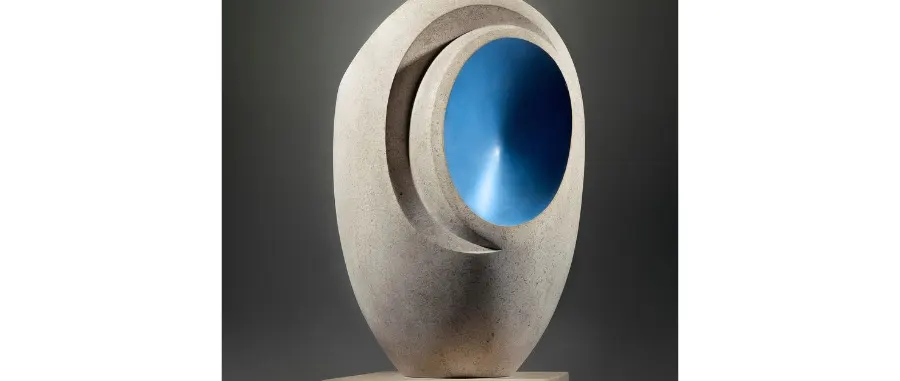
A major Hepworth sculpture returns to market
Christie's has announced that Sculpture with Colour (Eos), a work carved and painted by Barbara Hepworth in 1946, will lead its Modern British and Irish Art Evening Sale in London on 21 October 2026. The piece carries an estimate of £5 million to £8 million. The auction follows a recent exhibition appearance at the Courtauld Gallery and places a significant example of Hepworth's approach to colour and form before collectors.
An estimate is not an auction result, and the work has not yet been sold in the forthcoming event. The timing is important because the piece was recently accessible in a public museum setting, where visitors could consider its art-historical qualities without the immediate pressure of bidding. The two contexts reveal different aspects of the same sculpture.
Colour moves into carved space
Hepworth is strongly associated with modern sculpture that explores the relationship between material, empty space and the surrounding environment. In Eos, three hollow areas are painted blue, grey and white, creating distinct zones of colour within the carved form. The treatment makes colour an active part of the structure rather than an embellishment applied after the sculptural decisions were complete.
These hollows change as light and a viewer's position change, encouraging movement around the work. For collectors, reproductions provide only a partial idea of that effect. The meeting of painted interiors and carved surfaces is central to understanding why Christie's has identified this as a landmark example of Hepworth's development.
The significance of the year 1946
The work was created soon after the Second World War, during a period of social and artistic change in Britain. Its name, Eos, refers to the dawn in classical mythology, a title that invites consideration of light and renewal. Christie's places the sculpture at a pivotal stage in Hepworth's career, when the artist was developing the possibilities of colour and spatial relationships.
It is tempting to assign one fixed symbolic meaning to a work with such a title, but interpretation should remain open to evidence and direct observation. The sculpture can be examined through materials and formal decisions as well as through historical context. Those approaches make for a more grounded appraisal than treating the title as an exact explanation of the artist's intentions.
A history involving Lee Miller and the Courtauld
Christie's notes that Lee Miller photographed Hepworth in her studio for Vogue shortly after the sculpture was completed, with Eos visible nearby. The work was associated with the Lefevre Gallery in 1946 and was included in the Courtauld Gallery's Hepworth in Colour exhibition, held between June and September 2026. That recent public display helped bring attention to the artist's use of painted surfaces.
Exhibition history is valuable because it shows how a work has been discussed and displayed over time. It does not by itself determine market value, but it can provide context for provenance and scholarship. A buyer considering an important sculpture should examine the full exhibition and ownership records rather than rely on a few memorable images.
Where visitors can see it before the sale
Christie's has scheduled a London viewing through 14 October as part of its marquee-week programme, followed by another viewing from 17 to 21 October during the Modern British and Irish Art exhibition. Both periods were announced as free to the public. Visitors should confirm access details, because exhibition schedules and availability can change near a major auction.
Seeing the sculpture directly gives a better understanding of its scale, contours and painted recesses. Even viewers who have no intention of bidding may find the chance worthwhile, particularly if they recently encountered Hepworth's work in a museum. A public preview places a major object in a setting where both collectors and interested visitors can examine it.
A test of expectations on 21 October
The official estimate of £5–8 million establishes the auction house's expectations, not a guaranteed price or evidence of a record result. The outcome will depend on bidders, condition, provenance and the market on the evening. Those uncertainties are especially important when a single work is the subject of considerable advance publicity.
The verified news is the announcement, date, estimate and available exhibition history of Sculpture with Colour (Eos). Its importance as a work of British modernism does not depend solely on the eventual auction figure. The sale will provide an additional chapter in a history already shaped by museum exhibitions, photography and artistic scholarship.