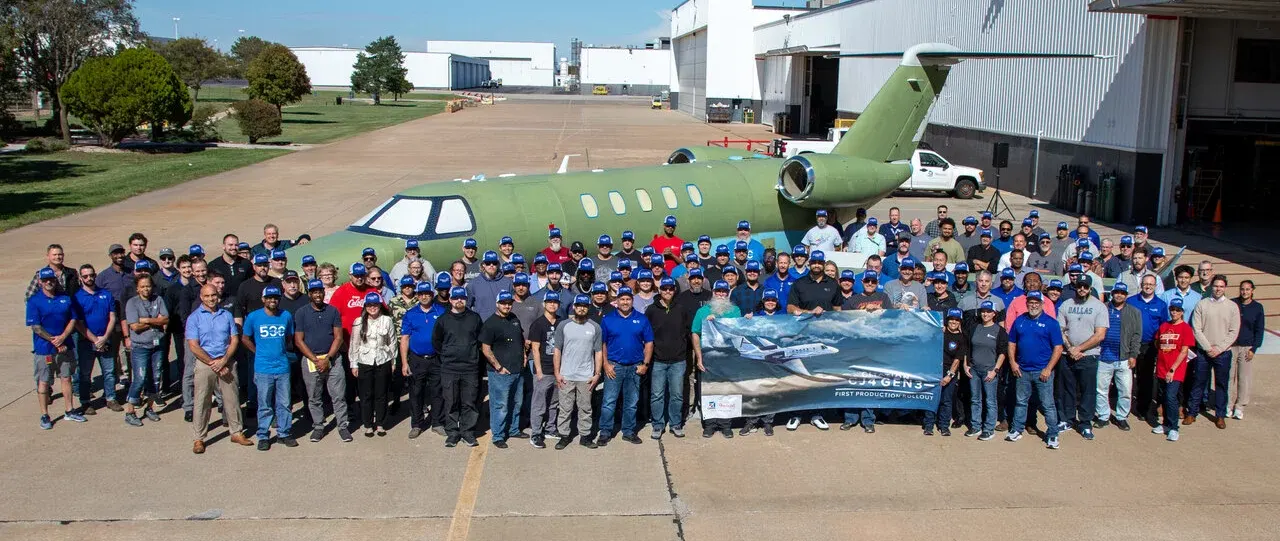
A production milestone for a light business jet
Private aviation is often discussed through the passenger experience: the freedom to choose a departure time, a quieter cabin and a direct journey to a destination that may be inconvenient by scheduled airline. Behind that flexibility sits a demanding programme of aircraft design, testing, certification and manufacturing. Cessna's latest milestone is a reminder of what must happen before a new-generation private jet can enter service.
On 20 October 2026, Textron Aviation announced that the first production Cessna Citation CJ4 Gen3 had rolled out at its Wichita, Kansas, factory. The company describes the aircraft as progressing towards entry into service, with a refreshed flight deck and additional technology aimed at pilot workload and situational awareness. A production rollout is not the same as a customer delivery or the completion of certification, and the distinction is central to this story.
What changes inside the cockpit
The CJ4 Gen3 is planned to feature Garmin G3000 PRIME avionics, a next-generation flight-deck arrangement built around advanced display capability and intuitive touchscreen interfaces. For the pilots, the intended advantage lies in organising information and controls so that vital tasks are easier to manage at the appropriate moment. The manufacturer's announcement presents this as part of a broader customer-driven update rather than an isolated new screen.
To passengers, cockpit interfaces are largely invisible. Their importance becomes clearer when considering the relationship between workload, flight planning and the ability to monitor changing conditions. Better presentation of information can support the crew, although no digital system removes the need for training, correct procedures or experienced judgment.
The Gen3 designation is therefore more meaningful than a styling exercise. It groups changes to systems and operation under a new version of an established light jet. Prospective owners should still verify the exact aircraft configuration, equipment approvals and delivery timetable with the manufacturer instead of assuming every announced function is already available on a production aircraft.
The significance of Emergency Autoland
One of the most closely watched elements is Garmin Emergency Autoland. Textron Aviation says the CJ4 Gen3 is expected to be the first light jet to market equipped with the system, which is designed to take control if the pilot becomes incapacitated. In the described emergency scenario, the system would identify a suitable airport, conduct an approach, land and bring the aircraft to a stop.
That description concerns a safety capability for a specific emergency, not an invitation to operate routine private flights without a qualified pilot. Emergency Autoland must be understood in the context of the aircraft's certification, operating procedures and approved equipment. Owners should not treat an expected future function as a substitute for crew readiness or the regulatory requirements applicable to a particular flight.
For a family or business owner evaluating private travel, the feature nevertheless raises an important question about design priorities. Luxury is not only the softness of a seat or the finish of a cabin. It also includes the depth of engineering and the consideration given to unusual situations that passengers hope never to experience.
The CJ4 Gen3's proposed performance envelope
Textron Aviation gives the new aircraft an expected maximum range of 2,165 nautical miles and a maximum cruise speed of 451 knots true airspeed. It also describes seating for up to eleven occupants and a useful load of 6,930 pounds. Those published numbers are planning specifications rather than a guarantee of a specific journey with full seats, luggage and reserves.
Real-world range depends on factors including fuel, passenger payload, winds, weather, airport performance requirements and the operating rules applied to the trip. A prospective flight from a home airport to a coastal resort must be considered with those factors in mind. A maximum headline distance cannot tell an owner where a particular aircraft can reliably fly on a given day.
The CJ4 family occupies an interesting place in private aviation because it promises the scale and convenience of a light jet without the complexity of a much larger cabin aircraft. Whether that balance suits a traveller depends on luggage, preferred routes, flight frequency and the comfort expected during longer sectors. A professional aircraft comparison should include all of those practical considerations.
Why single-pilot capability is discussed
The manufacturer describes the CJ4 Gen3 as single-pilot certified, a characteristic of the platform's intended operating role. For some owner-operators, that can be an important consideration when evaluating aircraft size and operational flexibility. It should not be confused with a recommendation that every owner fly without a second professional pilot.
Operational decisions depend on qualifications, current competency, insurance terms, route complexity and the owner's risk preferences. Many private-flight passengers will never operate the aircraft themselves and will simply want an appropriately qualified crew to provide a dependable service. The value of the aircraft's design is in offering possibilities within the framework of safe, regulated operations.
The aircraft also has potential uses beyond carrying executives and holidaymakers. Textron points to the broader CJ4's record in roles such as air ambulance, maritime patrol, search and rescue, and aerial survey. That versatility helps explain why manufacturing and support considerations remain prominent even when the aircraft is presented through luxury travel.
From factory rollout to a service-ready aircraft
Textron describes the October event as a celebration involving production teams in Wichita. It highlights the transition from design intent to a completed production unit, while the programme continues towards its next requirements. Photographs of the rollout record a real aircraft and the employees who built it, rather than a purely digital proposal.
Aircraft development proceeds through a sequence of engineering work, testing, regulatory review and customer acceptance. The precise stages vary by programme, and one public milestone should not be taken as evidence that all remaining work has been completed. That caution is especially important when a new safety system is among the most widely discussed features.
For owners and charter travellers, the practical question is when particular airframes, crew training and operating approvals will be ready. The factory milestone provides useful evidence of progress, but a booking or purchase decision should rely on current information from an authorised operator or the manufacturer. An attractive specification is only part of the overall travel proposition.
What private travellers can learn from the Gen3
Private aviation works well when technical capability matches an actual itinerary. A light jet may be a persuasive choice for a couple or a small group travelling between business centres, regional airports and yacht destinations, but baggage volume, runway length, weather and onward transfers can alter the most suitable aircraft. The best planning starts with the passenger's journey rather than a model name alone.
The CJ4 Gen3's public announcement directs attention to avionics, emergency capability and manufacturing progress. These subjects may sound less glamorous than cabin appointments, yet they shape the reliability and confidence on which luxury travel depends. The flight deck is not the part of the aircraft most passengers will photograph, but its design deserves attention.
As of the 20 October announcement, the first production aircraft had emerged from the factory and was moving towards entry into service. Its projected specifications and systems are significant, but they remain to be considered alongside certification and operational readiness. The milestone is best read as a clear step forward for Textron Aviation's light-jet programme, with the next practical developments still to come.