A particularly relevant change for time on the water
A day aboard a yacht can involve long periods outdoors, sometimes with relatively little opportunity to retreat into shade. The practicalities of carrying and applying sun protection therefore deserve as much attention as other preparations for a coastal holiday. On 18 November 2026, East Hampton skincare company Burnd announced a sunscreen stick incorporating bemotrizinol, an ultraviolet filter also known as BEMT. The company identifies the product as Burnd Stick SPF 38, with an advertised price of $29 in the United States.
The launch follows a significant development in American sunscreen regulation. In June 2026 the US Food and Drug Administration issued a final administrative order adding bemotrizinol to the requirements under which qualifying nonprescription sunscreen products can be marketed. The ingredient has already been used in sunscreen formulations in other markets, including Europe, for many years.
Burnd describes the new stick as a combination of zinc oxide and three per cent bemotrizinol. It also reports a broad-spectrum SPF rating of 38 and water resistance for 80 minutes. These are the manufacturer's claims for the finished product. The FDA's regulatory decision relates to the ingredient under specified conditions; it should not be confused with a separate FDA endorsement of this particular brand.
For Luxury Yacht Guide readers, the story has a significance beyond the introduction of one more product. It illustrates how changes in regulations can affect the options available to consumers, including people who travel frequently between markets and have become accustomed to particular sunscreens abroad.
Why the regulatory development matters
The FDA's Final Administrative Order OTC000039 is dated 10 June 2026. It amends the existing framework for sunscreen products in the United States by including bemotrizinol at concentrations not exceeding six per cent, subject to the conditions of the order. Those conditions concern permissible combinations, forms of the completed product and other applicable requirements.
The distinction between an active ingredient and a completed formulation is important. A sunscreen's performance depends on the product as a whole, including the way its ingredients are distributed and the properties of the film formed on the skin. The percentage of one ingredient is not a substitute for the labelled protection rating or the evidence needed to support it. Manufacturers must comply with the requirements that apply to the completed product.
Burnd's announcement says that its new stick is the first of this kind incorporating BEMT to be sold in the United States. That is a company claim about the timing of its market entry, not a finding from the regulatory order. The FDA document independently establishes the addition of the ingredient but does not identify the first retailer or manufacturer to introduce it.
International travellers may notice that sunscreens they have purchased in Europe or other countries carry different ingredient lists from products sold in the United States. The availability of an active ingredient depends in part on the regulatory framework of the market concerned. The appearance of a new ingredient on an American shelf does not mean it has just been discovered, nor does it establish that all previously available sunscreens are obsolete. The development expands the range of possible formulations under defined conditions.
Reading the protection information on the label
SPF is a measure associated primarily with protection against the ultraviolet radiation responsible for sunburn. A broad-spectrum designation addresses both UVA and UVB protection under the relevant testing rules. Neither statement should be interpreted as a promise that the wearer can remain in the sun for an unlimited period without sustaining damage.
A water-resistance statement has a more specific purpose. It indicates performance under a defined testing arrangement rather than a guarantee that the sunscreen will remain intact throughout a holiday. The 80-minute period identified by Burnd should not be read as an assurance of waterproof protection in all circumstances.
A person spending time on a beach or around a yacht may swim, perspire or use a towel at different intervals. The product's instructions should be followed, including its requirements for reapplication after water exposure or other activities. General FDA consumer guidance recommends regular reapplication at least every two hours while outdoors and more frequently when circumstances such as swimming or sweating warrant it. Users should also follow the more specific directions on the sunscreen they have selected.
Sun exposure cannot be managed adequately by considering the labelled SPF figure alone. Protective clothing, a suitable hat, sunglasses and shade all have a role. In particularly bright conditions, reducing the time spent in direct sunlight is important. Those measures remain relevant when a person is using an established sunscreen or a product incorporating a newer filter.
The November press release is not an independent trial comparing the new stick with other SPF-rated sunscreens. There is no basis in the announcement for declaring it superior to every alternative.
A compact format for travel and outdoor activities
Burnd's approach is to present the formula in a solid stick rather than a conventional bottle of lotion. This arrangement can be particularly convenient when a person wants to carry a small product during a walk, a shore excursion or a day spent moving between a marina and the surrounding town. It can also make reapplication easier to arrange when there is limited space for personal belongings.
The convenience of the format does not remove the need to apply an adequate and even amount. A person may find it easier to cover some areas with a lotion than with a narrow stick, particularly when the intended area is substantial. The choice of format should reflect both the user's preferences and the parts of the body to which it is to be applied. The relevant instructions for the product must guide actual use.
For someone preparing a travel bag, a compact sunscreen could complement other protective measures and products chosen for the trip. It may be worth keeping those items accessible rather than placing them in luggage that is unlikely to be opened until arrival at an accommodation. Passengers spending much of a day travelling by boat ought to have the protection they need while they are actually outdoors.
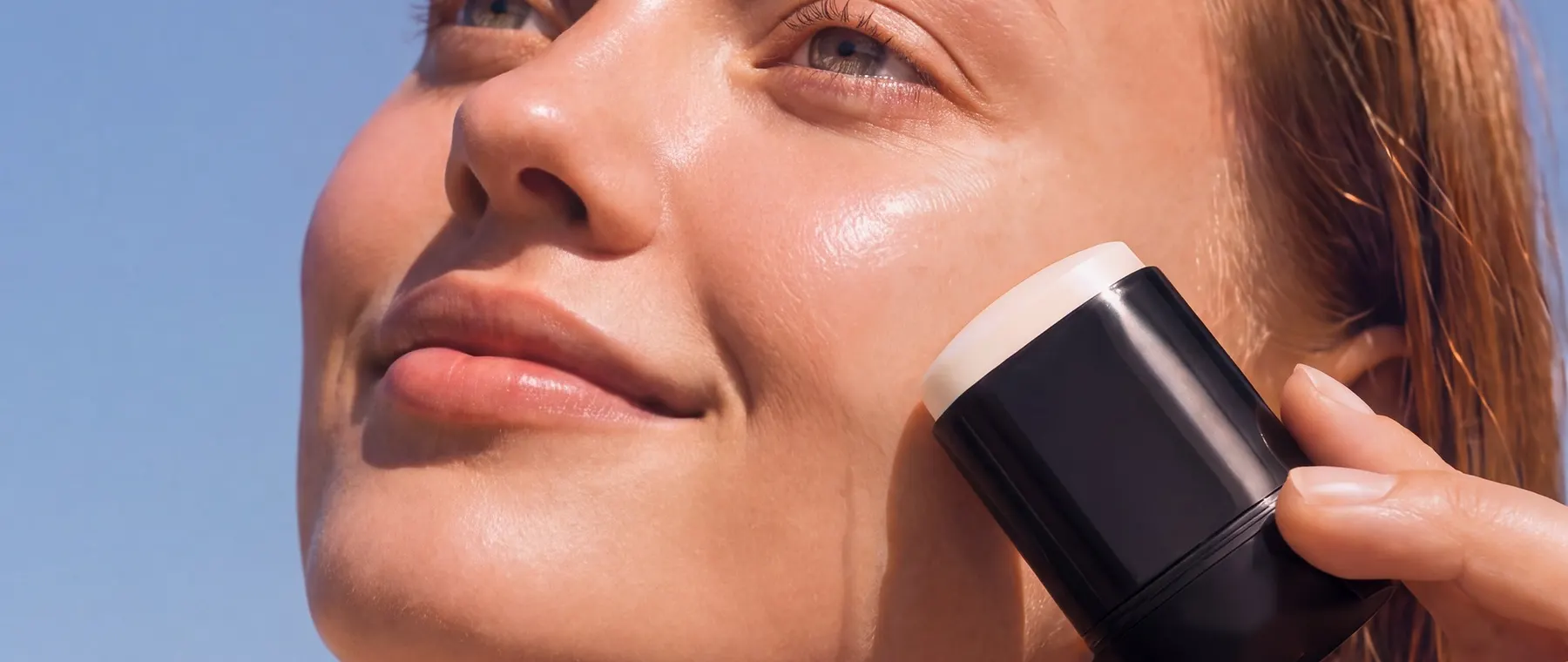
The official campaign photograph shows the use of the stick on the face. It illustrates the format, not a measurement of how effectively the product has been applied. The manufacturer describes its formula as free of fragrance and preservatives, with oils and waxes contributing to its physical form. Individual tolerance and suitability cannot be determined from that description. Anyone with a particular skin condition or a history of reactions should seek advice appropriate to their circumstances.
The relevance of sun care aboard a yacht
Outdoor activities on the water can involve exposure during periods when the temperature itself does not feel particularly high. A breeze may be refreshing without eliminating ultraviolet radiation. A shaded cockpit, bimini or other suitable covered area can therefore provide a valuable alternative to remaining continually in direct sunlight.
A well-planned leisure itinerary can incorporate those opportunities without interfering with the enjoyment of the holiday. A lengthy lunch might be enjoyed in the shade, while an excursion ashore can be arranged with some flexibility as to timing. Appropriate sunglasses and clothing are also useful parts of the preparation, independently of a person's preference for particular skincare products.
The selection of a sunscreen should not be made simply from a description of a product as suitable for beach or marine activities. Its labelled protection, instructions and suitability for the user are more relevant. Local restrictions on sunscreen ingredients may also apply in some destinations. The manufacturer has not established from its November announcement that its formula meets the requirements of every protected coastal area or that it has no environmental impact.
For families, choosing sun care for children or people with sensitive skin introduces individual considerations. The fact that a sunscreen is sold in a convenient format does not establish that it is appropriate for all ages or circumstances. FDA consumer guidance encourages consulting an appropriate healthcare professional regarding particular concerns, including use on infants.
Preparation for sun exposure is best viewed as part of a wider approach to spending time outdoors. A product that is easy to carry and use can be helpful, but its benefit still depends on consistent appropriate use and accompanying protective measures.
From a regulatory change to a retail choice
Burnd was established in 2025 by Mark and Malachy Mitchnick. Its November statement describes the addition of the stick to a skincare business that already includes other sunscreen formulations and facial products. The company gives November 10 as the availability date while issuing its formal launch announcement on November 18. The advertised price is $29, with sales identified through its own website and Amazon.
The release does not establish prices in other currencies, availability outside the United States or individual delivery charges. It also does not supply an independent assessment of comparative wear, skin feel or performance in actual yachting conditions. A consumer should evaluate the completed product against other options that meet the relevant requirements, taking account of the size of the package and the intended pattern of use.
The significant development is the introduction of a new retail formulation following the FDA's addition of bemotrizinol to the American sunscreen framework. That regulatory change is documented in the agency's published order. For people who enjoy coastal travel, it is a reminder that premium sun care does not have to be defined by an exclusive label or a high price. More important are the appropriate level of protection, trustworthy instructions and practical arrangements that make it straightforward to use consistently throughout the day.
Sources and lead image
Source documentation: https://www.prnewswire.com/news-releases/burnd-launches-the-uss-first-sunscreen-stick-made-with-bemt-the-newly-approved-european-filter-302943252.html, https://www.accessdata.fda.gov/drugsatfda_docs/omuf/order/supportDoc/OTC000039/Final_Administrative_Order.pdf. Lead image: Official campaign photograph showing the Burnd sunscreen stick being applied — Burnd, issuer-supplied product campaign photograph accompanying the 18 November 2026 announcement.. Official issuer-supplied press photograph, reproduced for editorial coverage of the specific announcement and resized for web display.