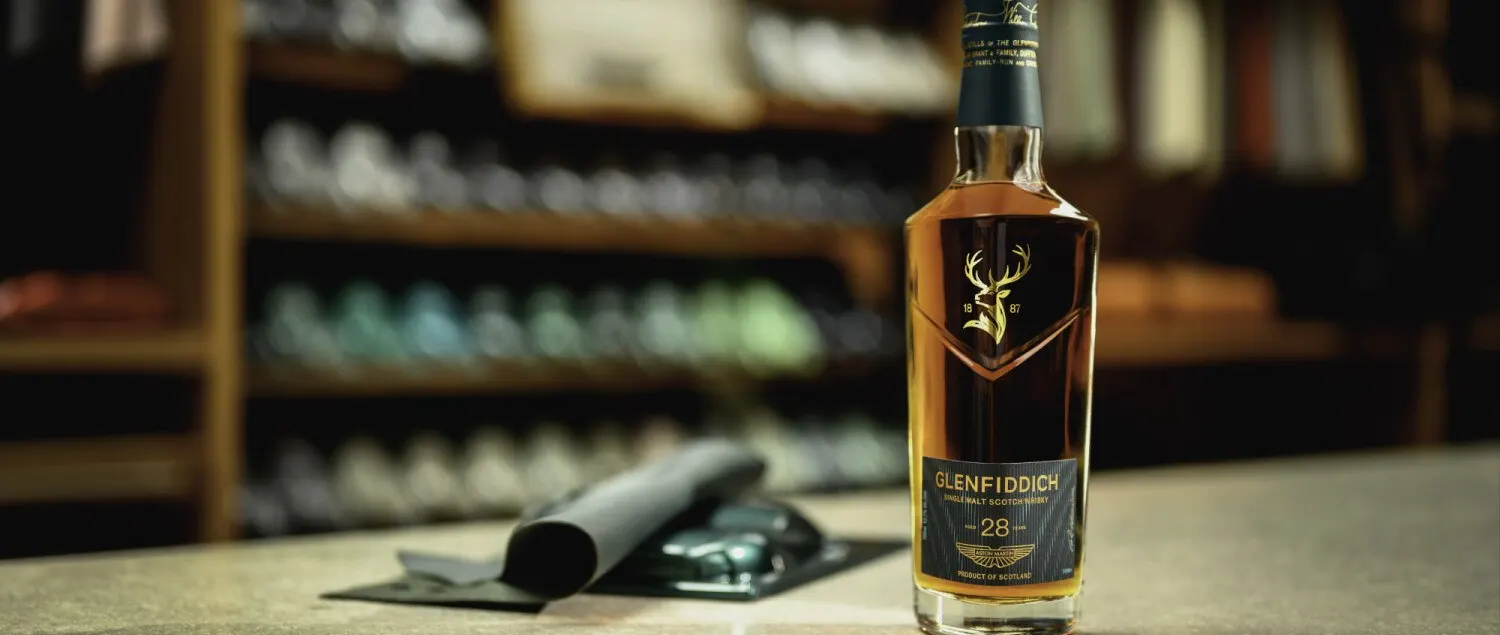
Aston Martin and Glenfiddich presented a limited-edition 28-year-old single malt on 4 November 2026, with distinctive packaging developed in cooperation with the British carmaker's design team. The collaboration is positioned as a meeting of two craft traditions: mechanical and visual design in ultra-luxury automobiles, and the long, carefully controlled process of whisky maturation. The companies say the expression is planned for availability from January 2027 in the United States and selected global travel-retail locations. For the luxury lifestyle audience, the most interesting subject is not a recommendation to purchase alcohol, but how an established spirits house and an automotive design studio have approached materials, visual movement, heritage and presentation. The November statement documents an announced release, not a bottle that has already reached all markets or an investment with assured resale value.
A design partnership built around movement
The name of the joint release alludes to the worlds of both brands, with motion used as the central visual idea. Aston Martin's design team worked on packaging intended to suggest flow and changing perspectives through layered forms and the play of light. The resulting design attempts to give a stationary object a sense of movement, a familiar concern in automotive styling where surfaces and proportions may imply speed even when a car is parked. A presentation box has very different practical requirements from a vehicle, but the shared visual problem provides a credible point of collaboration. The brands describe the package as distinctive; that is a design intention rather than an independently measured assessment of craftsmanship. Collectors can evaluate the concept by examining the quality of the physical object when it becomes available.
The significance of a 28-year age statement
The age statement refers to the maturation of the youngest spirit included under the applicable whisky rules, not simply the age of a brand or the amount of time invested in its package. Glenfiddich's release describes spirit matured over decades and then assembled through a considered combination of different cask influences. Such a process involves choices about wood, flavour and balance that belong to the maker's technical expertise. The accompanying marketing language emphasises rarity and patience, but an age statement alone does not guarantee superiority over a younger expression or establish the size of the release. For an editorial account of craftsmanship, the useful point is the number of decisions made over time and how they relate to a final presentation rather than the idea that age automatically equals value.
Brian Kinsman's role in the release
Glenfiddich identifies Malt Master Brian Kinsman as central to the blending and maturation decisions. His role is distinct from that of Aston Martin's designers. The spirit maker determines the composition and character of the liquid, while the automotive team contributes the presentation language. That division matters because a credible collaboration should not blur technical responsibility. A carmaker's reputation for performance engineering does not give it authority over distillation, just as a distiller's history does not establish expertise in vehicle design. Each participant can contribute established knowledge to a shared project without pretending to perform the other's craft. The official announcement positions Kinsman's approach as one of experimentation within the identity of Glenfiddich, balancing change with recognisable characteristics.
American and European oak in the composition
The company describes a combination involving American and European oak, with an important influence from new American oak. The release also references European oak seasoned with Oloroso sherry and conventional ex-bourbon casks. These details are relevant to understanding the maker's approach to flavour, but they should not be turned into promises that every drinker will perceive the same sensory notes. Glenfiddich discusses sweetness, spice, richness and fruit character in connection with the various components. Those are the producer's tasting descriptions. An editorial treatment can note them while recognising that individual perception varies and that production methods deserve attention independent of consumption. The distinct use of multiple cask types also reinforces the wider design analogy: the final object is assembled from elements chosen to contribute to an overall character.
Two established British identities
Aston Martin and Glenfiddich operate in very different parts of the luxury economy, yet both use heritage as an important part of their public identities. The former traces its story through generations of grand touring cars and highly personalised vehicles; the latter through longstanding Scottish distilling and the evolution of its single-malt range. Such narratives can provide meaningful context, but they should not be accepted as proof that every collaboration is artistically important. Consumers and collectors are entitled to ask what genuinely new work has been produced. In this case, the official release points to a specifically developed visual presentation and a particular spirits composition. Whether the partnership deserves a place in either brand's longer history will become clearer as the physical design and its reception can be assessed.
A late-1990s reference point
The November announcement draws a deliberate comparison with Aston Martin's development during the late 1990s, the period when the whisky was being laid into casks. At that time the Project Vantage concept foreshadowed the later Vanquish, and the DB7 Vantage helped define the marque's performance direction. Such a connection links two independent histories across a common timeframe. It does not mean the whisky was planned as an Aston Martin product 28 years ago. The association is retrospective, developed as part of the 2026 collaboration. For a collector interested in design, that distinction is important: a meaningful historical reference may enrich a presentation without making the items technically or institutionally connected throughout their earlier lives.
Packaging as an object of design
High-end packaging can be assessed using many of the same principles applied to furniture or an interior: proportion, tactility, surface treatment, durability and the relationship between materials. The Aston Martin and Glenfiddich project uses layered forms and light effects to convey movement. The brief appears designed to create a recognisable experience of opening and displaying an object, not simply to protect it during transport. Yet packaging still has a basic responsibility to keep its contents secure and appropriately supported. When a luxury presentation becomes elaborate, the risk is that its visual complexity overwhelms the object it was made for. The strongest examples integrate aesthetics with a clear function. The official press images are useful evidence of the intended appearance, though they cannot establish the long-term durability of every finish.
How luxury brands communicate craft
Both brands emphasise the work of skilled people and the cumulative importance of small decisions. That language is widespread in the luxury sector and can become vague if it is not connected to specific practices. The release is more useful where it identifies Kinsman's decisions about cask influence and Aston Martin's contribution to the packaging. These are concrete elements that allow readers to understand what each partner actually did. The broader claim of shared dedication to excellence remains an interpretation offered by the companies. Editorial analysis should preserve that distinction and avoid replacing independent judgement with promotional language. A collaboration has substance when its contributors, methods and resulting object can be examined directly.
Travel retail and the announced distribution plan
The companies plan a January 2027 release, identifying the United States and leading travel-retail locations as the intended channels. That is a forecast given in November 2026, not a guarantee of stock on a particular date or in an individual airport. The announcement also does not provide a complete list of outlets, current local restrictions or a universal price. Travellers should treat distribution information as subject to change and consult official channels if they need practical details. For a lifestyle publication, the relevance of travel retail is broader than one product: airports and international travel hubs increasingly serve as places where luxury collaborations are presented to global audiences. It remains essential to distinguish a planned retail environment from an invitation to purchase or consume.
Collecting collaboration objects with care
Luxury collectors often place value on objects that mark a particular partnership, but the market for them is highly variable. Presentation, provenance, condition, authorised documentation and the original quantity produced can all influence future interest. The November release does not establish a universal resale value or guarantee that scarcity will be permanent. A collector who is interested in the packaging as design may choose to document the original press release and the identity of the design collaborators. The broader approach is familiar from collecting watches, automotive memorabilia and limited artistic editions: understand what was made, by whom, when and under what terms. Do not confuse marketing language about rarity with independent valuation evidence.
The role of responsible editorial coverage
This is a story about craftsmanship and visual design involving an alcoholic product, not a health or consumption recommendation. Alcohol carries risks, and no form of luxury branding changes them. The age and prestige of a release should never be presented as a reason for anyone to drink or as evidence of a medical benefit. A design-oriented publication can examine packaging, company history and the cultural significance of a collaboration without encouraging use. The distinction is especially relevant when an item is promoted as a collectable. Its commercial availability and the legal conditions for sale differ by country; the editorial focus here remains on the design and cultural context of the announcement.
What it means for luxury-yacht lifestyles
Owners of luxury yachts may also collect watches, automobiles, design objects or memorabilia associated with heritage brands. The Aston Martin and Glenfiddich collaboration can therefore be discussed as part of the wider culture of bespoke presentation, rather than as a product for use aboard a yacht. No maritime collaboration or onboard service has been announced in connection with it. The comparison with yacht design is conceptual: material choices, craft skills and a client's emotional attachment can be important across different luxury fields. But a yacht must meet exacting operational and safety requirements that a presentation box does not. A responsible discussion keeps those differences visible and avoids implying a yacht connection unsupported by the source.
What remains to be established
The key unanswered questions concern the experience of the physical package, the authorised distribution arrangements in each territory and the number of units ultimately released. The official statement may be supplemented by further details closer to the expected January 2027 date. Readers should not assume that a promotional photograph proves the finish and construction of a delivered item, nor that the proposed launch schedule is equivalent to immediate availability. There is also no independent basis in the release for forecasting future collecting values. These uncertainties are normal when a branded collaboration is introduced in advance. Keeping them clear makes the underlying craft and design story more trustworthy.
The significance of the November announcement
On 4 November 2026, Aston Martin and Glenfiddich announced a jointly presented 28-year-old single malt with packaging shaped by the carmaker's design team. Glenfiddich described a composition using several cask influences overseen by Malt Master Brian Kinsman, while Aston Martin contributed visual themes of movement and layered form. Availability was planned for January 2027 in the United States and selected global travel retail. The release documents a specific collaboration, not an automotive launch, a new yacht product or a guaranteed investment opportunity. For luxury-lifestyle readers, its lasting interest is the attempt to translate different histories of craftsmanship into one physical presentation, which can be evaluated on its design merits once the announced item is in the market.
Sources and image credits: Aston Martin official media release of 4 November 2026, Aston Martin and Glenfiddich present Glenfiddich 28 years old, a spirit born from two worlds in motion, and the original jointly credited official media gallery photographs. Product and timing details are attributed to Aston Martin and Glenfiddich; discussion of design, provenance and collecting is independent Luxury Yacht Guide analysis.
Sources and image credits
Reporting based on Aston Martin and Glenfiddich original 4 November 2026 joint media release and gallery.
Lead photograph: Alternate Glenfiddich 28 Years Old and Aston Martin packaging image from original November 2026 media gallery. Image: Aston Martin and Glenfiddich official 4 November 2026 joint press image, different composition from the hero used on SYG. Original official image source.