A longstanding distributor becomes part of YANMAR
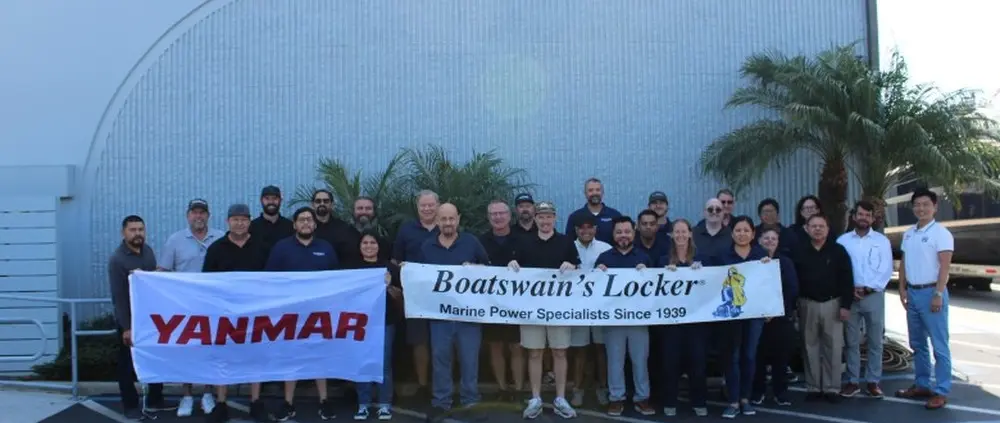
YANMAR Marine International has acquired Boatswain’s Locker, the marine engine and equipment distributor serving the United States West Coast. Announced in October 2026, the transaction brings an established regional business into YANMAR’s own recreational-marine organisation rather than replacing its customer relationships with an entirely new network.
Boatswain’s Locker was established in 1939 and built a service operation covering California, Oregon, Washington, Alaska and Hawaii. For yacht owners in these states, the business has long been a point of contact for equipment, installation advice, warranty questions and parts. YANMAR says the acquisition is designed to strengthen those functions while connecting them more directly to the manufacturer.
More than an engine distribution agreement
Although the story centres on YANMAR propulsion, Boatswain’s Locker also distributes VETUS equipment. YANMAR’s Marine Recreational Business Unit includes VETUS Maxwell, Flexofold and Smartgyro, reflecting an approach in which engines, manoeuvring equipment and other onboard components increasingly form a connected service proposition.
That relationship is relevant to luxury motor yachts and sailing yachts in the 12-to-24-metre sector. A yard or owner completing a technical refit may need several suppliers to collaborate on controls, propulsion, electrical power and deck hardware. Coordinating that work can reduce delays, but each component still requires the correct specialist and commissioning procedures.
Experienced local leadership remains
Robert Apted will remain president of Boatswain’s Locker under YANMAR ownership, according to the company. The distributor will also work closely with Mastry Engine Center as YANMAR develops its recreational-marine operations across the United States.
Continuity is particularly important where a distributor has supported engines over many years. Owners need access not only to current product catalogues but to people who understand earlier installations, spare-part substitutions and the practical constraints of repairs carried out away from a boat’s home berth.
What owners should expect from the change
The company has described the transaction as a way to strengthen dealer coverage, technical knowledge and the coordination of sales and aftersales service. It has not announced that every dealer contract or service procedure will change immediately, and existing owners should confirm who handles their particular equipment.
For a boat based in the Pacific Northwest or moving between the United States and Canada, planning maintenance ahead of a cruising season remains essential. Owners should retain engine serial numbers, service records and details of any third-party accessories so that the appropriate parts and service guidance can be identified promptly.
Implications for builders and refit yards
An established distributor becoming part of a manufacturer's organisation can give boatyards a more direct channel for feedback about equipment integration. Problems involving installation access, cooling arrangements or control systems may be easier to address when technical staff can communicate with the product organisation.
This does not eliminate the need for independent quality assurance. Builders and refit managers should still verify specifications, service clearances, documentation and acceptance tests before delivering a yacht to its owner. Good support is a complement to sound installation, not a substitute for it.
A regional investment in ownership support
YANMAR has positioned the acquisition as part of a wider strategy to grow its recreational-marine business. For the luxury-yacht market below 24 metres, the immediate significance is a potential strengthening of the support network for equipment already found in many cruising boats.
The announcement confirms the acquisition, but improvements in waiting times or service availability should be judged through subsequent operational experience. Owners and captains can use the development as an opportunity to confirm their authorised service contact before their next long passage.