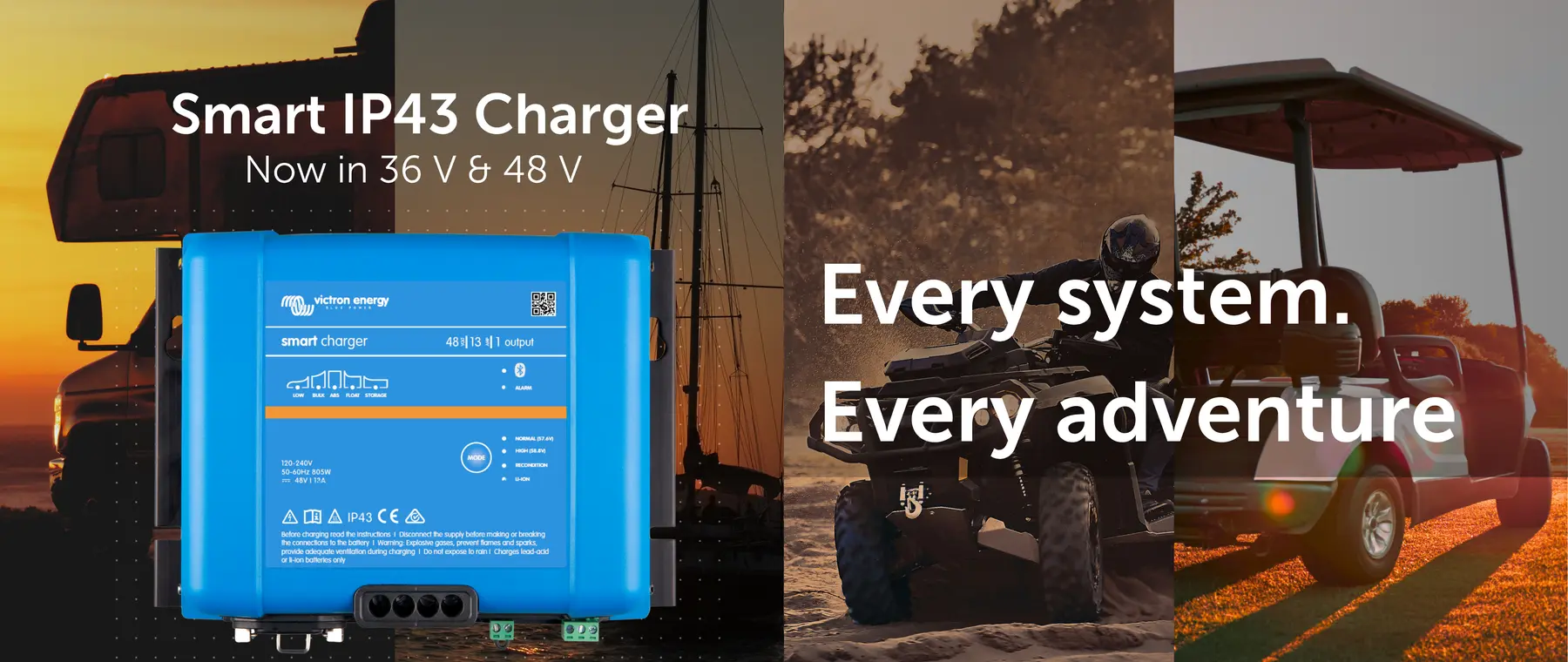
Victron Energy has expanded its Smart IP43 charger family with new 36V/15A and 48V/13A models, completing the range across the four common battery voltages used in marine, RV and off-grid installations. The new units retain VictronConnect Bluetooth configuration and support for lithium and conventional battery chemistries.
Higher-voltage banks gain a native charger
The two additions give owners with 36V or 48V service banks a dedicated Smart IP43 option rather than relying on a combination of smaller chargers. That can simplify wiring and charging logic on yachts using higher-voltage domestic or propulsion-support systems.
Higher system voltage can reduce current for a given power level, which may help cable sizing and efficiency. The benefit depends on the complete installation, so charger choice should still follow the battery manufacturer’s limits and the yacht’s electrical design.
Bluetooth puts setup in VictronConnect
Both new models include Bluetooth Smart and can be configured through the VictronConnect app. Owners and installers can adjust charging parameters and review status without opening panels or adding a separate programming interface.
App-based configuration is particularly useful when lithium batteries require specific absorption, float or storage behaviour. It also makes commissioning easier when several charging sources must be aligned to the same battery-bank requirements.
Networking adds coordinated charging
The chargers support VE.Smart Networking for synchronised charging and can use external battery-voltage and temperature data. VE.Direct, remote on/off and a programmable relay provide additional integration options for more complex systems.
Those functions make the IP43 range more useful in yachts where chargers, battery monitors and control devices are expected to work as one system. Integration should still be tested carefully so a network or sensor failure cannot leave the bank without an appropriate fallback charging mode.
Marine suitability depends on installation
The enclosure is rated IP43, so the chargers are intended for protected locations rather than exposed deck spaces. Installed correctly in a ventilated technical area, they can form part of a modern lithium or lead-acid charging system.
The new voltage options widen the range rather than changing the fundamentals of yacht electrical design. Cable protection, ventilation, battery temperature and correct shore-power installation remain just as important as the charger specification itself.