A New Superyacht Berthing Option on the Gold Coast
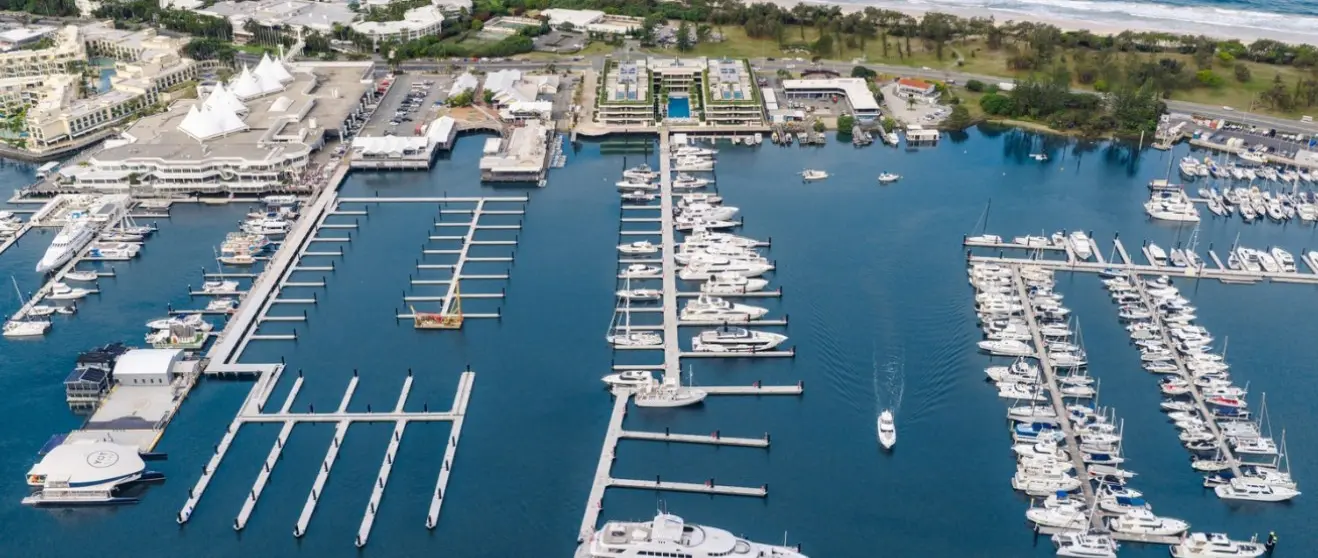
The Mantaray Marina on Australia's Gold Coast is open and operating, with berth holders taking possession of their places at the waterfront development on The Spit. Superyacht Australia reported the progress on 4 November 2026 after speaking with the project team and one of its early customers. The opening adds a significant element to the region's large-yacht infrastructure, where access, depth and dependable shore services are essential to attracting visiting and locally based vessels.
The Mantaray is more than a set of pontoons. Its developers have paired the marina with completed residences and a hospitality precinct still progressing toward its full intended form. That mix is aimed at owners who want the services of a well-managed yacht berth alongside the conveniences of a wider waterfront address. As with any new destination, the real test will be how those parts work together after the initial excitement of opening has passed.
Location on The Spit and the Broadwater
The marina occupies a position on The Spit, beside the Broadwater, giving it a distinctive place in the Gold Coast's boating landscape. The project is being developed by Gordon Corp, led by founder and managing director Tim Gordon. Its location connects the commercial proposition with a coastal area already familiar to Australian yacht owners, while the scale of the facility aims at a segment that requires considerably more than ordinary recreational berthing.
According to Superyacht Australia's official industry listing, the development provides 67 berths and is designed to accommodate yachts up to 60 metres. These figures set it firmly within the superyacht support market, although availability and the practical fit of an individual vessel depend on the assigned berth, draft, access conditions and marina management. An owner should confirm current specifications and operating requirements directly before making a berthing decision.
The Importance of Waterway Depth
A central feature of the project's story is the work undertaken to improve access for larger vessels. Gordon says the state government and local council dredged the Broadwater to provide the depth needed to bring these yachts into the waterway. Dredging can be as consequential to marina capacity as the dimensions of the pontoons themselves, because a berth serves little purpose to an owner if the approach cannot be navigated safely.
The work also illustrates the link between public waterway management and private waterfront investment. Marina developers can design substantial infrastructure, but access channels, navigation rules and surrounding traffic still influence whether larger yachts can use it. The published account does not specify every approach depth or tidal limitation, and such details should never be inferred from a general statement about dredging. Captains must rely on current local guidance and vessel-specific passage planning.
A Developer's Rationale
Superyacht Australia's report explains that the project followed a tender process involving the state government. Gordon describes demand from larger vessels as a reason for delivering a marina suited to a different scale of boat. The account presents the development as an answer to a perceived gap in the Gold Coast's existing facilities, supported by work to make the Broadwater more accessible to yachts that previously faced greater constraints.
That is the developer's assessment, not a published forecast of future berth occupancy or rental income. For readers evaluating the marina market, it is useful to separate the strategic argument from results that will only become clear over time. A successful opening establishes that the infrastructure is in place and being used, while long-term performance depends on service standards, repeat business and the ability to support the vessels the project intends to attract.
The View From an Early Berth Holder
The industry's latest account also introduces Rod Leech, an owner who committed to the marina before it opened. He had been based at neighbouring Marina Mirage and was able to watch the new facility take shape. Leech has since moved his boat across, making his experience an early example of how the project is drawing customers from established nearby options rather than relying solely on yachts arriving from distant cruising grounds.
Leech describes the attraction of enjoying hospitality services while remaining aboard his own boat. The idea is simple but important in luxury yachting: an owner may value a private dining space on the yacht while also wanting convenient food and other services delivered to the berth. Such expectations place demands on marina operations, staff communication and access arrangements. The development's hospitality plans are therefore part of the ownership experience rather than merely a neighbouring attraction.
The Mantaray Club Still to Join the Picture
Superyacht Australia says the next milestone is for The Mantaray Club to make its way down the Broadwater and connect with the marina later in 2026. That element is described as forthcoming, not a component already in full operation at the time of the 4 November report. Distinguishing what is open from what is planned matters for anyone deciding whether the entire development's proposed experience is available immediately.
The completed residential component and progressing hospitality precinct create a broader proposition, but amenities should be confirmed at the time of an enquiry. A yacht owner assessing a marina typically needs specifics about shore power, access arrangements, bunkering, waste services, concierge support and the handling of guests and contractors. The industry release does not publish a comprehensive technical inventory of those services, and it would be misleading to assume details it does not provide.
What Captains Need to Establish
For a captain, a new facility is judged first on safe entry and operational reliability. The maximum yacht size in an industry listing is a starting point, but approach depths, turning room, fendering arrangements and shore-side electrical capacity are all vessel-specific considerations. The captain also needs to know how a marina manages arrivals, departures and contractor access during a busy period. These are routine professional questions, not doubts unique to The Mantaray.
The dredged Broadwater approach is especially relevant to vessels with deeper draughts. Navigational conditions may change, so published charts, notices and current instructions from the relevant authorities remain necessary even after a major improvement project. Large-yacht itineraries depend on certainty: a berth that can be booked without repeated operational surprises is more valuable than one that looks impressive in publicity photographs but cannot reliably support a particular yacht.
The Owners' Waterfront Lifestyle
Luxury marina development increasingly involves more than providing space for a vessel. Owners and guests may spend significant time ashore between cruises, and the quality of that experience can influence the appeal of keeping a yacht in a particular region. At The Mantaray, the relationship between marina, residences and hospitality is explicitly part of the project. That creates a potentially convenient arrangement for users who want their boat close to other activities.
There is nevertheless a distinction between lifestyle appeal and operational suitability. A good waterfront restaurant or attractive residence does not compensate for a berth that is poorly matched to a yacht's requirements, while excellent marine infrastructure may not deliver the atmosphere some owners seek. The most successful mixed-use projects must meet both expectations. Owners should consider the everyday rhythm of the precinct, including privacy, deliveries and the movement of visitors.
Implications for the Gold Coast Industry
An operational 67-berth superyacht facility can influence the surrounding service economy, particularly if it encourages large vessels to remain in the region for longer periods. Marinas can create demand for maintenance specialists, provisioning, crew services, transport and local hospitality. These are possible downstream effects rather than outcomes quantified in the current release. The source confirms the project's opening and early berthing activity but does not provide a detailed economic-impact study.
Other Gold Coast marinas and marine businesses may view the development in different ways. Some will compete for berthing customers, while shipyards and contractors could benefit from a stronger local population of substantial yachts. The outcome depends on how owners use the facility and which supporting services they purchase locally. A clearer assessment will be possible as the marina's operations mature and its occupancy pattern becomes established.
From Opening to an Established Destination
The latest update marks a transition from development to operation. Berth holders are moving in, residences are complete and the hospitality project continues to progress, according to the official industry report. The story is strongest in those concrete milestones, not in claims about an unmeasured future. For a marina built to accommodate vessels up to 60 metres, the ability to put a real berth holder aboard a real yacht is a meaningful stage.
The coming months will show how smoothly The Mantaray Club joins the development and how well its marine and shore facilities serve customers through normal operating conditions. In the meantime, owners and captains have a new Gold Coast option to assess, supported by a stated berth capacity and the improved Broadwater access described by the developer. Any final booking decision should still rest on direct confirmation of the vessel's needs, available services and current navigational information.
Source: Superyacht Australia / Australian Marine, 4 November 2026.