Electric marine charging reaches another Solent harbour
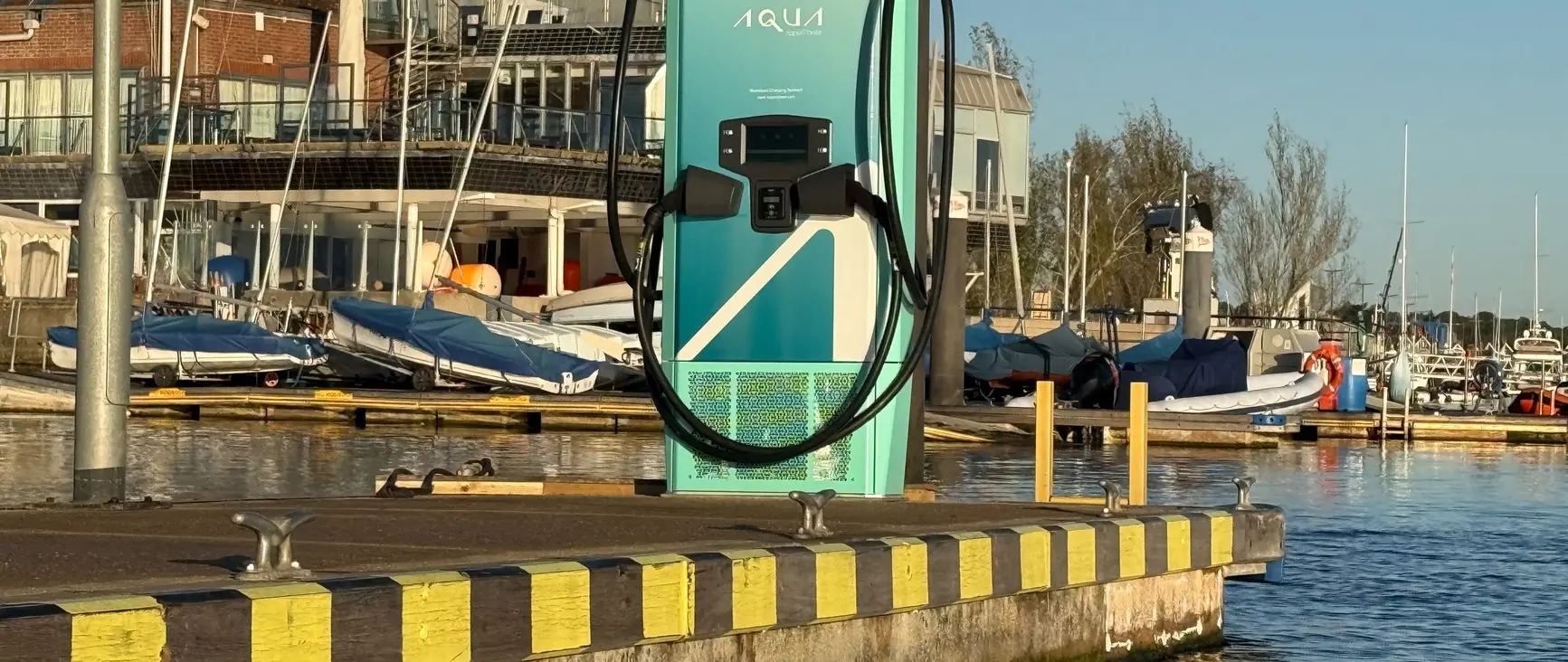
Aqua superPower has installed a 75-kilowatt direct-current fast charger at Lymington Harbour on the Hampshire coast, adding a new location for compatible electric boats travelling in the Solent region. Announced on 13 October 2026, the installation is part of a wider effort to make electric propulsion more practical for yachts and working vessels.
Lymington occupies a prominent position opposite the Isle of Wight, close to the New Forest and within an active sailing area. A dedicated high-power charger adds another service to the harbour, although electric boat owners should confirm compatibility and the booking or payment arrangements before building a passage plan around the installation.
The Electric Seaway is a network rather than one machine
The installation forms part of the Electric Seaway, a £3.2 million UK Government-backed programme led by Aqua superPower and ZPN Energy. Launched in 2023, the project aims to develop charging infrastructure along Britain’s south coast and to demonstrate how multiple sites can operate together for leisure and commercial boats below 24 metres.
Aqua superPower says sites developed within the network include Ocean Village, locations on the Isle of Wight, Fowey, Chichester Harbour and Falmouth. A connected corridor is important because electric propulsion depends on opportunities to recharge at practical intervals, rather than a single high-capacity charging stop at the home marina.
Charging at 75 kilowatts can be substantially faster than conventional low-power AC charging, but the actual speed achieved depends on the vessel’s charging interface, battery capacity, temperature and onboard battery-management limitations. Published charger output should not be treated as the guaranteed power accepted by every yacht.
Lymington’s environmental programme
Lymington Harbour’s chief executive Ryan Willegers has connected the new facility with the harbour’s Climate Commitment Policy, which sets targets to halve its carbon footprint by 2030 and reach net-zero emissions by 2050. Those are stated goals and should not be confused with outcomes already achieved.
The harbour is also examining the conversion of its own work and patrol boats to electric propulsion. A nearby fast-charging facility can make those plans more credible by reducing operational friction, although the suitability of each conversion depends on the vessel’s duty cycle, range and technical specification.
Aqua superPower has pointed to experiments with battery-backed charging at Fowey as a response to restricted grid capacity. Such alternatives matter because coastal locations cannot always deliver substantial new electrical power without infrastructure work, even when demand for low-emission boating is growing.
What owners should check before relying on the network
Electric boat operators should establish connector standards, supported charging rates and the process for obtaining access before departure. A marina listing a charger does not necessarily mean that every vessel can plug in immediately, and a planned route should include contingencies for unexpected delay, weather and equipment availability.
Yacht owners considering a hybrid or battery-electric installation should also examine realistic endurance under different sea conditions and power loads. Wind, current, heating, hotel services and speed all influence energy use, so a manufacturer’s maximum range figure cannot replace a skipper’s independent passage calculations.
The Lymington addition represents another practical step toward supporting electric boating along the Solent and beyond. Its significance lies in connecting a recognisable sailing destination to a wider network rather than presenting one machine as a complete solution to the challenges of marine electrification.