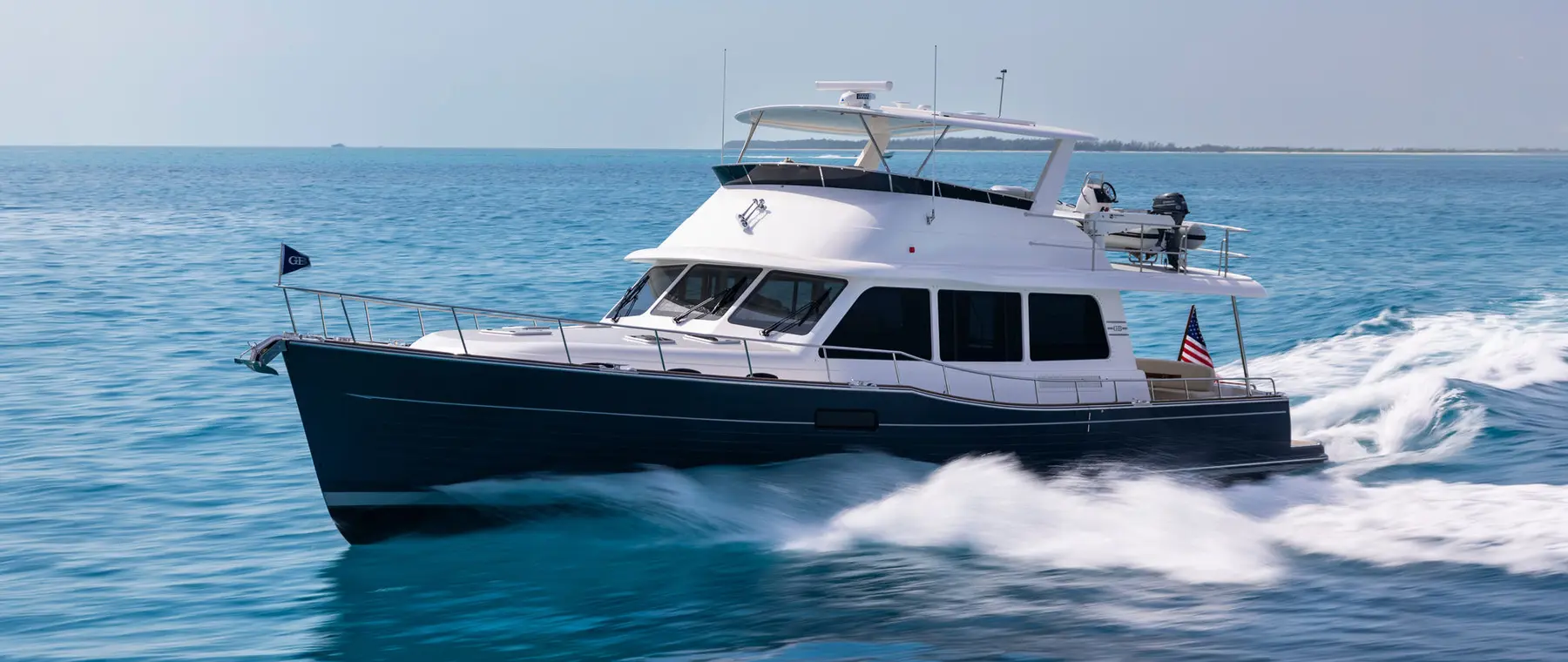
Grand Banks will exhibit the GB62 at the 2026 Newport International Boat Show, which opens on 17 September in downtown Newport, Rhode Island. The yacht is one of the builder’s current long-range cruisers and is being presented with published performance figures that combine a 30-knot top speed with a much slower economical mode for extended passages.
Official model data lists the GB62 at 21 metres overall, with an 18.9-metre length on deck and a 5.84-metre beam. That places the yacht firmly inside Luxury Yacht Guide’s under-24-metre scope while giving it the volume for three staterooms, three heads and several flybridge and galley configurations.
Newport focuses attention on long-range cruising
Grand Banks is using Newport to place the GB62 in front of owners who may be comparing cruising yachts for New England, the US East Coast and longer seasonal passages. The show runs from 17 to 20 September, and the builder is offering scheduled tours alongside its broader owner activities around Newport Harbor.
The event is also connected to the Grand Banks Owners Club presence in Newport, giving existing customers and prospective buyers a setting that extends beyond the display dock. That ownership context matters for a passagemaker because service support, factory contact and peer experience often influence buying decisions almost as much as interior finish or headline performance.
Speed and range are designed into one platform
Grand Banks quotes a top speed of 30 knots and a cruising speed of 27 knots for the standard GB62 configuration. At 20 knots, the company publishes fuel consumption of 38 gallons per hour and a range of 817 nautical miles, figures intended to show that relatively fast passage-making does not have to eliminate efficiency.
At 10 knots, the builder quotes a range of 2,000 nautical miles, giving owners a very different operating option when endurance matters more than arrival time. These are manufacturer figures recorded under defined test conditions, so real-world results will vary with load, weather, hull condition and equipment.
V-Warp thinking shapes the efficiency case
The GB62 develops the company’s V-Warp approach, which combines hull geometry, weight control and propulsion integration to reduce resistance across a useful speed range. Grand Banks has increasingly positioned this engineering philosophy as the reason its newer models can cruise quickly while still retaining the low-speed endurance expected of a traditional long-range cruiser.
Weight reduction through modern construction is part of that equation because unnecessary mass affects both acceleration and fuel consumption. The goal is not simply to make the yacht light, but to place structure and systems efficiently so the hull can deliver predictable performance without sacrificing the robustness required for extended cruising.
Three staterooms and three heads
Compared with the earlier Grand Banks 60, the 62 uses its additional volume to enlarge the starboard guest cabin and add an ensuite head. The room can include an athwartships double berth plus a single, while a utility area incorporates the standard washer and dryer for longer periods away from home.
The resulting three-stateroom, three-head arrangement gives the yacht stronger separation between owner and guest spaces without pushing overall length into the superyacht category. For private cruising, that can make a practical difference because family or friends can stay aboard with more privacy while the owner retains a dedicated cabin and predictable storage.
Volvo power with shaft or IPS choices
The standard specification lists twin Volvo D13 shaft-drive engines at 900 horsepower each, while an optional IPS installation uses Volvo IPS 1200S units at the same quoted power. Grand Banks publishes a slightly higher 31-knot top speed for the optional IPS package, although actual performance depends on configuration and conditions.
The choice lets owners weigh conventional shafts against the manoeuvring and installation characteristics of pod drives rather than forcing one solution across every yacht. That flexibility is useful in a global market where service availability, cruising grounds and owner preferences can differ substantially between regions.
Layouts can be matched to cruising style
Grand Banks offers the GB62 in several upper-deck and galley arrangements, including Skylounge and Flybridge configurations with different galley locations. Those choices allow an owner to prioritise climate-controlled upper living, open-air operation or a particular relationship between food preparation and the main social spaces.
Layout flexibility is especially valuable on a yacht intended for long stays aboard because the same 21-metre platform may be used very differently by a couple, a family or owners who frequently cruise with guests. The best arrangement is therefore less about maximising features and more about aligning circulation and storage with how the yacht will actually be operated.
The GB62 targets the owner-operator market
Grand Banks repeatedly frames the 62 around owner-operator confidence, combining substantial range with systems and dimensions that remain manageable for experienced private crews. A 21-metre yacht still requires disciplined seamanship and maintenance, but it avoids some of the staffing and regulatory complexity associated with moving beyond the 24-metre threshold.
Newport gives buyers an opportunity to judge whether that balance works in practice. The GB62’s combination of a 30-knot top speed, long-range economy, three-cabin accommodation and configurable upper deck makes it a useful reference point for owners who want one yacht to handle both fast coastal passages and slower extended cruising.