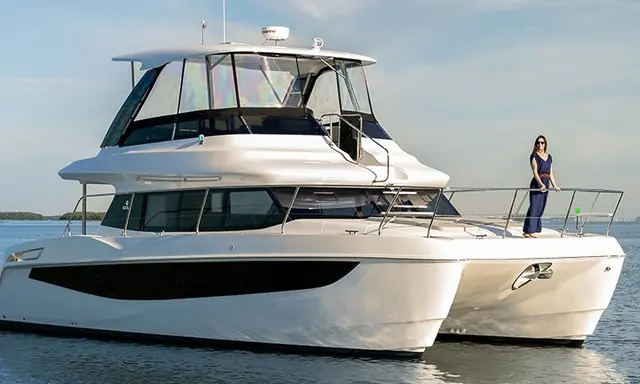
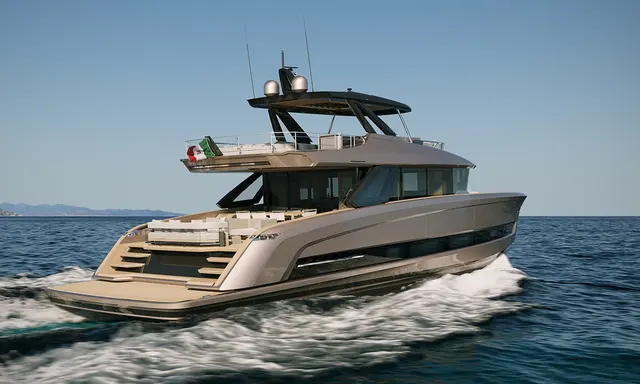
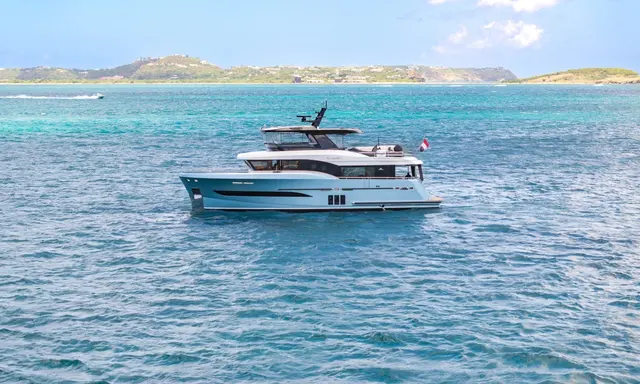
Astondoa’s 677 Coupé is back in Cannes as the larger half of the builder’s Coupé Collection, shown beside the newer 577 Coupé. The yacht sits at roughly 19 metres overall depending on the measurement basis used in Astondoa’s own published material, but all official figures place it comfortably below the 24-metre threshold covered by Luxury Yacht Guide.
The 677 was developed as a larger expression of Astondoa’s low-profile sports-yacht philosophy, using a broad beam, three-cabin accommodation and powerful IPS propulsion to combine open-air Mediterranean use with the privacy expected for longer stays aboard. That gives the larger coupé a different ownership brief from the new 577 displayed beside it.
A larger expression of the coupé idea
The 677 uses the same basic visual themes that now link Astondoa’s Coupé Collection: a low roofline, long glazed surfaces and an aft deck intended to work as an extension of the main living area. Its greater length and 5.04-metre beam allow the yard to add volume without turning the yacht into a conventional multi-deck flybridge model.
That distinction is central to its market position. Owners choosing the 677 are being offered more interior room than the 577, but the design still prioritises a sleek silhouette and a close relationship between the saloon, cockpit and water rather than maximising enclosed superstructure.
Twin IPS1350 power
Astondoa’s current Cannes material lists twin Volvo Penta IPS1350 units rated at 1,000 hp each for the 677 Coupé. The pod-drive installation supports joystick manoeuvring and efficient use of machinery space while keeping the propulsion package consistent with the model’s emphasis on refined cruising rather than exposed outboard power.
The choice also differentiates the 677 from the smaller 577, which can be configured with either IPS drives or triple Mercury V12 outboards. Astondoa is therefore using propulsion as another point of separation between the two members of the Coupé Collection rather than simply stretching one platform.
Three cabins plus crew accommodation
The 677 adds a three-cabin layout and dedicated crew accommodation, giving it a stronger case for longer private cruises than the two-cabin 577. The arrangement allows owners to carry family or guests without turning the lower deck into a dense charter-style plan.
Crew separation is particularly useful at this size because many owners are deciding whether to operate personally, employ seasonal help or carry a permanent captain. A dedicated crew area gives the yacht more flexibility across those operating styles and can make longer trips more practical without intruding on guest privacy.
Cannes links old and new
Showing the 677 beside the new 577 lets Astondoa demonstrate continuity rather than replacing one model with another. The larger yacht provides a reference point for customers who already know the yard’s coupé approach, while the 577 shows how that language is being adapted for a new generation.
This pairing also gives brokers and clients a useful comparison in the same display. Differences in accommodation, propulsion and volume can be understood directly, while shared details in materials, exterior character and build philosophy reinforce the idea that the two boats belong to one family.
Independent shipyard positioning
Astondoa continues to stress its status as an independent family shipyard with more than a century of boatbuilding history. In a market where many brands have been consolidated into larger groups, the company is using customisation and direct owner relationships as important parts of its proposition.
The 677 Coupé embodies that strategy at the upper end of the collection. It is large enough to offer crew space and three proper guest cabins, but still compact enough to retain the immediacy and owner-focused character that attracts buyers to this style of Mediterranean motor yacht.
Why the 677 remains relevant beside the new 577
The arrival of a smaller new model does not make the 677 redundant. Its extra beam, third guest cabin and dedicated crew space shift the ownership proposition toward longer stays aboard and more formal operation, while the low coupe profile keeps the yacht visually and operationally separate from a conventional flybridge cruiser of similar overall length.
For existing Astondoa clients, the two-model display also creates a clear progression within one design family. An owner who likes the 577 philosophy but needs more privacy and crew separation can move upward without changing to a different style of yacht. That continuity can be commercially valuable for an independent yard because repeat customers already understand the materials, service relationship and general design language.