A central figure in mechanical watchmaking
A. Lange & Söhne is remembering Günter Blümlein on the twenty-fifth anniversary of his death on 1 October 2001. Together with Walter Lange, he helped revive the historic Saxon watchmaking name after German reunification and played a wider part in the mechanical-watch industry's recovery. The commemoration, published in September 2026, focuses on decisions that continue to influence the company's identity.
Blümlein's role was not limited to publicity or a ceremonial partnership. He brought strategic and organisational experience to an ambitious attempt to re-establish a manufacturer that had been absent for decades. The resulting enterprise combined respect for historic craftsmanship with the demands of a modern precision-watch business.
The road from industrial engineering
Born in Nuremberg in 1943, Blümlein studied precision engineering and worked within the Diehl organisation, which had acquired Junghans. He advanced through marketing and sales responsibilities before taking on a major role in the management of IWC and Jaeger-LeCoultre through Les Manufactures Horlogères. Those firms were seeking their place in a watch industry dramatically changed by quartz technology.
His experience offered an understanding of both the factory and the commercial market. Mechanical watches could no longer rely on being the default means of telling time, so their craft, identity and performance had to be communicated differently. Blümlein's work helped demonstrate that traditional watchmaking could remain commercially and culturally relevant.
Rebuilding the Lange name in 1990
Walter Lange, a descendant of the founder Ferdinand Adolph Lange, set out to revive the company in 1990 after more than forty years of interruption. Blümlein joined him with expertise in strategy and product development. The aim was not simply to reproduce old pocket watches, but to make contemporary wristwatches worthy of an established Saxon tradition.
Reintroducing a fine-watch manufacturer requires much more than a familiar name. Skills, components, movements, design direction and reliable production must all be assembled into a credible business. That work was particularly demanding in a region emerging from the economic and institutional changes of German reunification.
The first collection makes a statement
The revived A. Lange & Söhne unveiled its first four wristwatches on 24 October 1994 at Dresden's Royal Palace. The line included the LANGE 1, with its asymmetrical dial and large date indication, alongside the ARKADE, SAXONIA and TOURBILLON Pour le Mérite. Those pieces established a distinctive design identity rather than imitating every prevailing Swiss luxury-watch convention.
The LANGE 1 became the most recognisable expression of the comeback, combining a historic sense of craft with an unmistakably modern face. Its success illustrates the importance of making a new manufacturer's first collection visually coherent and technically convincing. Collectors could see an independent identity rather than a generic revival.
The DATOGRAPH and technical credibility
The DATOGRAPH chronograph, introduced in 1999, demonstrated a commitment to developing and finishing complicated movements within the manufacture. Blümlein and Walter Lange presented the watch during the Basel event that year. At a time when in-house chronograph movements were comparatively rare, the model helped establish Lange's reputation for serious mechanical innovation.
Later developments, such as the DOUBLE SPLIT in 2004, extended the approach, although Blümlein did not live to see their introduction. Such distinctions matter when tracing an individual's influence. His strategic direction can be recognised in later achievements without incorrectly attributing every subsequent mechanism directly to his personal work.
A commemorative relief in Glashütte
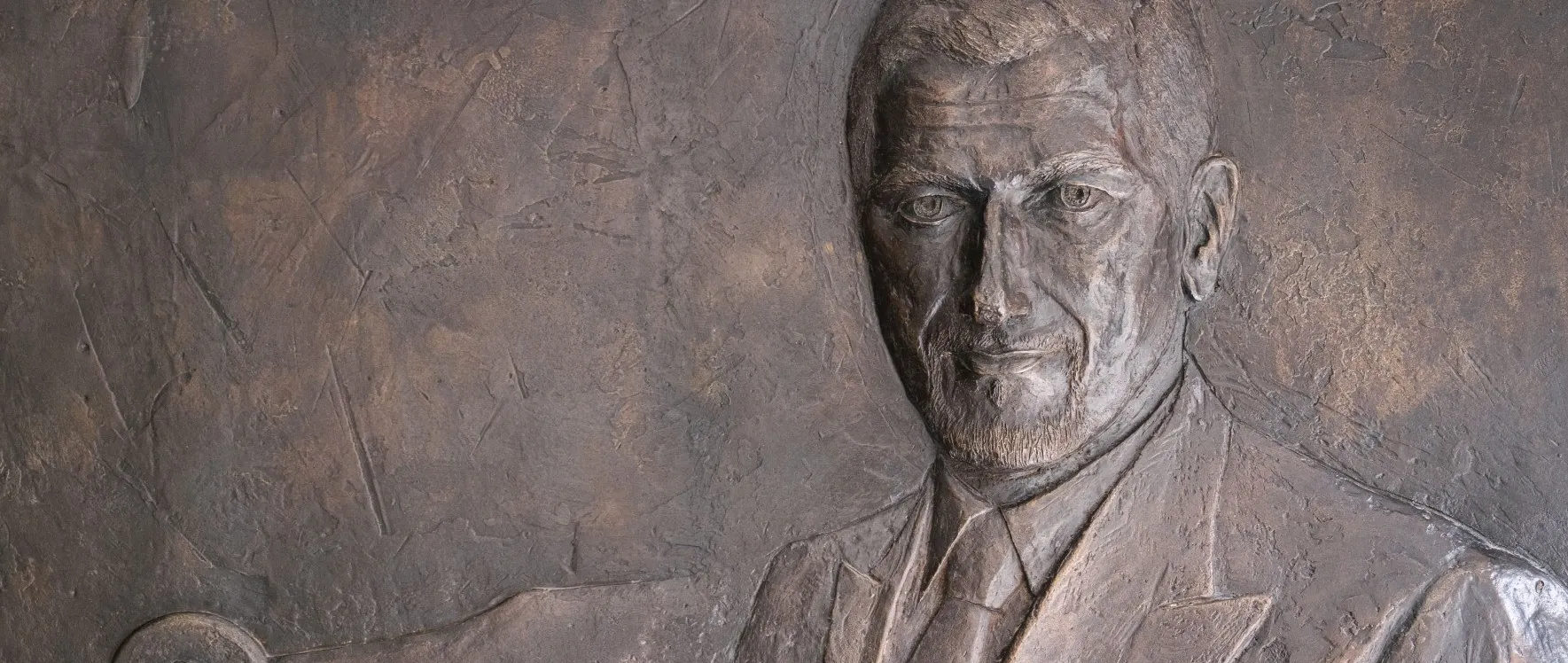
The company has a bronze relief of Blümlein within its Lange II manufacture building. Created by artist Beat Künzler and unveiled in 2002, it includes a reference to the LANGE 1 behind his portrait. The piece is an enduring reminder that a watchmaking business depends on people whose work may be less visible to customers than the products they helped create.
Current CEO Wilhelm Schmid has emphasised the complementary roles played by Walter Lange and Blümlein in rebuilding the company. The verified anniversary story concerns Blümlein's death in 2001 and his continuing legacy; it is not the launch of a new numbered watch edition. For collectors, understanding that history adds depth to the objects produced by the revived manufacture.