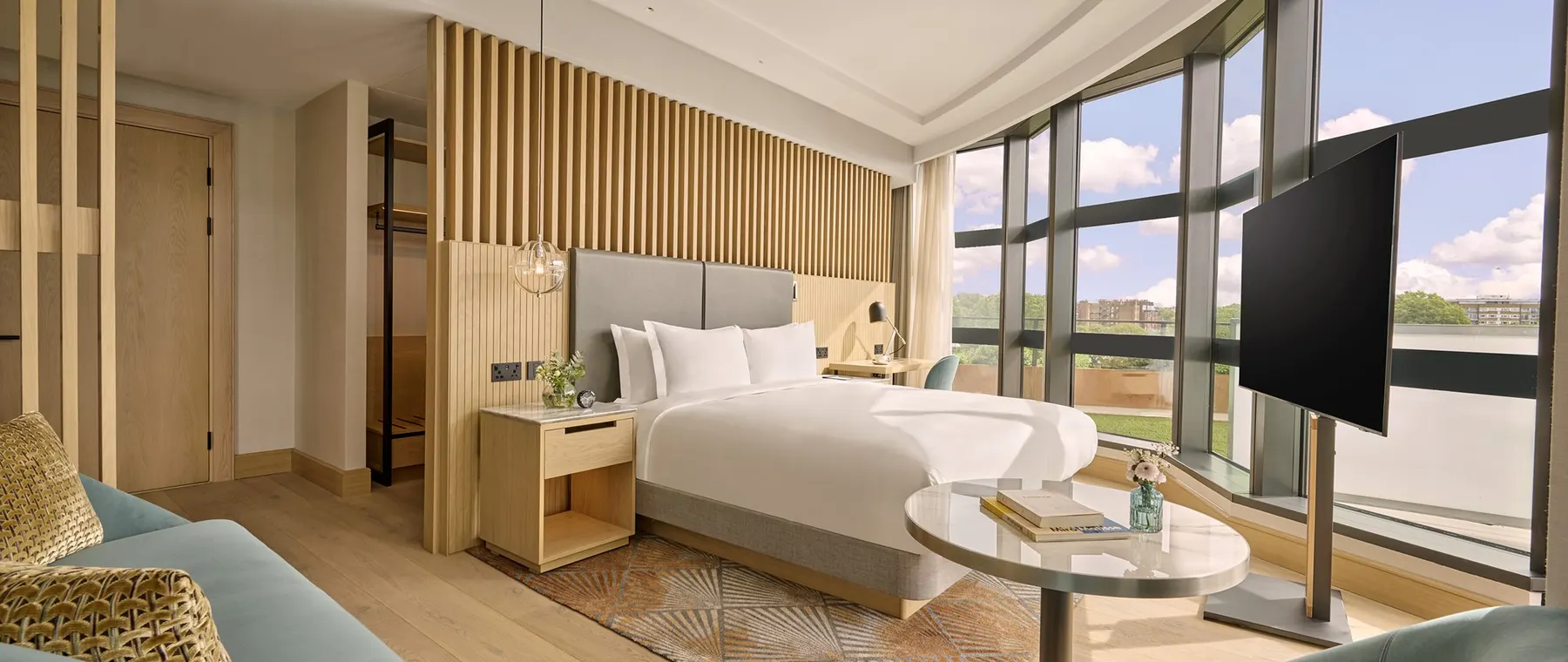
A new hotel within Olympia's transformation
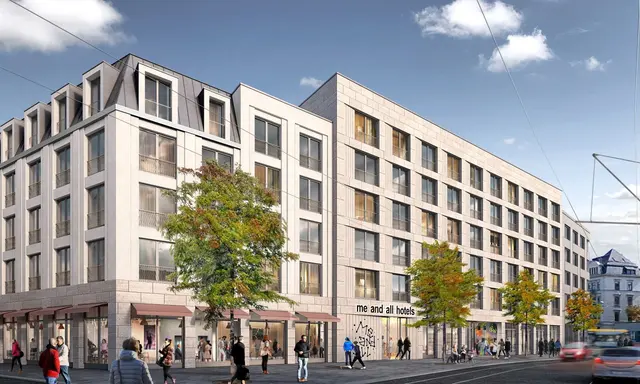
Hyatt Regency London Olympia opened in July 2026 as part of the redevelopment of the Olympia district in west London. The official announcement identifies the hotel as the fifth Hyatt Regency property in the capital and places it within a £1.3 billion destination intended to combine exhibitions, culture, entertainment, offices and dining. The hotel itself occupies Emberton House, a historic building that first opened in 1937 as a multi-storey car park. This is an operating hotel rather than a future concept, although reservations, room categories and access to particular venues require current checks. For a traveller who enjoys architecture and cultural activity, the conversion is an unusual example of adaptive reuse. A structure originally created to accommodate motorcars has been given a new role in accommodation and public life. The appeal lies not only in the hotel's facilities but also in its relationship with the changing Olympia neighbourhood.
Emberton House carries an industrial past
Emberton House was originally among Europe's larger multi-storey car parks, according to Hyatt's release. Its transformation into a hotel involves making an early twentieth-century industrial building function for overnight accommodation, which demands a different set of internal spaces and building systems. The project is associated with architectural work by Heatherwick Studio and SPPARC, while interior design was led by London-based twenty2degrees. The original identity is not erased: the announcement describes a continuing dialogue with the building's industrial character and the history of Olympia. A preserved façade or unusual structural rhythm can add interest, but the success of a conversion depends equally on circulation, sound isolation, safety and accessible routes. The company's images show the finished design, yet an independent evaluation of how the building performs requires a visit. A historic exterior is compelling only when modern guests can move comfortably and safely through the spaces inside.
Art Deco influences and a new visual vocabulary
The interior concept introduces contrasting metalwork, figured marble and shades of grey and deep green, combining modern finishes with references to Art Deco. Hyatt says the design is intended to connect the building's age with the experience of contemporary London. Such a palette may offer a more distinctive atmosphere than a generic new-build hotel, but decorative language is only one part of a successful stay. Furniture should be comfortable, lighting practical and surfaces capable of standing up to daily use. Historic references need not mean reproducing the past exactly. A good conversion can interpret the original era while making clear that the building now serves a different purpose. The press release does not provide a technical account of every restoration decision, so it would be misleading to claim that all historic fabric has been preserved untouched. The interesting aspect is the design team's attempt to acknowledge history without turning the interior into a museum set.
Olympia's exhibition history appears in artwork
The hotel includes bespoke artwork referencing the wider Olympia district. Hyatt describes corridor images inspired by Eadweard Muybridge's pioneering photographic studies of movement and points to connections with Olympia's original Hippodrome Circus. Guestrooms incorporate visual references to exhibitions and performances associated with the site, including early computing events and concerts by prominent musicians. These details can reward visitors who enjoy understanding how a place has changed over time. However, a decorative reference does not constitute a complete history of an exhibition venue, and the hotel's account should be read as a selection of themes rather than a scholarly archive. Travellers interested in the full story can explore independent historical resources and current programmes. The design is noteworthy because it uses the neighbourhood's own cultural history, rather than an unrelated luxury vocabulary, to shape a sense of place. Whether guests notice these details will depend on presentation and the quality of the surrounding experience.
Two hundred and four rooms across fourteen categories
Hyatt reports 204 guestrooms and suites divided into fourteen categories. The operator describes zones for working and resting, with a separate area for grooming and preparation divided by a sliding glass door. Such planning responds to the reality that city hotels often serve people attending meetings and performances rather than only holidaymakers. A traveller may appreciate the ability to work at a desk without giving up an entire room to business equipment. But a category description is not a guarantee that every room has identical dimensions or views. Guests should confirm accessible layouts, connecting rooms and any particular amenity when booking. Keyless entry and energy-conscious systems are included in the company's account, but those features should not be mistaken for a certified environmental performance claim. The quality of an overnight stay depends on practical details such as acoustic comfort and maintenance as much as the design's visible character.
The 1937 Lounge and other dining options
The property's food and drink programme includes the 1937 Lounge and Bar, positioned as a social space for coffee, light food and cocktails. A separate Market outlet serves guests seeking something to take away or eat quickly. These choices can be useful for someone moving between meetings or events, although current menus and opening hours need to be verified directly. Adjacent to the hotel, the restaurant Idalia occupies the Grade II-listed Pillar Hall and is described as an all-day dining destination led by chefs Samantha Williams and Lorena Tommasi. Hyatt associates the menu with modern British cuisine and European and Asian influences. A historic dining room can create a memorable setting, but its visual appeal cannot establish the quality of every dish. The release identifies the chefs and concept rather than supplying an independent tasting report. Visitors should also confirm reservations, allergy details and whether the restaurant's operation is separate from the hotel.
Connections to a growing cultural destination
The £1.3 billion Olympia redevelopment is intended to support a mix of activities, including a theatre and live music venue alongside its longstanding exhibition functions. The hotel's position directly opposite Kensington Olympia station may make it convenient for some public transport journeys, though actual travel times vary according to service patterns and disruptions. The operator highlights nearby destinations such as Holland Park, Kensington Palace, the Design Museum and the Natural History Museum. These are real parts of London's cultural landscape, but they require different journeys and opening arrangements. An international visitor should plan according to actual interests rather than assuming that every attraction is within a brief walk. For guests who attend a conference or concert at Olympia, the value of a hotel on the site can be especially clear. Yet public-event schedules and access should be checked independently of the hotel's own marketing.
Meeting space and a larger conference ecosystem
Hyatt says the hotel offers more than 900 square feet of meeting space spread across three rooms. That is relatively modest compared with a major exhibition centre, but the hotel's proximity to the wider Olympia facilities may make it useful for smaller group work within a larger event. The district's convention infrastructure is described as accommodating substantial gatherings, potentially up to 20,000 participants. That figure refers to the wider venue, not to a meeting room inside Hyatt Regency. Organisers should request actual floor plans, capacities, technical services, catering details and cancellation conditions before making arrangements. A hotel and a conference centre can operate in the same complex while using separate booking and security systems. The opportunity is the connection between intimate meetings and a large public-event destination. It becomes genuinely useful only when the logistics are confirmed for the particular programme.
Fitness and neighbourhood activity
The property provides an onsite fitness centre and access to a premium studio within the wider Olympia development. Hyatt also mentions nearby tennis facilities and green spaces. These options can help guests maintain routines during an urban stay, but they should not be described as included without qualification. A separate studio may have booking conditions, hours or charges, and the availability of outdoor sports spaces can vary. A traveller who wants a particular type of exercise should confirm the details before arrival. The surrounding Kensington area has its own cultural and residential character, which can offer opportunities beyond the event programme that initially brought a guest to Olympia. Exploring a neighbourhood on foot can be enjoyable, but accessibility and traffic conditions matter, especially for visitors with limited mobility. The hotel offers a base; the city itself remains the larger experience.
From an exhibition visit to a longer London itinerary
A hotel within a major exhibition complex can support a short business visit or form part of a longer stay that includes shopping, galleries and performances. Yacht owners visiting London for meetings or cultural events may appreciate a conveniently located city base, but this property is not a superyacht marina or a facility for large-vessel berthing. Marine services and transfers require separate arrangements. International guests may arrive through Heathrow or other transport hubs, and should not infer a guaranteed transfer time from the hotel's broad location description. The strongest appeal is the combination of historic architecture and modern access to cultural activity. An itinerary can be tailored around a specific exhibition or concert, with enough flexibility to enjoy the surrounding city. The practical test is whether the hotel delivers reliable service when the wider venue is busy.
The documented July opening
Hyatt's 7 July 2026 announcement confirms that Hyatt Regency London Olympia opened with 204 rooms and suites, within a converted 1937 building associated with Heatherwick Studio, SPPARC and twenty2degrees. It identifies food and drink venues, an onsite fitness offer, smaller meeting rooms and direct connections to the £1.3 billion Olympia redevelopment. These are first-party operational details rather than an independent accommodation review or guarantee of every venue's current availability. Luxury Yacht Guide reports the hotel as a design and cultural-travel development, with the original Hyatt press photograph credited to the company and photographer. The building's change from car park to hotel is an especially distinctive feature, illustrating how London can find new uses for architectural structures shaped by earlier economic needs. Future reporting can assess actual guest experience and the evolving programme of the surrounding Olympia destination.
Sources and image credits
Reporting based on Hyatt first-party official 2026 announcement or auction catalogue for Hyatt Regency London Olympia Opens in a Restored 1937 Building.
Lead photograph: Hyatt Regency London Olympia Opens in a Restored 1937 Building — official Hyatt media illustration, Luxury Yacht Guide 25 November 2026. © Hyatt and original photographer, artist, designer or publisher; first-party image from the credited official Hyatt announcement or catalogue. Any artwork copyrights remain with rights holders. Original official image source.