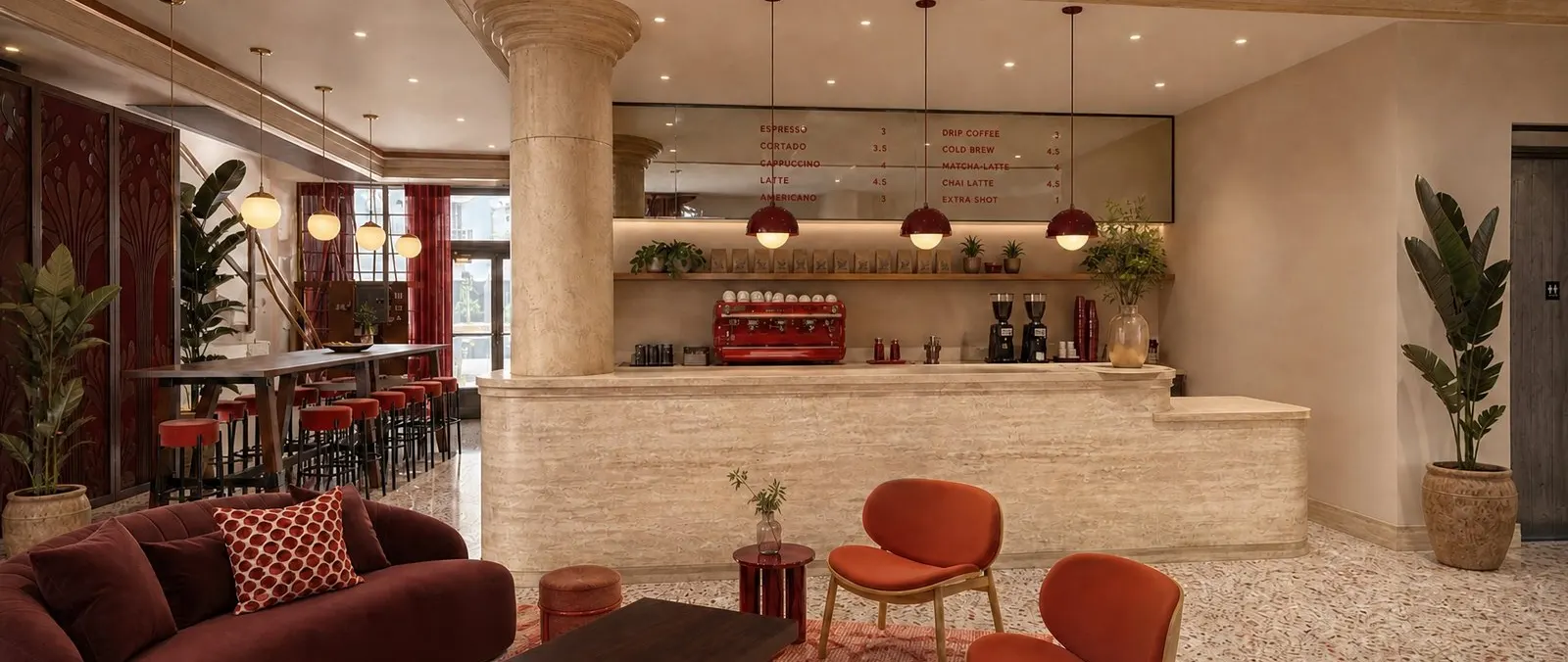
Hilton has announced plans to open a 289-room hotel in Miami Beach in early 2027, bringing five groups of historic Art Deco and Miami Modern structures into one hospitality address at 2000 Park Avenue. The official Hilton announcement dated 6 November 2026 describes a restoration programme that will connect buildings dating from 1938 to 1953 and introduce three swimming pools, contemporary dining, rooftop gathering spaces and guest accommodation. The proposed property is particularly relevant to luxury travellers who use Miami as a hub for boating, design events or winter stays, but it is a future opening rather than a hotel currently in operation. Its architectural appeal depends not only on new facilities but on the historical character the developer intends to preserve. The accompanying lead visual is an official architectural rendering, not a photograph documenting completion.
Five historic groups form one destination
The hotel project covers nearly a city block and combines structures associated with several phases of Miami Beach architecture. Hilton says its design approach is intended to preserve the identities of the buildings while allowing them to function as one hotel. That is a more complicated proposition than constructing a new tower on an empty site. Distinctive entrances, façades and structural arrangements can create memorable spaces but must also fit current expectations for circulation and guest services. Visitors will be interested in the sense of place, while preservation specialists will judge how much original material survives the work. The official announcement establishes the intent and the building history; a final assessment of restoration quality will require the completed property.
Architecture spans the late 1930s and early 1950s
Hilton identifies the former Collins Park Hotel, completed in 1939 to a design by Henry Hohauser, as one of the structures. It also names the Adams Hotel by L. Murray Dixon from 1938 and the Tyler Hotel by Albert Anis from 1940. Additional buildings include the former Copley Terrace Apartments, S&M Apartments, and the Lord Charles and Gamshire pair, whose designs extend the story into the 1950s. Such dates show how Miami Beach moved from Streamline Moderne toward postwar Miami Modern design. The collection should not be confused with a single building that represents every architectural period equally. Its interest is precisely the way several distinct identities will be brought into a common experience.
The Collins Park Hotel carries a complex history
The former Collins Park Hotel stands out in the operator's account because of its rounded corners, curved glass entrance pavilion and decorative details, including the historic '2000' address marker. Hilton also notes that the building served as military housing during the Second World War. This adds a historical dimension beyond beach holidays and glamour photography. It is possible to enjoy a beautifully restored lobby while recognising that the structure has been used for purposes very different from modern luxury hospitality. The company does not claim that every original room configuration will survive intact. For travellers who care about heritage, the relevant question after opening will be how the hotel explains those layers rather than simply using Art Deco as a marketing label.
Restoring vacancy and fire-damaged structures
The announcement refers to years of vacancy and a significant fire in 2012 among the challenges that preceded the new project. That background makes preservation more than a cosmetic exercise. Materials may require repair or reconstruction, and the resulting building must also perform safely for present-day guests. An independent article cannot infer the exact construction cost, insurance settlement or structural intervention merely from a press statement. What is documented is the decision to reconnect the historic buildings and retain their individual architectural language. Future photographs of the finished hotel will help reveal how that promise has translated into practical design. Until then, the renderings are useful descriptions of intent, not proof of the final outcome.
The 289 rooms balance history with contemporary needs
Hilton says the property will contain 289 guestrooms, with selected accommodation offering balconies or terraces and larger suites providing additional space. Announced room equipment includes custom furnishings, premium bedding, large televisions and familiar hotel amenities. These details indicate the operator's intended standard, but do not establish that every room category has identical dimensions or views. Historical structures can produce varied layouts, making careful room selection particularly important. Travellers booking a specific date should consult the final room inventory and accessibility details rather than rely on a general launch description. A location near major cultural venues may be appealing, yet the most successful room is one that fits the needs of its actual occupants.
Three pools will create different social settings
The planned facilities include a ground-level swimming pool in a landscaped courtyard and two rooftop pools. That range suggests distinct experiences within one hotel, from quieter daytime swimming to a more social elevated setting. Hilton also describes rooftop and outdoor areas intended for gatherings and celebrations. It would be premature to assign each pool an age policy, opening schedule or restaurant service without the final operating details. The existence of several planned pools does not mean each room will have direct pool access or that outside visitors can always enter. Guests should verify current rules, especially during events. The wider design idea is a hotel capable of accommodating different moods without leaving the historic property.
Dining moves beyond an overnight accommodation offer
The proposed food programme includes a signature coastal restaurant, a more casual café for coffee and quick meals, room service and a rooftop bar offering drinks and lighter dishes. An on-site market is also planned. These components are relevant because travellers often want the option to remain within their hotel for part of the day while still enjoying varied dining. The company has not published final menus, prices or every chef appointment in the release, so claims about a future Michelin rating or a named dish would be speculative. The appropriate description is a set of planned culinary venues drawing on the character of Miami Beach. Actual quality and execution must be judged once they are open.
Miami Beach location supports cultural exploration
The site is in the Museum Historic District, near the Miami Beach Convention Center, Collins Avenue, Ocean Drive and Lincoln Road. These references are useful for travellers who visit Miami for Art Week, design appointments, exhibitions or leisure. Location, however, is not the same as direct access to a marina. Anyone arriving on a yacht must independently arrange berthing, transfers and local transport based on the actual port and traffic conditions. The project is pitched as a central base from which to discover Miami Beach's cultural and dining areas. That is a persuasive urban-travel proposition without inventing a fixed transfer time from every yacht berth or airport.
Soft colour and geometric forms shape the interiors
Hilton says the design will use soft pink and green tones, polished metals, rounded forms and geometric detailing to reference the surrounding architecture. Public rooms will also draw on the city's cafés and diners through contemporary furnishings and decorative forms. These are elements visible in the operator's design description and visual materials, but not a guarantee that every feature appears in every guestroom. Design-minded travellers may be attracted by the continuity between façade and interiors rather than a themed treatment that could appear anywhere. The official rendering accompanying this report depicts the planned café environment and should be read as a visual proposal, not a picture of an already operating restaurant.
Additional amenities are planned for active stays
The group lists a fitness centre intended to operate around the clock, bicycle rentals, concierge services, beach access with loungers and towels and Wi-Fi among the proposed guest amenities. Such services can matter to travellers spending several days ashore before or after a yacht holiday. Nevertheless, individual inclusions and charges may depend on hotel policies, room rate and availability, and a press release does not replace binding booking terms. Beach equipment in particular may be affected by weather and local operational restrictions. Hilton Honors participation is also announced, but the precise benefits available to an individual member should be checked through official channels when booking.
Rooftops offer a new context for private gatherings
Hilton says rooftop and outdoor event spaces will be available for professional gatherings, receptions and personal celebrations. The property could therefore appeal not only to overnight guests but to people looking for a distinct Miami Beach setting for a private occasion. Historical architecture may give an event a sense of character, while the rooftop spaces provide a contrast with enclosed interiors. There is no verified event capacity or guaranteed exclusivity in the general announcement, and prospective organisers should ask the hotel for a current venue plan. A private reception may also involve local noise rules and separate contracting requirements. These practical details are part of planning well, rather than diminishing the appeal of the design.
The opening date remains a target
Hilton's announcement says early 2027, not a specific first-night guarantee. Restoration projects, inspections and operational preparations can affect hotel schedules, and readers should treat the opening as a published plan until the operator confirms that guests are being welcomed. The associated press images and the café rendering are first-party materials, but they do not establish that the final facility matches every proposed detail. This distinction is especially important for travellers buying flights or arranging yacht dates around an anticipated hotel launch. The original Hilton release is a useful basis for understanding the design ambition, with actual bookings and conditions to follow through current official channels.
A meaningful addition to Miami's hospitality landscape
The confirmed project combines a 289-room scale, a connected group of historic buildings and a planned mixture of cultural proximity, dining and pools. Its value to high-end travel is not simply the number of amenities; it is the attempt to bring nearly ninety years of the city's architectural character into a contemporary hospitality setting. What remains unknown is how the finished hotel will feel in use, what individual rates will be and whether every announced facility opens simultaneously. For Luxury Yacht Guide readers moving between yachts, galleries and Miami Beach, the early 2027 proposal is worth following as a heritage-led hotel redevelopment rather than treating a future rendering as an already completed luxury destination.
Explore related Luxury Yacht Guide lifestyle reporting
- Miami Design District Unveils Six Objects of Common Interest Installations
- Design Miami 2026 Sets Unveiling Theme for 22nd Collectible Design Fair
- Jumeirah Lake Como Plans Spring 2027 Debut With 40 Waterfront Suites
- Sofitel Rio Ipanema Prepares 1 December Beachfront Opening
Primary reporting and image credit
Primary manufacturer and organiser source(s): https://stories.hilton.com/releases/hilton-miami-beach-to-debut-in-early-2027-uniting-five-historic-art-deco-and-miami-modern-buildings. © Hilton Miami Beach / Hilton. Official rendering of the planned hotel café released November 2026, not a post-opening photograph. Image is used only for correctly attributed factual editorial coverage and never represented as open-licence stock photography.