An award for work beyond the guest experience
Four Seasons Resorts Maldives received the 2026 HICAP Sustainable Hotel Award for Biodiversity Action and Education, recognising conservation and training work at Kuda Huraa and Landaa Giraavaru. The honour, announced on 13 October, highlights the resorts' collaborations with scientists and local communities rather than a new hotel opening or an additional luxury villa. The judges identified continuing work to protect marine habitats and share practical knowledge.
The award comes from the Hotel Investment Conference Asia Pacific, which highlights hotel projects offering approaches that other businesses may adapt. That is a useful distinction for visitors interested in how an island resort operates beyond its accommodation and restaurants. A sustainability prize should still be assessed against published evidence: the recognition is one milestone in conservation programmes that have continued for many years.
Twenty-five years of marine conservation
The resorts describe roughly twenty-five years of conservation, research and teaching, beginning at Kuda Huraa in 1998 and extending to Landaa Giraavaru after that resort opened in 2006. Long-term effort matters because coral habitats and animal populations change over decades, while the effectiveness of a single restoration intervention can be difficult to judge immediately. A programme has to be maintained and monitored after its launch.
Four Seasons connects this work through Marine Savers, a programme operating from Marine Discovery Centres at both resorts. Those centres bring staff, researchers, guests and local students into contact with ongoing projects. Activities need to fit scientific aims and the safety of participants, rather than turn wildlife encounters into mere entertainment. The resorts' published reports provide the context for understanding results.
Reefscapers grows and monitors coral frames
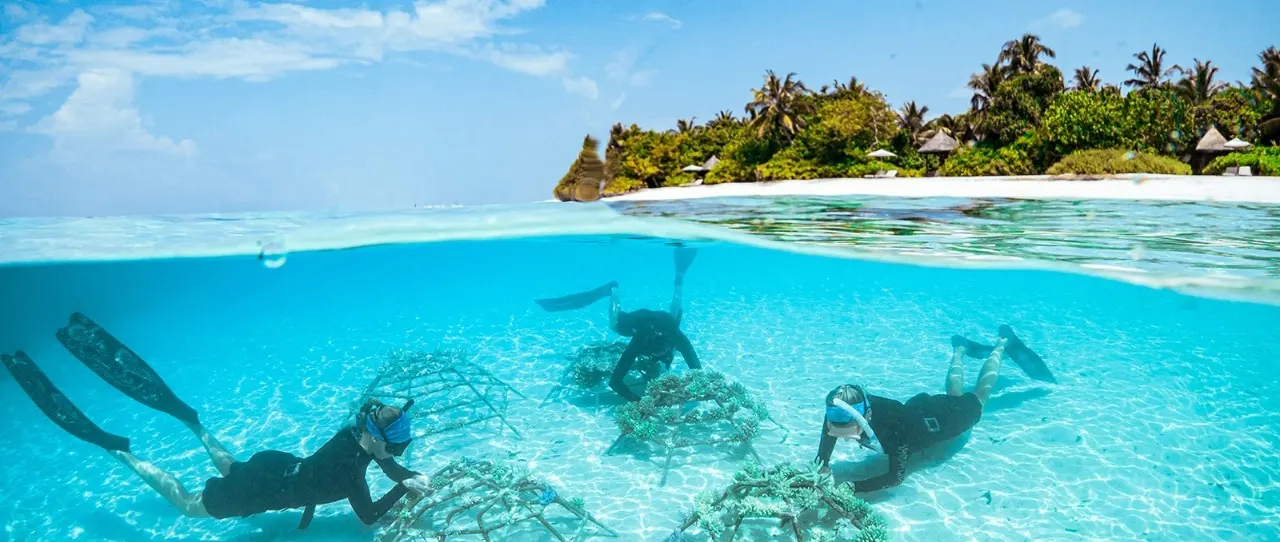
The Reefscapers partnership began at Kuda Huraa in 2001 and now encompasses more than nine thousand coral frames, according to the group's October statement. The frames provide artificial structures onto which coral fragments can be attached, with the aim of supporting reef recovery. The programme is not a substitute for reducing the wider stresses that damage reefs, but it can provide valuable opportunities for research and restoration.
Long-term monitoring has helped the team study survival rates and understand how different approaches perform in changing environmental conditions. Four Seasons says mature coral colonies on some frames reproduce naturally, while further work investigates spawning and larval settlement. A count of installed frames should not be confused with the number of surviving colonies or with a complete measure of reef health.
Research informs future restoration
The resorts say their coral data have contributed to peer-reviewed research supported by artificial-intelligence tools. Such analysis can help researchers compare outcomes across many sites and time periods, provided the original observations are reliable. It is especially important in a region where changing sea temperatures can affect coral condition and the likelihood of restoration success.
Other conservation collaborations include work with The Manta Trust. Field surveys and sustained observation can help scientists understand where animals are found and what influences their behaviour. Visitors may encounter these subjects through guided learning experiences, but a recreational trip should never be represented as equivalent to a formal scientific survey unless the necessary methods are followed.
Marine discovery for younger guests
Education is part of the award's emphasis. At Kuda Huraa, Junior Marine Savers gives children opportunities to learn about the sea through age-appropriate activities. Landaa Giraavaru's Trainee Marine Biologist Programme is designed for teenagers and includes six specialist modules taught with individual support. These experiences can make conservation more tangible than simply reading a hotel notice about the environment.
For families travelling by yacht or staying at a resort, a well-run programme can encourage curiosity about reefs and responsible behaviour around wildlife. Still, taking part in a visitor activity does not make someone a trained marine scientist. The purpose is to introduce observation, awareness and scientific questions, and to encourage participants to treat living habitats with care.
Training Maldivians for future careers
Landaa Giraavaru has hosted the Baa Atoll Marine Biology Internship Programme since 2023. Its structure runs through three stages across three years, introducing students from the atoll to marine science and giving them opportunities to develop practical skills. The programme reflects a commitment to knowledge within the local community rather than relying exclusively on visiting specialists.
The resorts also report 1,058 graduates from their government-accredited Apprenticeship Programme since 2001, across a range of career pathways that now includes marine conservation. A new four-year Marine and Environmental Science apprenticeship with Maldives National University combines study and fieldwork at both resort properties. Such routes may help young people build careers connected to the environment and tourism.
Sharing methods with other destinations
The company says reports and findings are shared through its Marine Savers website with researchers, students, other resorts and interested members of the public. Reefscapers has also been selected as a case study by the World Sustainable Hospitality Alliance. Making methods available can help others identify which elements might be adapted elsewhere, rather than assume success depends on a single resort's circumstances.
Marine ecosystems differ from island to island, and a coral-frame approach that works in one setting should not be copied without checking local conditions and regulations. Programmes need a scientific question, suitable supervision and a commitment to monitoring. The HICAP award acknowledges Four Seasons' efforts to join practical conservation with education, not a claim that all environmental challenges around the resorts have been resolved.
What travellers and yacht visitors can learn
Luxury travel in the Maldives depends in part on the health of the surrounding marine environment. Resorts and yacht operators have an interest in preserving the waters that attract their guests, although the appropriate action may differ. A yacht might support research logistics or encourage responsible guest activities, while a resort can maintain trained teams and long-term monitoring around its own facilities.
The official image accompanying this article shows divers working with coral-restoration frames in Maldivian waters, directly illustrating the programme recognised by the award. It is not a generic underwater stock image or a photograph of the HICAP presentation itself. Visitors interested in participating should consult Marine Savers for current activities, safety requirements and the scope of any guest programme.