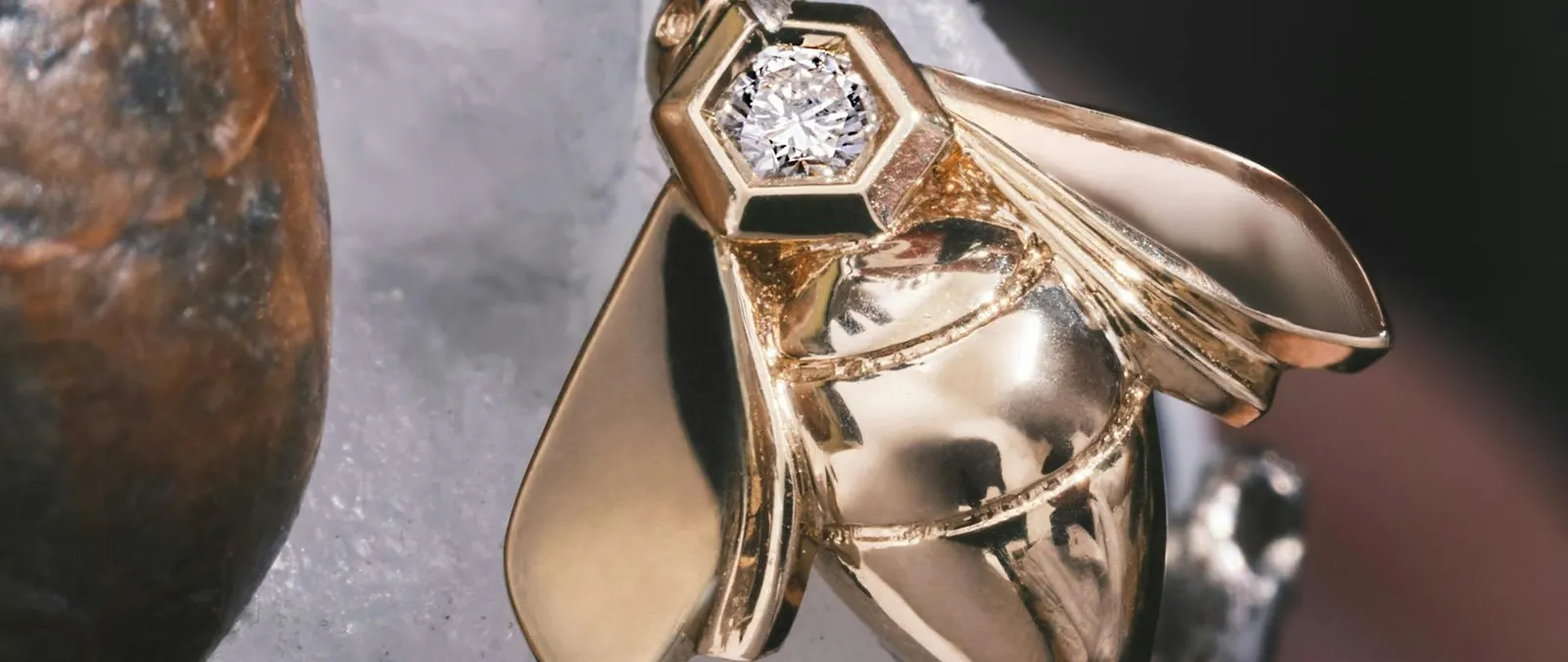
Chaumet has introduced its first High Jewellery creation made entirely from 100% traceable responsibly sourced gold, extending the Maison’s sourcing work into one of its most technically demanding product categories. The Bee de Chaumet set comprises a necklace and matching earrings built around the honeycomb motif associated with the collection.
The significance lies less in the visual design than in the chain of custody behind the metal. High Jewellery uses relatively small quantities of gold compared with many industrial sectors, but its clients increasingly expect clearer information about where precious materials originate and how they move from mine to workshop.
Bee de Chaumet becomes the test case for traceability
The new set uses polished gold and diamonds to create repeating geometric cells inspired by honeycomb. The motif lends itself naturally to a discussion of collective effort, since each individual element contributes to a larger structure while remaining visually distinct.
Chaumet previously introduced a Bee pendant using traceable gold in 2025. Moving the approach into High Jewellery increases the technical challenge because larger and more complex pieces require more components, more workshop stages and more rigorous consistency in material supply.
Traceability adds a second layer to provenance
Collectors traditionally think about jewellery provenance in terms of the Maison, designer, date, ownership history and gemstones. Responsible sourcing adds another dimension by asking where the metal came from and whether the supply chain can be documented beyond the finished workshop.
This does not replace conventional provenance; it expands it. A future collector may care simultaneously about who made a necklace, when it was created, which stones it contains and whether the gold can be traced through recognised sourcing standards.
Craft at 12 Vendôme remains central to the finished object
The set is produced through Chaumet’s jewellery savoir-faire at 12 Vendôme, where polished surfaces, diamond setting and sculptural volume turn a responsible-sourcing objective into a luxury object. Traceable material has little meaning to a collector if the finished piece does not meet the same aesthetic and technical standards expected from conventional high jewellery.
This is why sourcing and craft have to develop together. The industry cannot rely on sustainability claims as a substitute for design, but exceptional design increasingly has to acknowledge the material systems behind it.
Industry standards are becoming part of luxury manufacturing
Chaumet is a member of the Responsible Jewellery Council and the Swiss Better Gold Association. These organisations provide frameworks intended to improve environmental, social and governance practices across mining, refining and jewellery production.
The Maison says it intends to extend gold traceability progressively across its jewellery and High Jewellery collections. That suggests the Bee set is not being treated as a one-off ethical edition but as a step toward a wider change in sourcing practice.
Clients are asking more questions about invisible value
Much of what makes a luxury object expensive is visible in stones, polish, weight and complexity. Traceability belongs to a different category of value because it cannot be assessed simply by looking at the finished piece; it depends on documentation, auditing and confidence in the supply chain.
For collectors, that invisible value may become increasingly important as major houses make sourcing data easier to understand. Chaumet’s move shows how High Jewellery can preserve the emotional appeal of precious materials while adding a more explicit account of how those materials reached the atelier.