A Middle East showing for the Rebel range
SACS Marine says it is presenting the Rebel range in the Middle East for the first time at Dubai International Boat Show, running from 25 to 29 November 2026. Its dated company announcement identifies the Rebel 55 as the featured model and places the brand at stand MD-28. This is a report about a confirmed exhibition presence, not a claim that the design was launched for the first time anywhere in the world.
The distinction matters to buyers following the development of larger rigid-inflatable and hybrid-style open cruisers. A regional debut concerns access to a boat and the ability to examine its layout in a particular market. It does not automatically demonstrate orders, completed regional deliveries or sea-trial results in Gulf conditions. The information presently established by the manufacturer is the exhibition, the Rebel 55 and the wider brand presentation.
Why the Rebel 55 belongs in the luxury-yacht sector
The Rebel 55 is a substantial cruiser rather than a compact tender. SACS lists a hull length of 55.77 feet for its inboard configuration and 56.76 feet for the outboard layout, approximately 17.0 and 17.3 metres respectively. Both are squarely in the 12-to-23.99-metre yacht segment. The builder describes a deep-V hull and accommodation below deck, alongside open-air circulation and social areas.
That combination is central to the model's position. A yacht in this size range may be operated by an owner, used for coastal passages or configured as a high-performance day cruiser. A stand display helps buyers assess the relationship between exposed deck space and enclosed accommodation. Those are distinct decisions from those faced by owners selecting a smaller rigid inflatable as a tender for a much larger yacht.
A dated show announcement rather than a new launch
The official SACS article was published on 25 November and describes the Middle East arrival of the Rebel character. An earlier 23 November press package supplied on the brand's behalf by Sculati & Partners identifies the actual show configuration as two 1,000-horsepower Volvo Penta D13 engines with IPS 1350 drives, a white hull and deck, and carbon off-white D-fenders. The PR document mistakenly writes 2027 in its headline, whereas the builder's own dated 25 November 2026 notice, the current edition and stand dates confirm that the attendance being reported is in November 2026. It confirms the show dates, Dubai venue and MD-28 stand reference, but does not specify a new hull being launched or a customer handover during the event. The Rebel 55 already has an established technical page, available in both inboard and outboard formats.
Reporting the difference avoids overstating the news. A manufacturer's return to a market, a model's regional premiere and a brand-new world launch are separate events. The 2026 Dubai display is relevant because customers can encounter an existing model in a new regional context. Any information about transactions, contracts or future dealership expansion needs fresh first-party confirmation and should not be inferred from attendance alone.
Inboard and outboard choices serve different priorities
The published technical sheet distinguishes an inboard variant with suggested twin 1,000-horsepower diesel engines and IPS transmissions from an outboard version listing four 600-horsepower engines. Maximum installable power is stated as 2,000 horsepower for the inboard and 2,400 horsepower for the outboard. SACS gives different fuel capacities, installation weights, draughts and performance figures for the two arrangements.
These options are not interchangeable in practice. Buyers should look beyond engine count and consider maintenance access, service availability, noise, underwater equipment and the intended use of deck and transom space. Propulsion selection also affects where a boat can be supported. The Dubai exhibit provides an opportunity to ask for the exact specification of the displayed craft instead of assuming that every advertised figure applies to every Rebel 55.
Performance figures require their original conditions
The builder lists a maximum speed of 38 knots and 30-knot cruising speed for its suggested inboard setup. The outboard specification lists 48 knots maximum and 32 knots cruise. These are manufacturer-published figures marked with an asterisk in the official technical presentation; they are not independently witnessed results from the Dubai event. Displacement, weather, loading and maintenance affect actual operation.
An owner weighing higher speed against passage comfort should ask how the numbers were measured, including fuel load and sea state. Cruising speed is also not the same as economical cruise speed. Neither brochure range nor top speed removes the need for a passage plan with an appropriate reserve. Good editorial reporting preserves the maker's estimates without presenting them as a promise for every day and every hull.
Range is more than a single brochure number
SACS quotes approximately 280 nautical miles of cruising range for the suggested inboard arrangement and 270 nautical miles for the outboard configuration. Published fuel tank capacities are 528 gallons for the former and 925 gallons for the latter. The figures need to be read alongside the manufacturer's stated cruising speeds and its asterisked performance qualifications.
Those numbers are starting points for an operating discussion, not universal passage guarantees. Fuel margins, distance from diversion ports and the ability to refuel safely matter on longer coastal legs. Owners planning Gulf cruising should request realistic performance data for their loading and selected engines, including the effect of air conditioning, generator use and optional equipment on the practical operating profile.
Beam and draught shape the destination choices
The official specification puts the Rebel 55 beam at 17.32 feet, a little over 5.2 metres. It gives a draught of 4.36 feet for the inboard design and 3.81 feet for the outboard version. These dimensions affect berth allocation, clearance and the anchorage locations an owner may reasonably choose, regardless of how versatile the open-deck design looks in photographs.
A marina booking should rely on the final vessel measurements, including fenders, platforms and any protruding equipment. A nominal model name does not tell a harbourmaster the beam or draft to use. Owners visiting a display should request the exact certified and operational dimensions of their selected configuration and confirm local restrictions before drawing conclusions about access to shallow anchorages.
Accommodation changes the nature of the boat
The manufacturer lists sleeping accommodation as four plus one optional berth, alongside a published persons capacity of 22. Those two figures mean very different things. An authorised total capacity for people aboard is not a statement that all passengers can sleep on board, nor does it guarantee that every social gathering will feel comfortable in all weather.
Below-deck layout and the quality of transition between cockpit and accommodation should therefore be inspected rather than assumed. For an owner considering extended weekends, headroom, ventilation, privacy, wet-storage space and access to bathrooms can matter more than a headline passenger number. Prospective buyers can compare the practical cabin arrangement with the time they expect to spend aboard.
The deep-V hull and D-fender construction
SACS specifies a V hull with 18.7 degrees of deadrise and identifies its foam-filled D-fender anti-shock protection. Both details speak to the design's combination of planing performance and contact protection. The manufacturer emphasises stability, control and the ability to use the craft dynamically, although its marketing descriptions are not a substitute for independently tested seakeeping data.
Deadrise alone does not determine comfort, dryness or behaviour at rest. Hull geometry, appendages, mass and handling play their parts. The protective fender can be important during marina manoeuvres, but it should not be read as licence to make uncontrolled contact with docks. Owners should assess fit, repairs, replacement availability and fender condition when comparing examples.
Design credited to Christian Grande
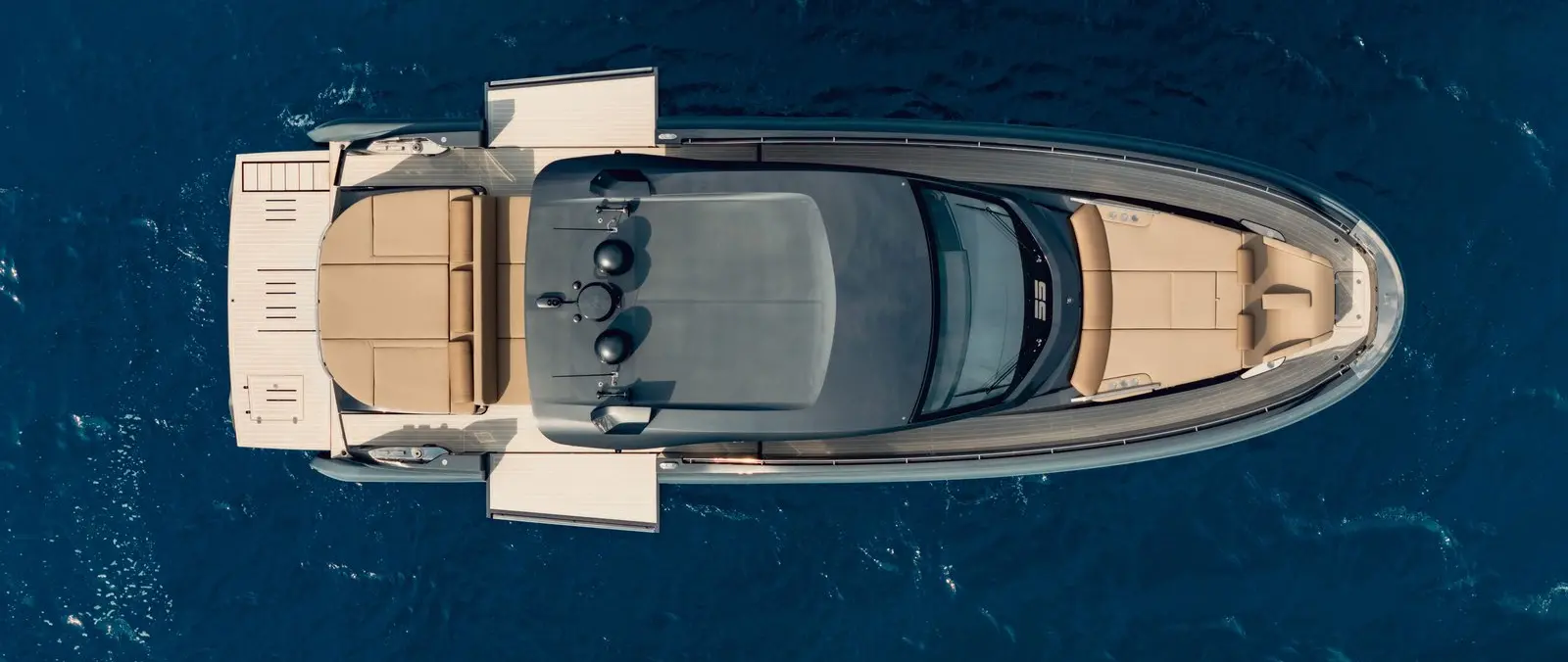
The Rebel 55 technical sheet credits design to Christian Grande Design Works, with the project attributed to SACS Marine. The distinction is useful: the styling and arrangement have named design authorship, while the boat is built and marketed by the marine brand. The official photographs show the established Rebel design rather than documenting the November Dubai stand.
Design identity can create immediate interest, but it is the combination of ergonomics and construction that determines utility. Buyers should examine sightlines from the driving position, safe movement between seating zones, weather protection and the maintenance implications of decorative finishes. A visually striking exterior should still work for the owners and guests who will use the boat.
An outdoor boat with enclosed obligations
The Rebel formula emphasises open leisure space, but any yacht of this size must also function when weather is unsettled or when the crew wants to secure equipment before leaving a berth. The manufacturer's published configuration includes hard-top and interior options, and the choice of propulsion arrangement changes available space at the stern.
The practical assessment is not limited to photographs taken in sunshine. Owners should consider how quickly cushions and loose equipment can be secured, where guests can shelter and whether drainage and movement routes remain workable. An exhibition viewing can establish basic access and storage observations, but it is not a sea trial and cannot prove noise, vibration or ride quality.
Capacity is not a substitute for a passage plan
A declared people capacity of 22 refers to the builder's published technical specification. Responsible operation remains subject to the boat's actual certification, applicable flag and local rules, loading and the judgement of its master. Seating allocation, lifejackets, escape routes and safe guest movement must be considered in a way that reflects a real outing.
The approach matters especially for a fast open cruiser with widely spread social areas. More people on board can change weight distribution and the way passengers respond to a sudden manoeuvre. Owners should ask the dealer to demonstrate handholds, safe seating and emergency equipment arrangements in the exact configuration being offered rather than relying on a promotional maximum.
Regional demand cannot be inferred from one appearance
The Dubai International Boat Show offers the manufacturer an opportunity to present the Rebel design to Middle Eastern buyers. The official announcement establishes that opportunity, not its commercial outcome. There is no verified order total, booked demonstration programme or published regional customer delivery figure in the short SACS statement.
Market interpretation therefore requires restraint. A stand visit can help a potential owner understand the product, and manufacturer representatives may be able to answer technical questions. Nevertheless, the strength of future demand is a separate question for which evidence would include confirmed customer orders, delivery reports and announced service arrangements. None should be invented to make the event seem larger.
Service logistics are as important as specifications
For a 17-metre performance cruiser, reliable operation depends on support for engines, drive systems, electrical equipment and interior components. SACS identifies different engine and propulsion arrangements, meaning maintenance planning will differ materially between an IPS inboard boat and one with four outboard engines.
Owners should verify authorised repair arrangements in the territories they intend to visit, not simply the market where the boat is displayed. Spare parts lead times and haul-out access can shape the total ownership experience. The presence of a manufacturer at a show is a starting point for those conversations, but it does not itself establish a particular service contract or local workshop capacity.
Fuel, water and waste planning on board
The builder's published water capacity is 106 gallons and waste tank capacity 53 gallons in both displayed specification columns. Those are finite onboard resources. The capacity of a yacht to accommodate guests for a full day does not equate to the endurance expected for several nights without replenishment.
Prospective owners can use the figures to discuss typical passenger numbers, washing and showering routines, galley use and marina access. Local climate may increase demands on drinking water and comfort systems. Any calculation must be tailored to the actual equipment and people aboard; the specification alone does not support a universal number of independent days at anchor.
Seeing the displayed example matters
A manufacturer's model page may show several arrangements, options or alternative finishes. The 25 November announcement does not provide a detailed equipment inventory for the individual boat at MD-28. Visitors should therefore avoid assuming that every photographed option is installed on the unit present at Dubai.
Useful questions include whether the display is an inboard or outboard boat, what equipment is standard, which installations are optional and what the final delivered specification would cost. A buyer comparing different 17-metre cruisers benefits from written specifications, build terms and a survey or sea trial appropriate to the transaction. The event itself does not replace those steps.
What the official images actually show
The image accompanying this report comes from SACS Marine's own Rebel 55 model gallery. It depicts the established design and is used to identify the yacht under discussion. It is not presented as evidence that the pictured boat was photographed in Dubai or that a particular owner attended the November event.
Keeping an accurate caption matters for both historical reporting and image rights. The company retains its photographic ownership and receives explicit attribution. The editorial account relies on its dated show announcement for the event and on its technical model page for dimensions and equipment; neither the photograph nor the narrative should be repurposed to assert unverified attendance or deliveries.
The immediate takeaway for 17-metre buyers
The verified development is a first Middle East Rebel-range showing, with Rebel 55 promoted by SACS Marine at Dubai International Boat Show from 25 to 29 November 2026. The latest event statement provides the venue and stand, while the technical page supplies a range of inboard and outboard specifications for prospective customers to examine.
Interested owners can meaningfully compare hull dimensions, available engine configurations, cabin arrangements, capacity and the service consequences of each choice. That is the practical value of the announcement. Claims about confirmed contracts, sea-trial results during the show or a newly launched design would go beyond the public source evidence, and are deliberately excluded from this account.
Primary sources and image provenance
News based on the current verified manufacturer or event news announcement and original builder, event or authorised distributor specifications and imagery. © SACS Marine / original creator. Official Sculati & Partners press photograph for the SACS 23 November 2026 Dubai announcement, high-resolution image (4) from the first-party press kit. Existing Rebel 55 yacht shown as an illustrative model photograph; not stated to have been photographed at the exhibition. Images are genuine original subject-specific manufacturer, authorised distributor or original event photographs or official product design visual; they are not AI newsroom artwork. Prior events, future shows and construction are identified distinctly.