A new test adds evidence beyond the launch announcement
A new independently reported sea trial has added operating detail to the story of the Itama 70, the large open motor yacht that made its public debut at Cannes in September 2026. PressMare published its account on 4 November, describing a run aboard the first example and reporting a measured top speed of 38.7 knots. This is a different development from the original yard launch or the subsequent boat-show presentations: it offers observations made while the yacht was actually underway.
The trial was conducted off Cannes aboard a boat fitted with the higher-output propulsion package, and its findings should be read with those conditions in mind. They are not a guarantee that every Itama 70 will achieve the same speed with different loads, weather, hull condition or optional equipment. Nevertheless, the results help prospective owners connect the manufacturer's design ambitions with the way the vessel behaves in an identifiable operating situation.
The high-output MAN package reached 38.7 knots
PressMare reports a maximum speed of 38.7 knots at 2,370 revolutions per minute from twin MAN V12 engines rated at 1,550 horsepower each. The test vessel used five-blade propellers, and the journalist describes smooth running at speed with a responsive helm. The observed result sits close to the optional-engine performance figure previously associated with the model, although comparisons should distinguish measured trial results from preliminary manufacturer forecasts.
The standard engine choice is a pair of 1,400-horsepower MAN V12s, giving prospective owners a meaningful decision between the two configurations. Higher top speed is only one consideration in that decision. Fuel use at the speeds an owner actually prefers, maintenance requirements, noise, availability of service support and the total acquisition cost can all matter more than the last one or two knots. Those figures require current technical documentation and, where possible, a representative sea trial.
An efficient cruising speed was not necessarily the maximum
The sea-trial report identifies approximately 25 knots as a comfortable operating compromise rather than presenting the yacht's top speed as the only relevant performance measure. For an owner, that distinction is important because most journeys involve time at a sustainable cruising pace, not repeated full-power runs. Lower speed can make conversation, deck use and fuel planning easier, although the precise consumption benefit is dependent on the actual engines, trim and sea state.
The builder has also circulated higher nominal cruising-speed figures associated with its published propulsion packages. Those should not be confused with the tester's preferred pace on the day. A prospective purchaser should ask for the full speed-and-consumption curve and determine which point best fits intended passages. An appropriate test should include turns, acceleration, visibility and sound levels as well as speed measured over a short straight run.
Test conditions make the numbers more useful
The reported test boat carried 12 people, approximately 1,854 litres of fuel and 571 litres of water. Listing these details helps readers understand why a single measured speed cannot be applied without adjustment to every operating condition. A boat loaded for an extended family cruise, with more equipment and supplies, may sit differently in the water from one used for a short demonstration near a yacht show.
Sea state is another important qualifier. The Cannes trial took place in relatively calm water, allowing the reporter to examine acceleration and handling without claiming that the conditions represented an offshore passage in heavy weather. Buyers interested in year-round use should obtain evidence relevant to the waters they intend to navigate. No one test can replace appropriate training, weather judgment or the certified operating limits of an individual yacht.
The open cockpit remains the defining experience
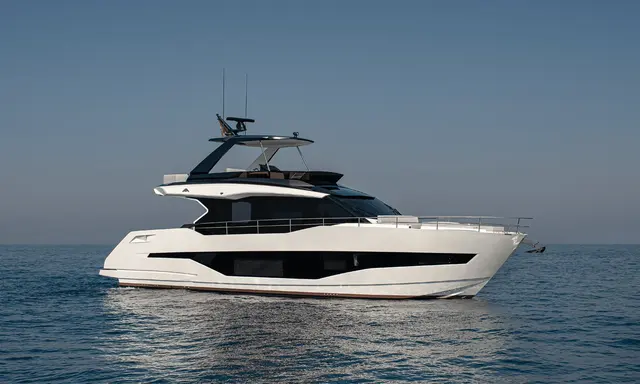
The Itama 70 follows the brand's established low-profile form, with a long forward deck, a protective windscreen around the helm and no large enclosed superstructure above the principal deck. The report says that underway the cockpit can be windy, a predictable consequence of an open design that prioritises direct contact with the sea. That is a feature some owners actively want, while others may prefer a more sheltered sports cruiser.
Prospective buyers should assess the trade-off with their intended cruising season in mind. A large open cockpit can be outstanding in settled Mediterranean weather and enjoyable at anchor, yet shade, spray protection and circulation may matter more on longer or cooler passages. The Itama 70's practical value depends on whether owners appreciate the open-yacht character enough to accept its limitations rather than expecting it to behave like an enclosed flybridge yacht.
Three ensuite cabins extend the boat's intended use
The yacht combines its open deck plan with three guest cabins and three bathrooms, giving it a more substantial overnight programme than a pure dayboat. The owner's accommodation is positioned aft, while a VIP cabin occupies the bow and a further cabin sits to port. That allocation changes the relationship between sleeping accommodation and the main social areas, making extended family trips a realistic part of the model's design brief.
The availability of private bathrooms for all guest cabins is meaningful in a yacht of this type, especially when friends or relatives share several nights aboard. However, buyers should inspect storage, sound insulation, ventilation and the route to the lower deck when guests are moving around after dark. A generous published cabin count is only the start of assessing comfort. The day-to-day quality of an extended stay depends on how the spaces work together.
Crew and storage arrangements remain a choice
A separate single crew cabin with its own bathroom can be specified, according to the reported layout, and it is accessed without taking crew through the guest accommodation. For owners who prefer to drive their own boat, the equivalent space can instead serve as storage. That is a practical example of how the same hull may be configured for different forms of use rather than having a single mandatory operating model.
The choice also affects how a yacht should be assessed before purchase. An owner planning to employ professional assistance needs a workable crew arrangement and clear responsibilities, while an owner-operator may value extra space for water toys, cleaning equipment or cruising supplies. The correct configuration depends on actual use. Any specific layout option should be confirmed against the latest builder specification and the equipment installed on the available boat.
Hull and tankage set the range-planning context
The published technical particulars describe a fibreglass planing hull driven through conventional shaft lines, with a fuel capacity of about 4,100 litres and water capacity of about 700 litres. The sea-trial account lists light displacement at 36 tonnes and full-load displacement at 43 tonnes. These numbers help explain why apparently similar open yachts can require quite different operating strategies depending on loading and passage length.
The manufacturer's quoted range is approximately 290 nautical miles for the standard engines and 280 for the higher-output version at the relevant stated cruising settings. Those figures must be treated as reference values, not distances an owner can automatically plan to cover without reserve. Weather, speed, fuel condition, generator usage and prudent margin for diversion all affect safe passage planning. Buyers should work from measured consumption and an appropriate reserve policy.
Design teams have protected a recognisable identity
The exterior design comes from Vallicelli Design, while IdeaeItalia is responsible for the interior, working with Ferretti Group's product and engineering teams. The model's profile remains closely associated with Itama's heritage: long horizontal lines, a prominent foredeck sunpad and an open helm experience. New features have been incorporated without turning the vessel into a different type of motor yacht or moving it outside the luxury-yacht market below 24 metres.
The internal arrangement is where some of the more meaningful changes appear. A larger aft owner's cabin and dedicated guest bathrooms address the demands of overnight cruising, while the cockpit still carries much of the social programme. The balance may appeal to experienced open-yacht owners who want more comfort without abandoning the character of the type. It remains important to inspect the actual boat, because pictures do not reveal every ergonomic compromise.
What the findings mean for a prospective owner
The new report gives the Itama 70 story a specific performance datum and a first-hand description of handling that earlier launch announcements could not provide. It does not change the basic identity of the yacht, nor does it settle every question about fuel use, rough-water comfort or the economics of ownership. Its value is that it narrows the gap between preliminary specifications and a vessel operating in real conditions during a documented test.
Owners considering the model should request the full technical sheet, examine the propulsion alternatives and arrange an appropriately loaded demonstration when possible. They should also compare an open-deck yacht with enclosed alternatives before committing to a long cruising programme. The practical headline is a 38.7-knot top speed observed in the high-output version during the Cannes trial, with the conditions clearly stated and the new report available for readers to examine.
Source: PressMare independent first-hand Itama 70 sea trial, 4 November 2026.