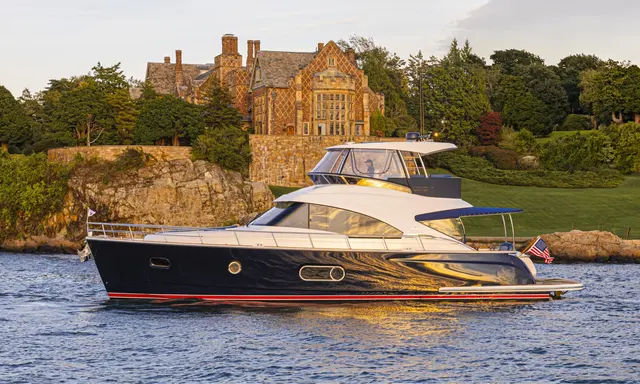
Greenline Yachts is presenting the all-new Greenline 42 at the Cannes Yachting Festival 2026, giving the model its French Riviera debut after its world premiere and initial sea trials earlier in the year. The 42 replaces neither the brand’s efficiency focus nor its family-cruising identity, but develops both with a more contemporary exterior and greater emphasis on flexible living space.
The yacht is offered with conventional twin 250hp Yanmar diesels or Greenline’s H-Drive 6G hybrid system. That choice allows owners to approach the same hull in two different ways: either as a straightforward diesel cruiser or as a more complex energy-managed yacht capable of silent low-speed operation under electric power.
A new hull raises the performance ceiling
Naval architects MICAD developed the hull with a published top speed of 25 knots, around three knots faster than the Greenline 40 with comparable power. Greenline is trying to preserve the economical cruising behaviour associated with the brand while giving owners more reserve speed for weather, timetable changes and faster coastal hops.
That balance is important because the 42 is not being positioned as a performance boat. Its appeal depends on delivering useful efficiency at normal cruising speeds, so the more meaningful sea-trial evidence will be fuel burn, noise and range across realistic loads rather than the single maximum-speed figure shown at the top of the specification sheet.
The H-Drive hybrid adds silent low-speed running
In hybrid form, electric motors sit between the diesel engines and propellers and can propel the yacht at speeds up to 6.5 knots. That allows silent manoeuvring and low-speed cruising while retaining diesel engines for longer or faster passages, giving owners flexibility rather than requiring them to accept the range limitations of a purely electric drivetrain.
When the diesels are running, the system can also harvest energy back into the battery bank. The usefulness of that arrangement will depend on the owner’s operating profile, because a yacht that spends long periods at anchor or moving slowly may exploit the electric capability more often than one used mainly for fast marina-to-marina passages.
Solar capacity supports the hotel load
Ten solar panels integrated into the coachroof can generate up to 4.5kW in peak conditions. They feed a standard 22kWh house battery bank that can be expanded to 66kWh, giving the yacht a substantial reservoir for air conditioning, refrigeration, induction cooking, charging and other domestic loads while at anchor.
Greenline says favourable sunshine can allow the array to produce more energy than the air-conditioning system consumes. That claim will vary with climate and onboard use, but it demonstrates the design priority: reducing generator dependence for hotel services rather than treating solar panels as a token addition to the roof.
The cockpit has been reworked around flexibility
Designer Marco Casali has given the 42 a larger and more adaptable cockpit, with a central four-person dining table and optional arrangements including a drop-down aft platform and more open lounging space. Large galley windows and fully opening aft doors are intended to connect the saloon and cockpit into one continuous social area.
The layout makes sense for an owner-operated yacht because the person preparing food remains connected with guests outside instead of being isolated inside a separate galley. It also allows the same space to work differently at anchor, underway or when the yacht is stern-to in a marina, which matters more in this size range than adding a rarely used formal area.
Two cabins keep the accommodation straightforward
Below deck, the Greenline 42 uses a two-cabin arrangement with the owner’s cabin forward and a guest cabin that can be configured with twin or double berths. An optional second bathroom adds privacy for longer stays, while the interior is offered in Golden Teak and Silver Oak schemes.
The decision to retain two primary sleeping cabins avoids squeezing extra berths into a 42-foot platform at the expense of circulation and storage. For couples or families cruising for more than a weekend, usable wardrobes, headroom and access to bathrooms can matter more than the maximum number of people a brochure says the yacht can sleep.
Cannes will test the complete ownership proposition
The Greenline 42 is significant because its technology is tied closely to everyday ownership rather than a single headline innovation. Hybrid propulsion, solar charging, large house batteries and a flexible cockpit only become valuable if they make the yacht quieter, easier to live aboard and simpler to manage over a full season.
At Cannes, prospective owners can compare those systems with more conventional cruisers of similar length and decide whether the added electrical complexity delivers benefits they will actually use. The model’s success will depend on that practical equation as much as on its new styling or higher top speed.