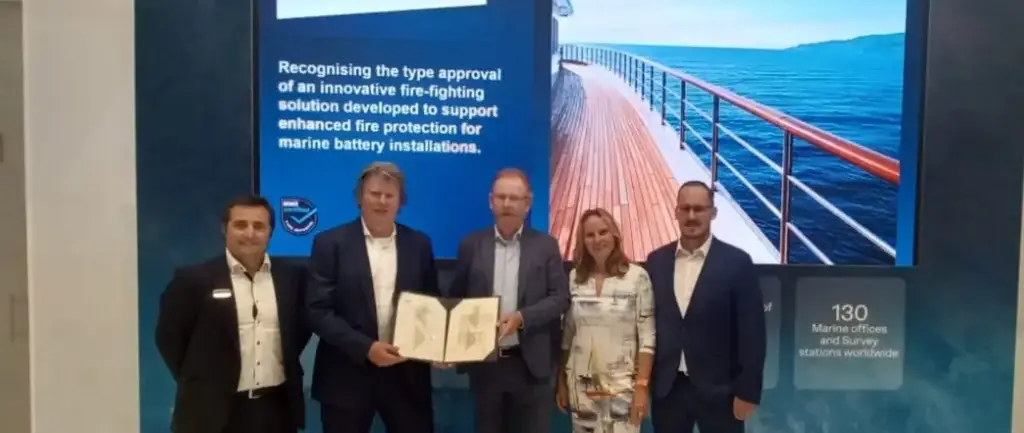
FIFI4MARINE has become the first lithium-ion battery fire-suppression system to receive RINA Type Approval. The certification validates the approved product design for repeat marine applications while leaving vessel-specific integration and statutory requirements to be addressed for each installation.
The milestone is relevant as electric propulsion, hybrid systems and large lithium house banks move into more recreational yachts. Battery safety is becoming a design issue for boats well below superyacht size, particularly where high energy density is concentrated in enclosed machinery spaces.
The system targets thermal runaway at source
FIFI4MARINE combines gas and fire detection with automatic suppression arranged around the battery installation. The aim is to identify an incipient thermal event early and contain it before heat propagates through neighbouring cells or modules.
Lithium-ion battery fires differ from conventional fuel fires because cells can continue generating heat internally. Early detection and localised intervention can therefore be more effective than relying only on a general engine-room extinguishing system.
Type Approval simplifies repeat use
RINA Type Approval does not remove the need for engineering on each yacht, but it means the core product design has already been assessed against the relevant approval process. That can reduce repeated design work when the same system is used across multiple projects.
For production builders, that repeatability is important. A yacht model with an electric or hybrid option can integrate a pre-assessed protection architecture more efficiently than starting from a bespoke suppression concept for every hull.
Electrification raises a new safety requirement
Yachts are carrying larger batteries for propulsion, silent overnight operation, hotel loads and peak-power support. As capacity rises, so does the importance of compartment design, monitoring, ventilation and fault containment.
Owners should still view fire suppression as one layer in a broader safety strategy. Battery quality, correct installation, thermal management and proper charging control remain essential to reducing the likelihood of an incident in the first place.
Approval may accelerate adoption on smaller yachts
FIFI4MARINE lists installations and projects across a wide range of vessels, showing that the technology is not restricted to one propulsion type. As battery systems become more common in yachts under 24 metres, approved fire-protection systems are likely to become a more routine part of technical specifications.
For LYG owners, the practical significance is that electrification is maturing beyond motors and batteries. Supporting safety systems are now moving through formal approval processes that can make advanced battery installations easier for yards, surveyors and insurers to evaluate.