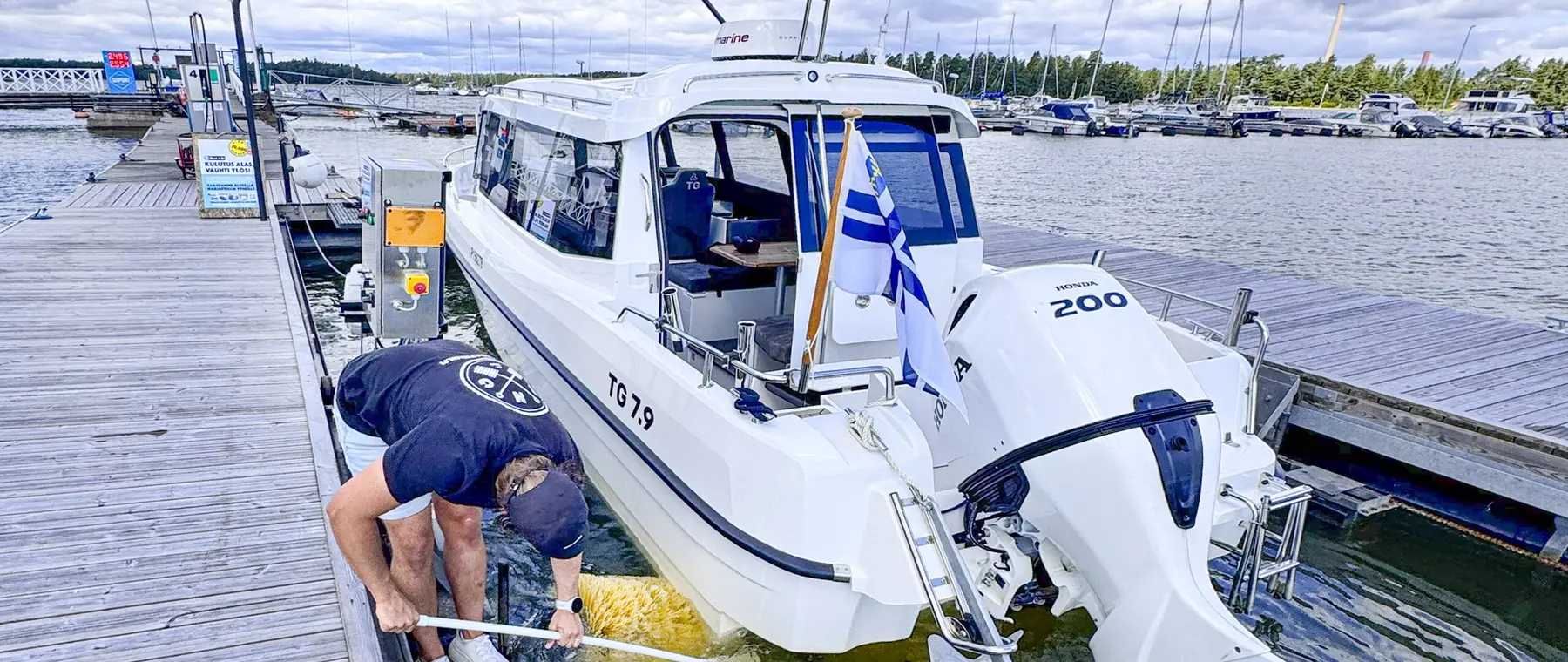
Finnish hull-cleaning company Brush ’n Go and boating media association Veneilytoimittajat ry have released results from practical trials conducted between April and August 2026. Three experienced boaters measured performance and fuel consumption before and after removing hull fouling.
The tested TG 7.9, Bella 550R and Buster XXL were all smaller than Luxury Yacht Guide's twelve-metre threshold. Their results are therefore useful evidence of fouling effects in the marine industry, but they cannot be presented as verified fuel-saving percentages for larger luxury yachts.
A measurable drop in one boat's consumption
On a Bella 550R, economical cruising speed rose from 21.3 to 24.2 knots after cleaning, while fuel consumption fell from 0.82 to 0.59 litres per nautical mile. The reduction is about 28 percent for that particular measurement.
This is the most concrete percentage reported in the trial and not a guaranteed outcome for other boats. Load, hull type, operating conditions and the severity of fouling all matter.
Different changes on two other hulls
For an unpainted TG 7.9, the reported cruising and top speeds improved by around four knots, with consumption falling by as much as half a litre per nautical mile. The owner estimated a fuel-cost saving of approximately €2,300 during the summer.
On a Buster XXL, fouling had reduced top speed from 40.5 to 30.4 knots and raised cruising consumption from 0.88 to 1.2 litres per nautical mile. The separate test results reflect different boats and patterns of use.
Mechanical cleaning without a haul-out
Founded in Finland in 2020, Brush ’n Go provides mechanical in-water cleaning without soaps or solvents. The company says its service operates across around sixty Finnish marinas, giving owners an alternative maintenance option.
Any cleaning programme should still be compatible with the particular hull surface, coatings and local environmental rules. An unpainted small craft cannot be treated as the same maintenance case as a coated larger yacht.
What the findings mean for luxury-yacht owners
The broader lesson is to consider hull cleanliness when investigating unexpected changes in fuel use and attainable speed. Larger vessels have different hydrodynamics and coatings, so savings must be assessed on the yacht itself rather than borrowed from a small-boat trial.
The study was a limited real-world comparison, not a controlled multi-class certification of cleaning products. LYG is reporting the observed data with that limitation rather than making a universal 28-percent claim.