Farther into the Maldives
Six Senses Laamu is positioned in the southern Maldives, on Olhuveli Island in Laamu Atoll. Its identity rests partly on distance: travellers arrive in a more remote setting than the heavily developed resort areas close to Malé. Once on the island, the defining elements are white sand, warm water and a landscape deliberately kept close to its natural character.
The resort describes a scenic air transfer as part of the approach, but guests should confirm the current transfer route and timing when booking. International arrivals, domestic connections and local weather can change the practical shape of a journey. It is sensible to allow a margin rather than planning the tightest possible onward connection.
Choosing between land and water
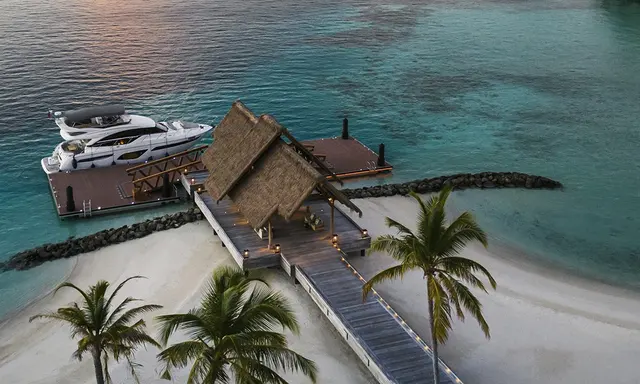
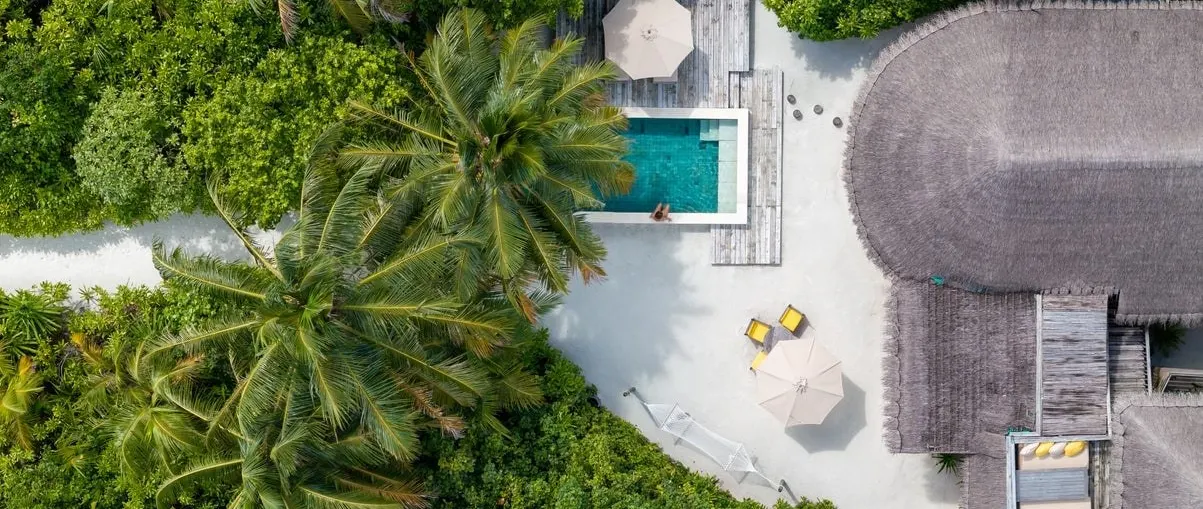
Six Senses Laamu describes 94 beachfront villas, over-water bungalows and private-pool villas. Some place the guest immediately beside sand and island vegetation, while others extend over the sea on wooden jetties. The broad choice allows travellers to decide whether they prefer the intimacy of a garden or the open horizon of an over-water deck.
The water accommodation is not identical across categories. The Laamu Water Villa, for example, includes separate upper and lower deck areas and a glass-sided sunken bathtub. Buyers of a holiday experience should examine the exact floor plan and access route, including suitability for children, before being swayed by a spectacular photograph.
The house reef as a daily destination
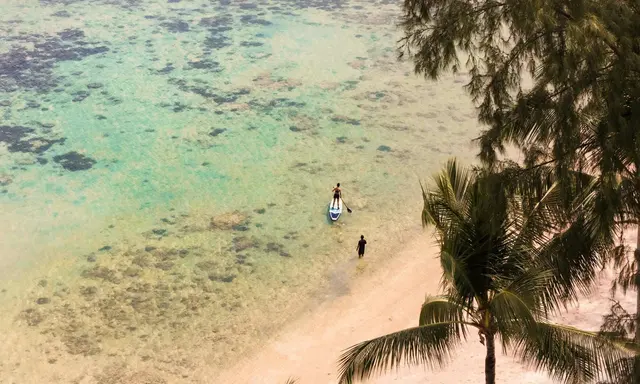
A central attraction is the ability to observe marine life around the island without treating every underwater experience as a full-day expedition. Six Senses promotes snorkeling and diving close to the resort, as well as the opportunity to explore reefs farther afield. It also highlights the appeal of dolphins and rays in the surrounding waters.
As with any reef destination, conditions, currents and individual ability must guide activity decisions. Guests should use properly qualified instructors where appropriate, follow local wildlife rules and avoid touching or standing on coral. The proximity of marine life is a privilege and a reason to behave carefully, not an invitation to crowd or pursue animals.
Conservation with a local structure
Six Senses Laamu hosts the Maldives Underwater Initiative, a conservation collaboration involving the Manta Trust, Blue Marine Foundation and Olive Ridley Project. The initiative brings research, guest education and community outreach into the resort’s wider identity. This is a more substantial proposition than treating sustainability solely as a description of villa materials or restaurant ingredients.
Visitors interested in these programmes should enquire about educational activities and the genuine scope of guest participation. Scientific projects vary in timing and priorities, and some work should remain undisturbed. Supporting local conservation can mean listening, learning and respecting access restrictions as much as taking part in a visible activity.
Surfing and other adventures
The Laamu Atoll setting also appeals to travellers who want more than tranquil water. The resort highlights surfing and references the well-known Yin Yang break, alongside snorkeling, diving and boat trips. A holiday can therefore alternate between energetic days and quieter periods spent reading or swimming near the villa.
Surf conditions depend on swell, season and experience, and a famous break is not suitable for every beginner. Guests should seek advice from qualified local operators and avoid assuming that equipment availability guarantees safe conditions. It is worth organising the more weather-dependent activities early in a stay so that there is some flexibility for changes.
Dining by water and under the stars
The resort presents a choice of East-West dining and special experiences, including a private barbecue on the beach. That range suits guests who want a relaxed lunch one day and a carefully arranged celebration the next. The distinctive setting is the essential ingredient: a simple meal beside the Indian Ocean can feel more memorable than a lengthy formal menu.
A private dinner should be discussed in advance, including seasonal weather and dietary needs. Travellers booking a longer stay might alternate resort dining with opportunities to learn about Maldivian ingredients and regional food traditions. The most satisfying programme leaves space for both discovery and the simple pleasure of dining without a timetable.
Design that responds to place
Six Senses describes the use of local and sustainable materials in its beachfront and over-water villas, reflecting an effort to relate the buildings to the island setting. Natural textures and open-air spaces support a feeling of connection to the landscape. Such design choices have practical consequences too, including exposure to salt air, sunshine and changing weather.
Guests should ask about their villa’s shade, privacy, accessibility and arrangement of outdoor bathrooms or decks. These characteristics can be attractive in photographs but need to suit the actual travel party. A family with young children may value direct access to sand and a protected pool area more than the dramatic outlook of an isolated jetty.
A place to learn as well as unwind
Laamu is best approached as an ocean destination with a conservation story, not simply a collection of turquoise photographs. Guests can combine quiet days in their accommodation with carefully chosen excursions and opportunities to understand the life beneath the surface. The island’s remoteness supports the feeling that time is being set aside for something different.
Before travel, verify the transfer schedule, villa configuration, activity conditions and any opportunities to engage with the marine initiative. These details will shape the holiday more than a generic resort rating. For yacht-minded travellers, Six Senses Laamu offers a rewarding reminder that the best waterside experiences are often about understanding the sea, not only looking at it.