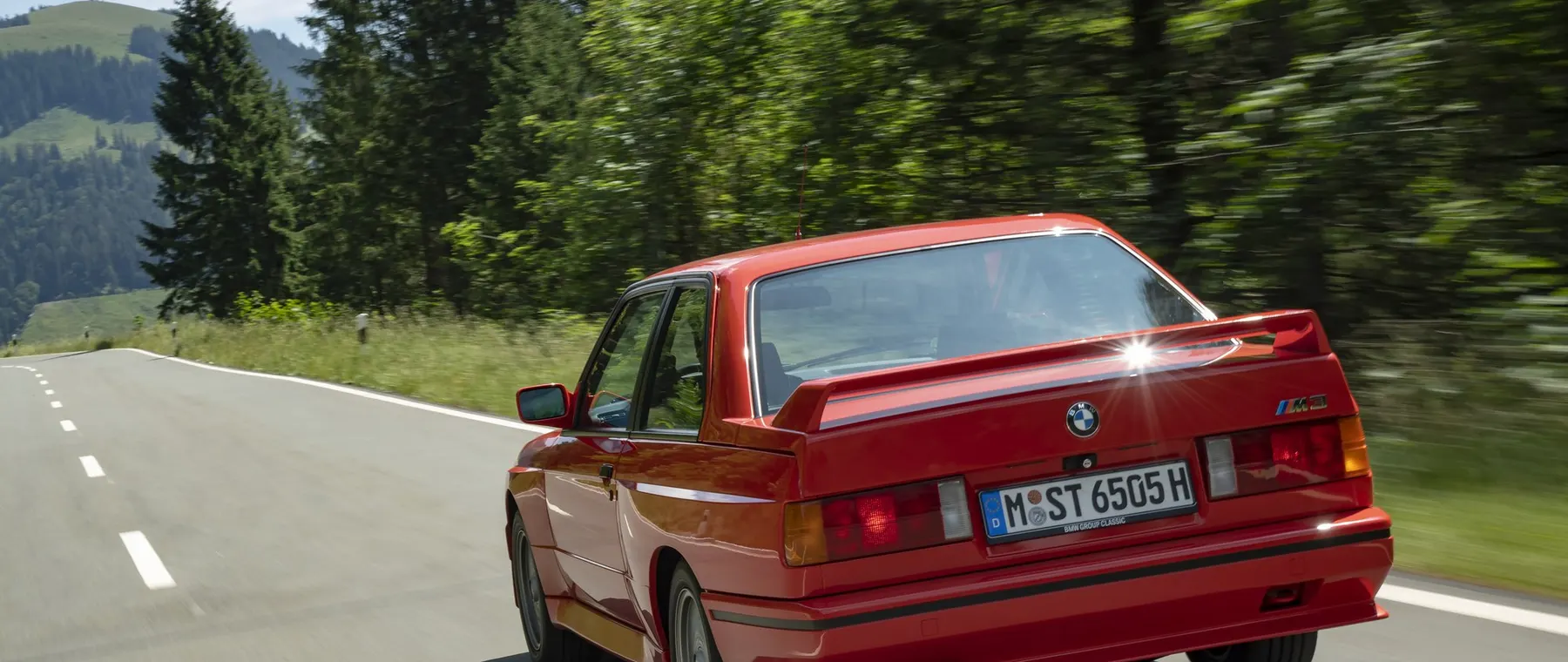
Four decades of a distinctive performance saloon
BMW has published a retrospective marking four decades of the M3, a model whose identity has developed across six generations of road and racing cars. The official history released on 9 October 2026 goes beyond anniversary branding to explain how the M3 moved from a compact two-door homologation-style machine to a family that now includes sophisticated saloons and a Touring estate. Throughout those changes, the link between the road car and BMW's racing activity has remained important.
The M3 was not the first product developed by BMW's M operation; the mid-engined M1 came before it. Nevertheless, the M3 became the model through which many drivers first encountered the M brand. For enthusiasts and collectors, the anniversary provides an opportunity to compare radically different engines and body styles while considering what the manufacturer has tried to preserve.
The E30 begins the story
The first M3 made its official debut at the Frankfurt motor show in 1985 and developed its reputation during the years that followed. BMW records a 2.3-litre, four-cylinder engine with four-valve technology, producing 200 horsepower in the early version. With a quoted weight of 1,200 kilograms, it was a relatively light and direct performance car by contemporary standards.
The E30's importance cannot be measured solely by horsepower. Its success in touring-car competitions, including the DTM and international series, connected the M3 badge to real racing achievements. For collectors, a particular car's build specification, originality and documented history may now carry greater weight than a straightforward comparison of acceleration figures with a modern model.
The E36 grows more mature
The second generation arrived in 1992 and broadened the M3's appeal. BMW introduced a six-cylinder engine and later extended the range to include a four-door saloon alongside the coupé and convertible. From 1996, the Sequential M Gearbox could be specified, marking another change in how drivers interacted with performance.
This was a different brief from the original E30, with more everyday refinement and a wider choice of configurations. A convertible and a saloon attract different buyers, even when they share an M3 badge. The period showed that a motorsport-associated nameplate could grow without necessarily abandoning the performance focus that established its reputation.
E46 and CSL establish a lasting benchmark
The third generation arrived in 2000 with more dramatic wheelarches, a prominent bonnet profile and a 3.2-litre inline-six engine rated at 343 horsepower. It became one of the best-known M3 shapes, combining a relatively understated overall silhouette with unmistakable details. The special CSL edition developed the lightweight approach further.
BMW quotes 360 horsepower for the M3 CSL and a 0–100 km/h acceleration time of 4.9 seconds. Such figures help place the car in its era, though present-day enthusiasts are equally interested in steering feel, maintenance and provenance. Its racing connection continued through the M3 GTR, which achieved successes in American competition and at the Nürburgring.
A V8 and a racing return
The fourth-generation M3 introduced in 2007 took another route, using a naturally aspirated 4.0-litre V8 developing 420 horsepower. That engine gave the car a distinctive character compared with the inline-six models before and after it. BMW records 4.8 seconds for the coupe's sprint from rest to 100 km/h, a measure of the technical change without capturing the full driving experience.
The generation also supported BMW's return to the DTM in 2012 after two decades away. Bruno Spengler secured the drivers' championship, while BMW Team Schnitzer and the manufacturer took major honours. That achievement reaffirmed the relationship between the road-going M3 and touring-car competition even as the mechanical architecture of the series had changed.
Turbocharging defines a new period
In 2014, BMW introduced the fifth generation with the M3 badge reserved for the four-door saloon, while the two-door counterpart became the M4. The V8 made way for a newly developed turbocharged six-cylinder, bringing a different torque delivery and lower claimed fuel consumption. The factory history says emissions and consumption were reduced by about one quarter compared with the outgoing model.
The M3 with Competition Package was rated at 450 horsepower and reached 100 km/h from rest in a quoted 4.0 seconds. Those numbers tell a story of efficiency and performance gains, but buyers of used examples should also consider service history and condition. A vehicle's place in the model family does not replace the need for a thorough mechanical inspection.
Sixth generation adds a Touring
The current sixth-generation M3 arrived in 2020, with M xDrive all-wheel drive joining the programme in 2021. The range expanded further when the M3 Touring appeared in 2022, combining estate-car practicality with the established performance identity. The limited-run M3 CS is one of the most extreme interpretations of the modern car.
BMW cites a 3.4-second 0–100 km/h sprint for the M3 CS and an electronically restricted 302 km/h top speed. These figures highlight how far the line has travelled from the original four-cylinder E30. The everyday question has changed too: a prospective buyer can now consider rear-seat use, luggage needs, transmission and all-wheel drive, in addition to traditional enthusiast priorities.
What 40 years of M3 tells collectors
A six-generation history cannot be reduced to identifying the fastest version. The original E30 has motorsport pedigree; the E46 is prized for its classic inline-six character; the V8 generation offers a distinctly different driving experience; and the current family demonstrates the breadth of a modern performance car. Each demands different ownership expectations and maintenance knowledge.
The verified anniversary news is BMW's retrospective of the M3's development from 1985 to 2026, illustrated with original historic imagery. It is not an announcement of a new anniversary special edition or a prediction of investment returns. For luxury motoring enthusiasts, the enduring value of the story lies in how engineering choices and the needs of drivers have evolved across forty years.